Plant Detention and Turnaround Time (TAT) in India: Yard and Gate Operations Guide
Plant detention and long truck turnaround time (TAT) often cost more than highway transit on industrial full truckload (FTL). This in-plant logistics and yard management guide covers five-stage TAT, free-time clocks, loading slots, weighbridge lock, and a 25-point plant audit for Indian manufacturers.
01
How to use this guide
This is an in-plant logistics and yard management guide for plant managers, yard supervisors, dispatch chiefs, warehouse leads, and supply chain heads who need to reduce plant detention and truck turnaround time (TAT) at Indian manufacturing sites. Use it on a plant walk before you blame the corridor for late deliveries.
On industrial full truckload (FTL) lanes, the expensive friction is often not the highway. It is the unmanaged queue at the gate, the typed weighbridge slip, the wrong body type at the wrong bay, and the paper LR line after loading is done.
National logistics work from NITI Aayog and related studies is worth reading for the wider cost of road freight in manufacturing. Uncontrolled plant idling still shows up as detention claims and as rate premiums vendors quietly bake into lane cards. Measure your own gate-to-exit logs before anyone sells a 75% cut.
The rest of this guide is five-stage plant TAT, how to baseline delays on paper first, free-time clocks finance will trust, loading slot rules, industry patterns, a 25-point audit, and a six-week rollout. For the wider TMS scorecard, see the TMS evaluation guide for Indian manufacturers. For cement-specific windows, see cement plant loading windows.
02
Where in-plant logistics bottlenecks sit
Walk a steel cold-rolling mill in Odisha, an FMCG hub near Bhiwandi, a chemical complex in Dahej, a machinery plant in Chakan, or a processing site in Gujarat. The highway plan can look fine. The morning gate does not.
Between about 8 a.m. and 10 a.m., dozens of commercial vehicles often converge at once. Security writes registrations into paper books. Weighbridge clerks type empty and loaded weights. Drivers wander looking for a bay that was never assigned. The approach road becomes a parking lot. Local police and neighbours notice before finance does.
Four failures repeat: unscheduled arrival clusters, manual weighbridge typing, body-type mismatches inside the yard, and paperwork that holds the truck after the cargo is already on the trailer. None of that is fixed by a prettier highway map pin.
The surge chart below is a workshop shape. Plot your own arrivals by hour for two weeks. That chart is what slot capacity should match. If every transporter still aims for 8 a.m., software will only digitize the stampede.
- Before 7 a.m.15 relative arrivals
- 7 to 9 a.m. surge95 relative arrivals
- Midday40 relative arrivals
- Late afternoon55 relative arrivals
- Night / off-peak20 relative arrivals
Workshop shape for high-volume industrial sites. Plot your own arrivals by hour for two weeks before you freeze slot rules.
01
Unscheduled arrivals
Peak-hour clusters choke the gate when transporters all aim for the same morning window.
02
Manual weighbridge
Typed tare and gross numbers create queues, re-weighs, and override risk.
03
Body-type mismatch
Open body sent to a closed bay, or tanker sent to a crane dock, burns yard minutes.
04
Paperwork lag
Physical LR and gate-pass lines hold trucks after loading is already done.
Operational pattern on Indian industrial yards. Not a single-plant case study.
03
Five stages of plant turnaround time (TAT)
To cut plant detention, stop treating truck turnaround time as one end-to-end number. Break plant TAT into five stages you can timestamp and manage. If a stage has no stamp, it will always win the blame argument in the cabin.
Stage 1 is gate entry and security. Manual plants burn half an hour checking papers by hand. Disciplined plants clear identity, slot window, and e-Way Bill status before the barrier opens. FASTag or QR readers help where hardware is installed. They are not magic on every Indian gate. Ask what is live in the demo.
Stage 2 is tare. Typed empty weights create queues and override risk. Capture from the indicator. Stage 3 is bay or dock loading. This is usually the longest stage. Body-type matching, packing readiness, and real bay assignment matter more than a motivational LED slide.
Stage 4 is gross weigh with net and GVW checks. Stage 5 is documents and exit. If drivers still walk to a cabin for paper L₹after loading, you have not finished the job. The table below is a workshop shape. Your bay labour and cargo type will move the middle stage. Steel crane time is not FMCG dock time.
1. Gate entry and security
Illustrative manual drag
Often 30 to 60 minutesDisciplined target shape
A few minutes with pre-cleared papers and slot control2. Tare weigh
Illustrative manual drag
Often 20 to 40 minutesDisciplined target shape
A few minutes with IP or serial capture3. Bay or dock loading
Illustrative manual drag
Often 2 to 4 hoursDisciplined target shape
About 45 to 90 minutes when bay assignment is real4. Gross weigh and GVW check
Illustrative manual drag
Often 30 to 60 minutesDisciplined target shape
A few minutes with auto net and overload block5. Docs and gate exit
Illustrative manual drag
Often 45 to 90 minutesDisciplined target shape
Minutes when digital LR and exit clear togetherTotal plant TAT (shape)
Illustrative manual drag
Often 5 to 8+ hoursDisciplined target shape
Toward roughly 1 to 2 hours on well-run sitesWorkshop targets for industrial plants, not a ZAFTYS contract SLA. Bay loading time still depends on cargo and labour. Measure your last 90 days before you publish a plant goal.
- 01
Gate
Vehicle and driver identity, e-Way Bill status, and slot window before the barrier opens.
- 02
Tare
Empty weight from the indicator, not a clerk keyboard.
- 03
Bay
Body type matched to dock; driver told where to go without wandering.
- 04
Gross
Loaded weight captured; net and GVW checked before a gate pass.
- 05
Exit
Digital LR and papers ready so the truck does not wait in a cabin queue.
Ops checklist. If a stage has no timestamp, you cannot manage it.
04
What plant detention really costs
When trucks wait many hours inside or outside the plant, the bill does not land in one place. Manufacturers pay detention and higher baseline rates. Fleet operators lose trips and burn idle fuel. Drivers absorb fatigue. Customers feel late stock.
Detention clauses often talk in daily bands for multi-axle trucks after a free-time window of a few hours. Confirm your contract. Vendors also price chronic plant wait into lane cards. Plants known for long queues quietly pay more on the same corridor even when the detention invoice is zero that month.
Warehouse floors fill when dispatch cannot clear finished goods. That is a safety and handling cost as well as a freight cost. Idle engines in the approach queue burn diesel that never moved cargo. Cutting plant detention is a production and yard problem, not only a transporter complaint.
Put the cost conversation on one slide for the plant head and the freight buyer together. If only one function owns the metric, the other will keep optimizing against it.
01
Manufacturer
Detention claims, higher baseline lane rates, finished-goods backup on the floor.
02
Fleet operator
Fewer trips per month, idle fuel, weaker asset utilization on the same truck.
03
Driver
Long duty hours in unmanaged queues, fatigue, and attrition pressure.
04
Customer
Late arrivals and stockout risk when the plant clock eats the corridor plan.
Directional cost shapes from industrial FTL programs. Detention rupee bands vary by contract. Confirm your free-time clause before a board pack.
Cost lever
Detention after free time
What to ask
What is free time, and when does the clock start?
Illustrative band
Often discussed around ₹1,500 to ₹3,500 per day per multi-axle truck
Cost lever
Rate premium for slow plants
What to ask
Do vendors price expected wait into the lane card?
Illustrative band
Efficient plants often avoid an 8% to 15% talk premium vs chronic queues
Cost lever
Lost trips
What to ask
How many round trips does plant wait steal per month?
Illustrative band
A truck stuck in yards can lose multiple long-haul turns
Cost lever
Idle fuel
What to ask
Are engines idling in the approach queue?
Illustrative band
Often discussed around 1.5 to 2.5 litres per hour while waiting
| Cost lever | What to ask | Illustrative band |
|---|---|---|
| Detention after free time | What is free time, and when does the clock start? | Often discussed around ₹1,500 to ₹3,500 per day per multi-axle truck |
| Rate premium for slow plants | Do vendors price expected wait into the lane card? | Efficient plants often avoid an 8% to 15% talk premium vs chronic queues |
| Lost trips | How many round trips does plant wait steal per month? | A truck stuck in yards can lose multiple long-haul turns |
| Idle fuel | Are engines idling in the approach queue? | Often discussed around 1.5 to 2.5 litres per hour while waiting |
Common cabin and contract talk on multi-axle FTL. Your rate card wins.
05
How to baseline plant TAT before you buy software
Do not start with a vendor architecture diagram. Start with two weeks of stamps at your busiest gate. Paper is fine. A shared sheet with five columns beats a GPS pin that only knows arrival and departure.
For every long trip, tag whether gate, weighbridge, bay, documents, or packing readiness owned the wait. That tag list is your prioritisation order. Many plants discover the bay or packing hold is the real villain while the gate takes the public blame.
Count arrivals by hour. That chart sets how many slots you can honestly sell per window. Publishing more slots than weighbridge and bay throughput is how slot programs lose transporter trust in week two.
Only then set stage targets from your median and 90th percentile. A vendor slide that promises every plant will hit 66 minutes is not a baseline. It is a wish.
- 01
Pick one site
Choose the highest-volume outbound or inbound gate, not the quietest plant.
- 02
Stamp five times
Gate in, tare done, bay start, gross done, gate out. Even a shared sheet beats one arrival pin.
- 03
Tag the failure
For each long trip, mark whether gate, weigh, bay, docs, or packing readiness owned the wait.
- 04
Count morning surge
Arrivals by hour for ten working days. That chart sets slot capacity.
- 05
Only then set targets
Publish stage goals from your median and 90th percentile, not from a vendor slide.
Ops method. Software amplifies a measured baseline. It does not invent one.
06
Free-time clocks that survive finance
Detention fights are usually evidence fights. If free time starts when a driver says he reached the highway, finance and the transporter will never agree. Prefer gate-in after identity clears, with early trucks held in staging until the booked slot opens.
Write free time by body type and load class where the work differs. A tanker wash-and-fill cycle is not a container dock cycle. Log plant-side holds that pause the clock. Keep five-stage stamps and weight tickets as the evidence pack.
Weak contracts use reasonable time language and cabin memory. Strong contracts use timestamps. If your TMS cannot export those stamps into a detention claim trail, you will recreate Excel after go-live.
Clock start
Strong version
Gate-in timestamp after identity clearsWeak version to reject
Whenever the driver says he arrived on the highwayFree time
Strong version
Fixed hours by body type and load classWeak version to reject
Vague reasonable time languageExclusions
Strong version
Plant force majeure and packing holds loggedWeak version to reject
Open-ended plant excuses with no stampEarly arrival
Strong version
Staging yard; clock starts at slot openWeak version to reject
Early truck jumps the queue and starts billingEvidence
Strong version
Five-stage stamps plus weight ticketsWeak version to reject
WhatsApp screenshots and cabin memoryContract and yard design notes. Counsel still owns the final free-time clause.
07
Slot windows that transporters will follow
Timed loading windows cut morning surges only when capacity, booking, and gate behaviour agree. Capacity first: do not sell more slots than the weighbridge and open bays can clear that hour.
Book before dispatch. The transporter reserves a window when the indent is accepted, not when the truck is already on the service road. Early arrival means staging, not jumping the barrier. Missed slots go to overflow, not to a blocked highway approach.
Train security to refuse queue jumpers even when a familiar driver argues. One exception becomes the new rule. Slot PDFs that nobody enforces are theatre, and transporters learn to ignore them.
01
Capacity first
Slots cannot exceed weighbridge and bay throughput for that hour.
02
Book before dispatch
Transporters reserve windows when the indent is accepted, not at the gate.
03
Early = staging
Arrive early and wait off the highway. Do not open the barrier for queue jumpers.
04
Missed slot = overflow
Reassign the next free window. Do not punish the corridor with a blocked approach road.
Yard discipline pattern. A slot PDF nobody enforces is theatre.
08
Yard management from queue to scheduled gate
Yard management for industrial plants is the shift from an uncontrolled queue to a scheduled gate. Stop inviting every truck for 8 a.m. Start from production and dock readiness. Allocate timed loading windows. Stage early arrivals off the highway. Direct body types to the right bay. Capture weights without typing. Close exit with digital papers.
A yard management system (YMS) helps when it sequences slots, staging, and bay assignment on the same trip record as weighbridge capture. ERP sync helps when sales orders, packing output, and dock capacity are real feeds. Slot booking helps when transporters actually use it and the gate refuses queue-jumping. Weighbridge APIs help when overrides are locked. Ask for each of those live in a demo, not only on an architecture slide.
For how this sits inside a wider industrial TMS, see ZAFTYS TMS and the TMS evaluation guide. For the booking brief before the truck is called, see planning commercial shipments.
- 01
Production sync
Know dock and material readiness before you invite trucks.
- 02
Timed slots
Transporters book loading windows instead of all arriving at 8 a.m.
- 03
Gate control
Early trucks stage off the highway; on-slot trucks clear identity and papers.
- 04
Directed bay
Body type and open dock decide the path, not a shouted instruction.
- 05
Auto weigh
Tare and gross from the indicator; overload blocks the exit pass.
- 06
Digital exit
LR and e-POD trail close the trip without a paper cabin queue.
Field pattern. Ask in the demo which gate hardware and slot tools are live, not assumed.
09
Industry patterns that change yard design
The same five stages fail differently by vertical. Steal the pattern that matches your plant. Do not copy an FMCG dock rule onto a coil bay.
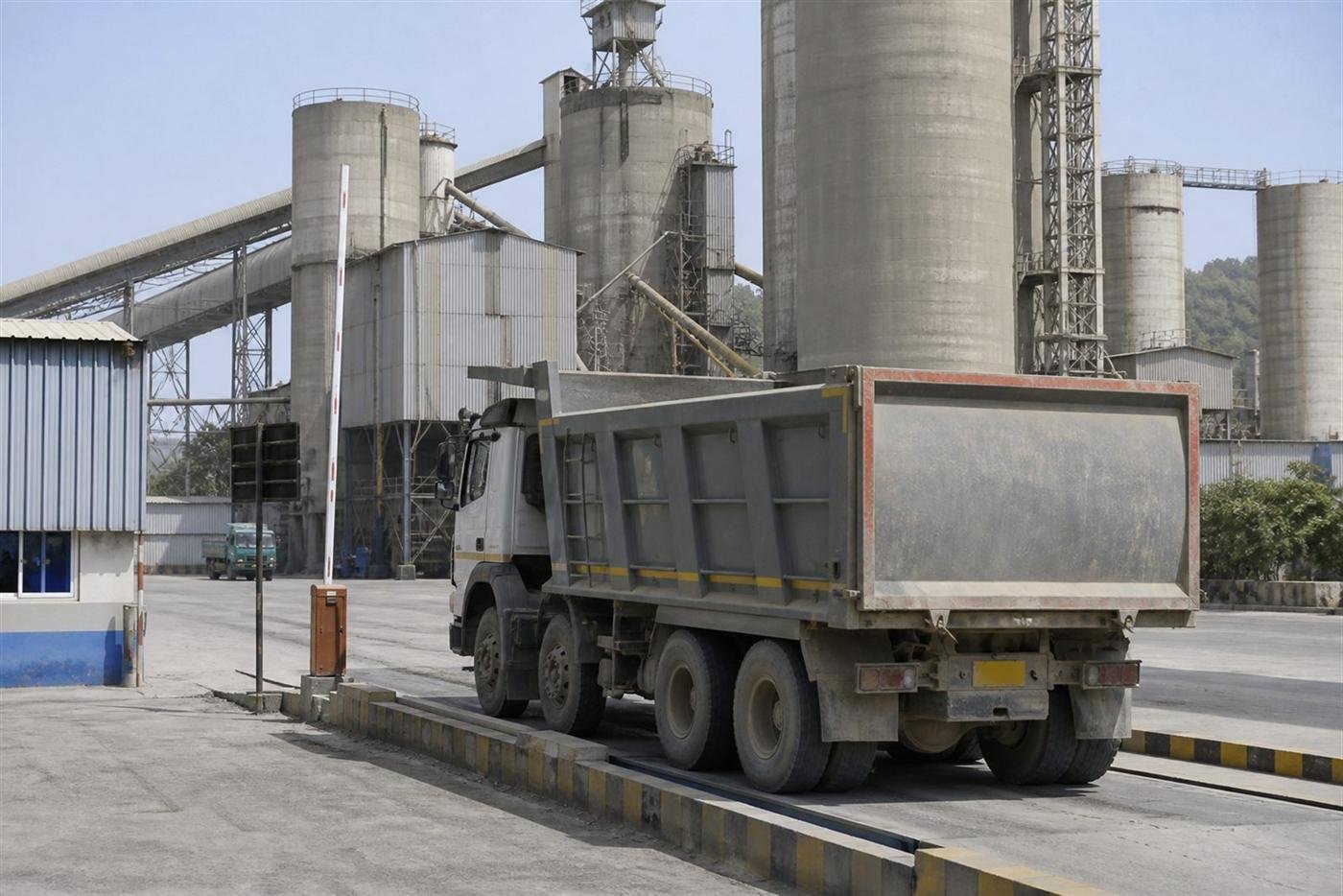
Steel and metals usually lose time on crane, cradle, and securement. Body-type mismatch destroys the morning faster than a slow gate. Cement and bulk live on tipper windows, silo readiness, and weighbridge queues, with monsoon moisture swings on top. See cement plant loading windows and steel coil transport basics.
Chemicals and liquids need wash, permit, and bay segregation. Speed without segregation is a safety event. FMCG and auto parts usually starve for dock doors in festive weeks. Slot adherence beats hero dispatchers.
If axle and GVW discipline is part of your heavy FTL risk, pair this yard guide with India axle load norms and GVW limits. A faster gate that ships an illegal axle load is not a win.
01
Steel and metals
Crane and cradle time dominate bay dwell. Body-type and securement mismatch destroys the morning.
02
Cement and bulk
Tipper and silo windows, weighbridge queues, and monsoon moisture swings drive detention.
03
Chemicals and liquids
Wash, permit, and bay segregation matter more than raw speed. Wrong bay is a safety event.
04
FMCG and auto parts
Dock door scarcity and festive surges. Slot adherence beats hero dispatchers.
Pattern talk for plant walks. Your bay labour and cargo still win.
10
Manual vs GPS vs yard management
A basic GPS track proves the truck reached a geofence. It does not prove which weighbridge queue or bay ate three hours of plant turnaround time. Put paper ledgers, GPS-only tools, and industrial yard management on one slide for the plant walk.
If your current system only shows arrival and departure, you are managing plant detention with a guess. Five-stage timestamps and fail-closed weight capture are the difference between a map and a yard operating system.
Use the matrix below in the vendor demo. Ask them to walk an early arrival, a typed-weight attempt, a bay mismatch, and a refused overload. If those four fails are not live, the rest of the pitch is decoration.
Gate check-in
Manual paper
Paper registerBasic GPS only
Phone call or geofence pinIn-plant guidance
Manual paper
Oral instructionsBasic GPS only
Not supportedWeighbridge capture
Manual paper
Typed numbersBasic GPS only
Not supportedLoading slots
Manual paper
First come, first servedBasic GPS only
Arrival pin onlyTAT audit
Manual paper
One entry timeBasic GPS only
Arrival and departure onlyDetention calc
Manual paper
Paper disputeBasic GPS only
Rough dwell estimatee-POD / LR path
Manual paper
Physical mail weeks laterBasic GPS only
Usually missingEvaluation frame for plant walks. Not a ranked vendor score.
11
A 25-point plant detention and TAT checklist
Use this plant detention and TAT audit on the plant walk. Rate each line 1 to 5. Weight the groups: gate 25%, weighbridge 25%, yard and bays 20%, documents 20%, analytics 10%. If they skip a weighbridge lock, score it zero.
Walk with security, weighbridge, bay supervisors, dispatch, and finance in the same loop. The arguments that surface are the program design. Do not let one function score the sheet alone and call the plant fixed.
- Gate and arrival · 25%
- Weighbridge · 25%
- Yard and bays · 20%
- Documents and e-POD · 20%
- Vendor analytics · 10%
Weights for this guide: gate 25%, weighbridge 25%, yard and bays 20%, documents 20%, analytics 10%.
Gate and masters
Weight 25%·Lines 1-5
- 1
Timed loading slot windows enforced for incoming trucks
- 2
Off-highway staging for early or unscheduled vehicles
- 3
Driver and registration checks before the barrier opens
- 4
e-Way Bill or PO status checked at entry, not after the truck is inside
- 5
Inbound raw-material and outbound finished-goods lanes separated where volume needs it
Weighbridge
Weight 25%·Lines 6-10
- 6
Indicator linked by IP or serial; no typed weight as system of record
- 7
Manual override disabled or dual-controlled with an audit log
- 8
Net weight calculated and checked against MoRTH GVW framing
- 9
Tare logged before a bay slip is issued
- 10
Gate pass blocked when weight sits outside e-Way Bill tolerance
Yard and loading bays
Weight 20%·Lines 11-15
- 11
Bay and dock queues visible to drivers without wandering the yard
- 12
Vehicle body type matched to dock capability
- 13
Warehouse or packing readiness visible before the truck is called in
- 14
Bay assignment sent by SMS, WhatsApp, display, or equivalent
- 15
Bay dwell tracked separately from total plant TAT
Documents and e-POD
Weight 20%·Lines 16-20
- 16
Digital LR generated after gross clearance
- 17
Photo e-POD captured at destination with a usable trail
- 18
Detention calculated from free-time rules and gate timestamps
- 19
ERP or billing sync for weight, LR, and detention where claimed
- 20
e-Way Bill validity watched on long hauls after exit
Vendor analytics
Weight 10%·Lines 21-25
- 21
Stage-by-stage TAT reported by shift
- 22
Transporters scored on slot adherence and compliance
- 23
Auditable log of detention claims approved or rejected
- 24
Yard density visible to plant managers without a paper walk
- 25
Plant TAT data used in lane-rate negotiations with transporters
Print for the plant walk. A skipped weighbridge lock is not a phase two.
12
A six-week yard TAT rollout
You do not need to shut the plant. Connect capture, set slot rules from your baseline chart, and pilot one high-volume site first. Expand only when five-stage TAT reports are trusted and overrides stop being the real system.
Weeks 1 to 2: link weighbridge capture, define slots and staging, onboard transporters. Weeks 3 to 4: enforce staggered arrivals at one plant, train gate and bay staff, run a peak-morning drill. Weeks 5 to 6: add sites, hand finance detention trails, and feed TAT into lane-rate talks.
If week four still depends on a hero supervisor with a paper pad, the slot rule is not real yet. Fix the rule before you scale the logo across every grinding unit.
Weeks 1 to 2
Connect and set rules
Link weighbridge capture, define slot rules from the baseline chart, onboard transporters, and map staging for early trucks.
Weeks 3 to 4
Single-plant pilot
Enforce staggered slots at one high-volume site. Train gate, weighbridge, and bay staff. Fail-close overrides. Run one peak-morning drill.
Weeks 5 to 6
Scale and settle
Add plants when TAT reports are trusted. Hand finance automated detention and three-way match trails. Feed TAT into lane-rate talks.
Field rollout pattern. Expand only after one site proves five-stage timestamps.
13
What good yards tend to show
When manufacturers replace unmanaged gate queues with timed windows and fail-closed weighbridge capture, plant metrics move in a directional way. TAT falls from multi-hour chaos toward roughly one to two hours on disciplined sites. Detention claims drop. Weighbridge throughput rises when typing stops. Billing cycles shorten when e-POD is trusted. Morning approach congestion eases when early trucks stage instead of lining the highway.
These are planning bands, not a promise to cut every plant to 66 minutes or to erase detention forever. Measure your last 90 days first. Then decide whether the program is working on stage times, claim volume, and transporter slot adherence, not on a single vanity percentage.
In-plant turnaround time
From multi-hour unmanaged queues toward roughly one to two hours on disciplined sites.
Unbudgeted detention claims
50-75 % lower
Toward far fewer claims when slots and free-time clocks are real.
Weighbridge throughput
30-50 % higher
When typing stops and IP capture is mandatory.
Billing after e-POD
From multi-week paper LR cycles toward a few days when finance trusts the trail.
Morning approach congestion
Toward fewer highway-side queues when early trucks stage and slots are enforced.
Planning ranges from industrial yard programs and corridor work, including ZAFTYS plant and fleet experience. Measure your last 90 days before anyone writes a 75% cut guarantee.
14
How we would use this at ZAFTYS
We run industrial FTL and we dispatch on ZAFTYS TMS. Yard and gate stages have to survive a busy morning, not only a slide. Login for operators is at app.zaftys.com.
For plant programs and dedicated capacity, start from services or manufacturing logistics. When company trucks are not enough, TranZfort is the overflow rail. Listing and search are free. A broker fee applies on booked loads.
Bring the checklist to a plant walk. Ask to see a refused early arrival, a typed-weight block, a bay mismatch catch, and a digital exit. Pair it with cement plant loading windows, industrial TMS control stack, planning commercial shipments, and the TMS evaluation guide.
15
References
Public sources below are for orientation. They are not ZAFTYS audited financials. Read the originals before a number goes into a board pack.
- NITI Aayog, RMI, and RMI India work on transforming trucking and freight in India.
- Ministry of Commerce and related logistics cost studies for manufacturing GDP framing. Confirm the edition you cite.
- MoRTH FASTag and electronic toll guidance: relevant where gate hardware is installed, not as a universal plant claim.
- ZAFTYS operations: plant yard and dispatch logs on industrial lanes, 2024 to 2026. Directional and site-specific.
- ZAFTYS TMS · industrial TMS control stack · TMS evaluation guide
Frequently asked questions
What does TAT mean in logistics?
TAT stands for turnaround time. In plant logistics it usually means truck turnaround time: gate entry to gate exit at a manufacturing site, including security, weighbridge, loading or unloading, and documents.
What is plant turnaround time (TAT) in industrial logistics?
Plant TAT is the time from gate entry to gate exit for a truck at a manufacturing site. Measure it as five stages: gate, tare weigh, bay loading, gross weigh, and documents exit. A single GPS arrival and departure pin hides which stage failed.
How do you reduce plant detention charges in India?
Enforce timed loading windows, stage early trucks off the highway, capture weighbridge weights without typing, match body type to bay, and issue digital LR so exit is not a cabin queue. Free-time clocks must use gate timestamps, not cabin arguments. See ZAFTYS TMS.
What is a yard management system (YMS) for manufacturing plants?
A yard management system sequences trucks inside the plant: slots, staging, bay assignment, and stage timestamps. On industrial FTL it should sit with weighbridge capture and gate control, not as a standalone map. Ask for five-stage TAT and a refused override in the demo.
How should we baseline plant TAT before buying yard software?
Pick your highest-volume gate. Stamp gate-in, tare, bay start, gross, and gate-out for two weeks. Tag which stage owned each long wait. Count arrivals by hour. Set targets from your median and 90th percentile, not from a vendor slide.
When should the detention free-time clock start?
Prefer gate-in after identity clears, with early arrivals held in staging until the slot opens. Reject clocks that start when a driver claims he reached the highway. Put exclusions and evidence rules in the contract.
How does slot scheduling work if drivers do not use smartphones?
Vendors can book slots in the TMS. Drivers can receive a simple SMS or WhatsApp with the window and a QR or reference. At the gate, identity can still come from registration checks and, where installed, FASTag or QR readers. Ask what is live in the demo.
What happens if a truck misses its loading slot?
A disciplined yard reassigns the next available overflow slot and holds the truck in staging so it does not block the active gate. Missing a slot should not mean jumping the queue or parking on the highway approach.
How does weighbridge automation stop tampering?
Connect the indicator over IP or serial so tare and gross come from the load cells. Disable casual typing. Block the gate pass when weight fails GVW or e-Way Bill tolerance. If a vendor cannot fail a truck in the demo, they will not fail it on a busy Saturday. See also axle load and GVW limits.
Can one yard system handle tankers, flatbeds, tippers, and containers?
Yes, if body type is captured at booking and gate, and bays are typed in the master. Tankers go to liquid docks, flatbeds to crane bays, tippers to bulk points. Without that match, slot scheduling alone will not cut TAT.