Understanding India's Axle Load Norms and GVW Limits: How Heavy Freight Shippers Avoid Penalties and Plant Delays
Heavy FTL in India fails when total gross vehicle weight (GVW) looks legal but one axle group is already over MoRTH axle load limits. This guide covers axle load norms, GVW bands, Section 194 overloading fines, industry traps, and a plant weighbridge loop you can audit before the truck hits the highway.
01
How to use this guide
This is a compliance and plant-ops guide for logistics heads, dispatch managers, fleet operators, procurement, and safety officers moving steel, cement, minerals, machinery, and liquid bulk across India. Use it before an RFP rewrite or a weighbridge walk. It is not a licence brochure and not legal advice.
The core failure mode is simple. A trailer can sit under overall gross vehicle weight (GVW) and still fail on a single axle group under India axle load norms. Highway checking posts and RTO checks weigh those groups. The overloading fine is only the start. Offloading, cargo damage, plant re-queuing, and e-Way Bill weight fights follow.
MoRTH revised axle-load framing (commonly referenced via S.O. 3467(E) and S.O. 4353(E)) and Section 194 of the Motor Vehicles (Amendment) Act are the legal rails for heavy freight shippers. Published GVW and axle load bands in this article are starting points for plant talk. The registration certificate and the latest gazette win. Do not hard-code last year's circular as eternal truth.
Axle load compliance is not a highway surprise. It is a gate, tare, bay, gross, and document loop on heavy FTL. The rest of this guide is how to test that loop, by industry and with a printable checklist.
02
Why total weight is not enough
Walk a steel mill in Odisha or Chhattisgarh, a cement belt plant in Rajasthan or Andhra, or a mineral tipper lane in monsoon season. The same paradox shows up. Net payload looks comfortable. One axle group is already illegal.
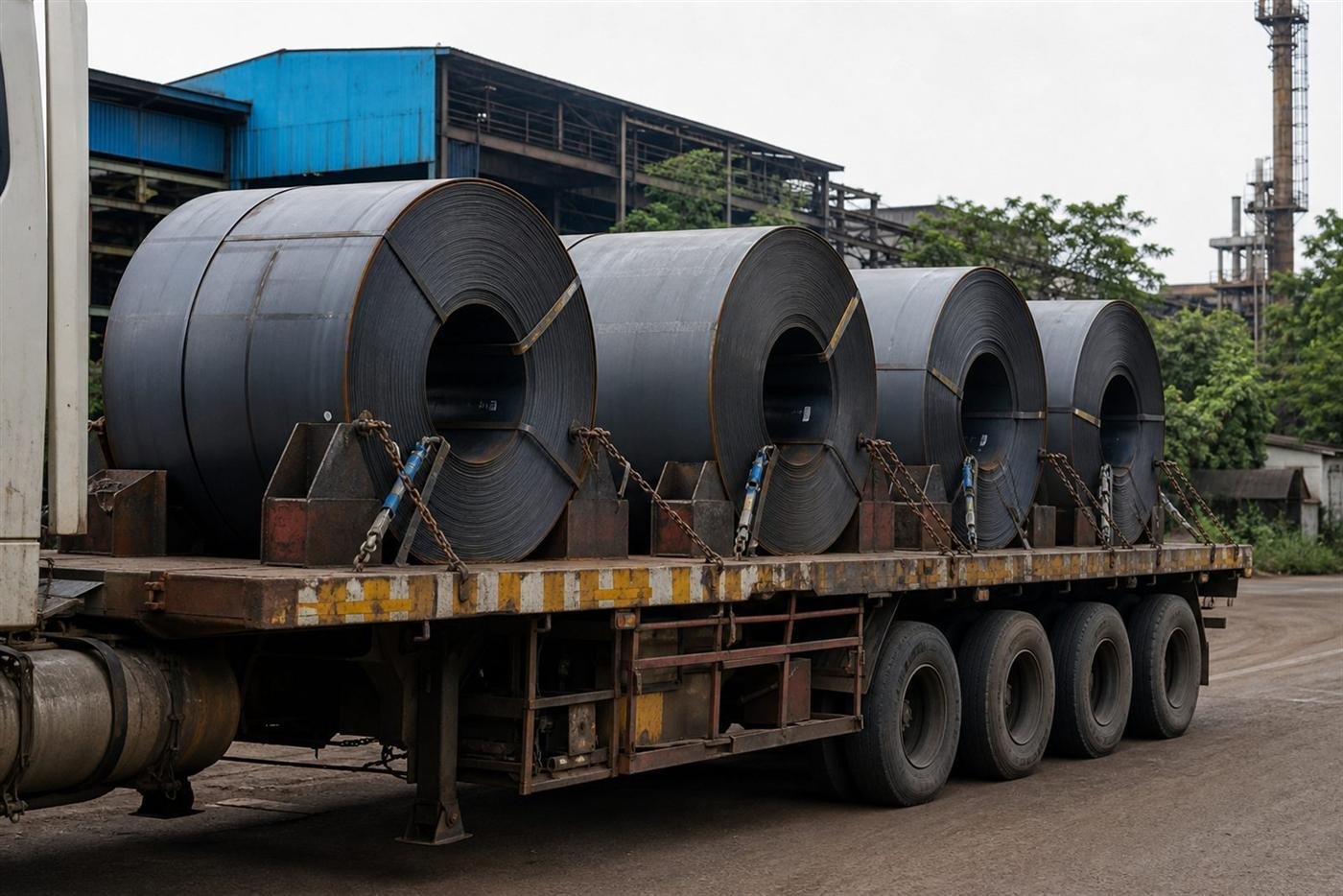
Example shape, not a claim about your last trip: a multi-axle trailer under a 35 tonne GVW talk band loads coils that total well under payload. The crane parks two heavy coils over the rear tandem. The highway weighbridge fails that group. The truck is held. A mobile crane on the shoulder re-handles the load. The plant clock and the e-Way Bill clock both suffer.
Axle discipline is load placement, cradle or well choice, and a weighbridge that can refuse the gate pass. It is not a motivational poster in the cabin.
01
Total GVW looks fine
A multi-axle trailer can sit under the overall MoRTH GVW while the load still fails on one axle group.
02
One axle group fails
Two coils parked over a rear tandem can overload that group even when net payload looks comfortable.
03
Highway weigh catches it
Checking posts weigh axle groups, not only the full truck. Impoundment and roadside re-handling follow.
04
Plant time doubles
Rejected trucks return to re-weigh and re-load. Gate TAT and e-Way Bill clocks both suffer.
Illustrative plant example. Your trailer layout and coil placement will differ.
03
Four costs of getting axle load wrong
When axle and GVW control is weak, four expensive failures repeat. They are process holes, not software bugs. Fix them at the plant. A highway fine is a late signal that the bay already lost control.
01
Highway impoundment
Fines and locked transit. Shipper and transporter both feel the delay.
02
Roadside offloading
Mobile cranes on a shoulder damage coils and create safety risk.
03
Gate bottlenecks
Non-compliant trucks bounce back into the queue and burn plant TAT.
04
e-Way Bill flags
Net weight vs declared weight variances invite GST audit noise and invoice holds.
Operational pattern from industrial corridors. Not a rupee loss model.
04
Axle group limits under MoRTH framing
Logistics teams need the axle-group limits as well as overall GVW. The bands below are the ones that show up in plant conversations under MoRTH revised axle-load framing. Confirm them against the gazette and the RC before you write a rule into software.
- Single axle, 2 tyres (steer)7.5 t
- Single axle, 4 tyres11.5 t
- Tandem axle, 8 tyres21 t
- Tridem axle, 12 tyres27 t
Starting points from MoRTH revised axle-load framing (S.O. 3467(E) / S.O. 4353(E) era). Confirm the gazette and the vehicle RC before you hard-code anything.
05
GVW bands by vehicle type
For rigid (single-chassis) goods vehicles, plant talk usually follows axle count. Articulated steel, cement, and container moves live on tractor-trailer combinations. Modular hydraulic trailers for over-dimensional cargo sit under special MoRTH permit rules, not a casual GVW row. Manufacturer rating or schedule limit, whichever is less, still wins on the day.
- 2-axle rigid (6 wheels)18.5 t
- 3-axle rigid (10 wheels)28 t
- 4-axle rigid (12 wheels)35 t
- 5-axle rigid42 t
Plant conversation bands. Manufacturer rating or schedule limit, whichever is less. RC wins.
Configuration
3-axle tractor + 2-axle semi
Typical layout
5 axles / ~18 tyres
GVW band (talk)
About 45.5 t
Configuration
3-axle tractor + 3-axle semi
Typical layout
6 axles / ~22 tyres
GVW band (talk)
About 55 t
Configuration
Modular hydraulic / ODC
Typical layout
Multi-axle puller assemblies
GVW band (talk)
Special MoRTH permit rules
| Configuration | Typical layout | GVW band (talk) |
|---|---|---|
| 3-axle tractor + 2-axle semi | 5 axles / ~18 tyres | About 45.5 t |
| 3-axle tractor + 3-axle semi | 6 axles / ~22 tyres | About 55 t |
| Modular hydraulic / ODC | Multi-axle puller assemblies | Special MoRTH permit rules |
Orientation only. Modular / ODC moves need MoRTH permit rules and route clearances, not a generic GVW row.
06
What Section 194 typically costs
Ignoring axle and weight compliance is expensive under Section 194 framing in the Motor Vehicles (Amendment) Act. Ops rooms cite a base fine, a per-tonne add-on, and mandatory offloading before the truck moves again.
NITI Aayog work on Indian trucking also stresses why authorities care: pavement damage rises sharply with axle overload. That is a public-road reason for strict axle enforcement, not only a shipper fine.
Verify current statute and state practice before a legal memo. The numbers below are the ones procurement and dispatch already argue about in the cabin.
01
Base fine
About ₹20,000 when an overloaded commercial vehicle is detected.
02
Per excess tonne
About ₹2,000 for each tonne above the permissible limit.
03
Mandatory offload
The truck does not move until excess cargo is offloaded and re-weighed. Handling cost sits with the parties on the trip.
04
Repeat offences
Repeated overloading can trigger longer licence consequences for the driver. Do not treat the first fine as the only cost.
Motor Vehicles (Amendment) Act framing as commonly cited in ops rooms. Verify the current Act and state practice before a legal memo.
07
Industry-specific weight traps
Each vertical fails in a different physical way. Steal the pattern that matches your plant. Do not copy a cement density rule onto a coil bay.
Steel: coils are point loads. A coil a metre forward or aft overloads steer or tandem groups. Mandated cradles or wells and placement templates matter more than a generic open body.
Cement and fly ash: volumetric fill is not legal weight. High-density cement can breach GVW at full volume. Low-density ash can leave paid capacity unused.
Mining minerals: moisture swings. Monsoon tipper tonnes are not summer tipper tonnes. Pithead pads and moisture-aware payload limits reduce surprise gross weights.
Chemical tankers: ullage and sloshing. Under-filled compartments move weight while rolling. Baffles and compartment rules protect both axle stability and product integrity.
01
Steel coils
Point loads. A coil a metre forward or aft overloads steer or tandem groups.
02
Cement and fly ash
Density changes. Full volume is not the same as legal GVW.
03
Ore and minerals
Moisture swings at the pithead. Monsoon tonnes are not summer tonnes.
04
Chemical tankers
Ullage and sloshing. Under-filled compartments move weight while rolling.
Ops pattern across steel, cement, mining, and liquid bulk. Not a ranked risk model.
08
Pre-dispatch weighbridge loop
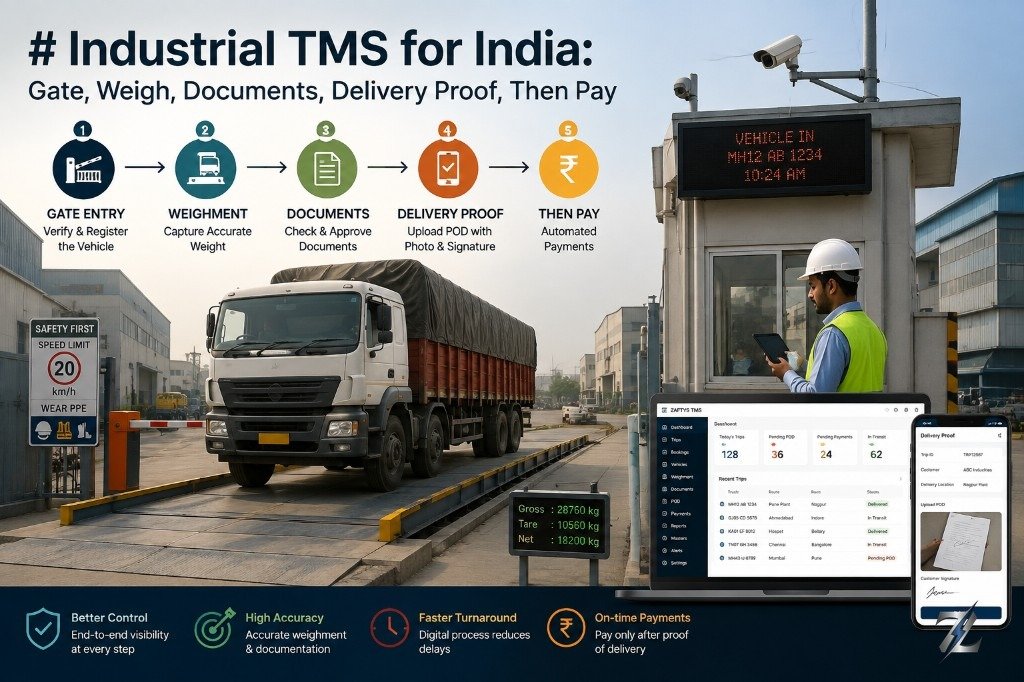
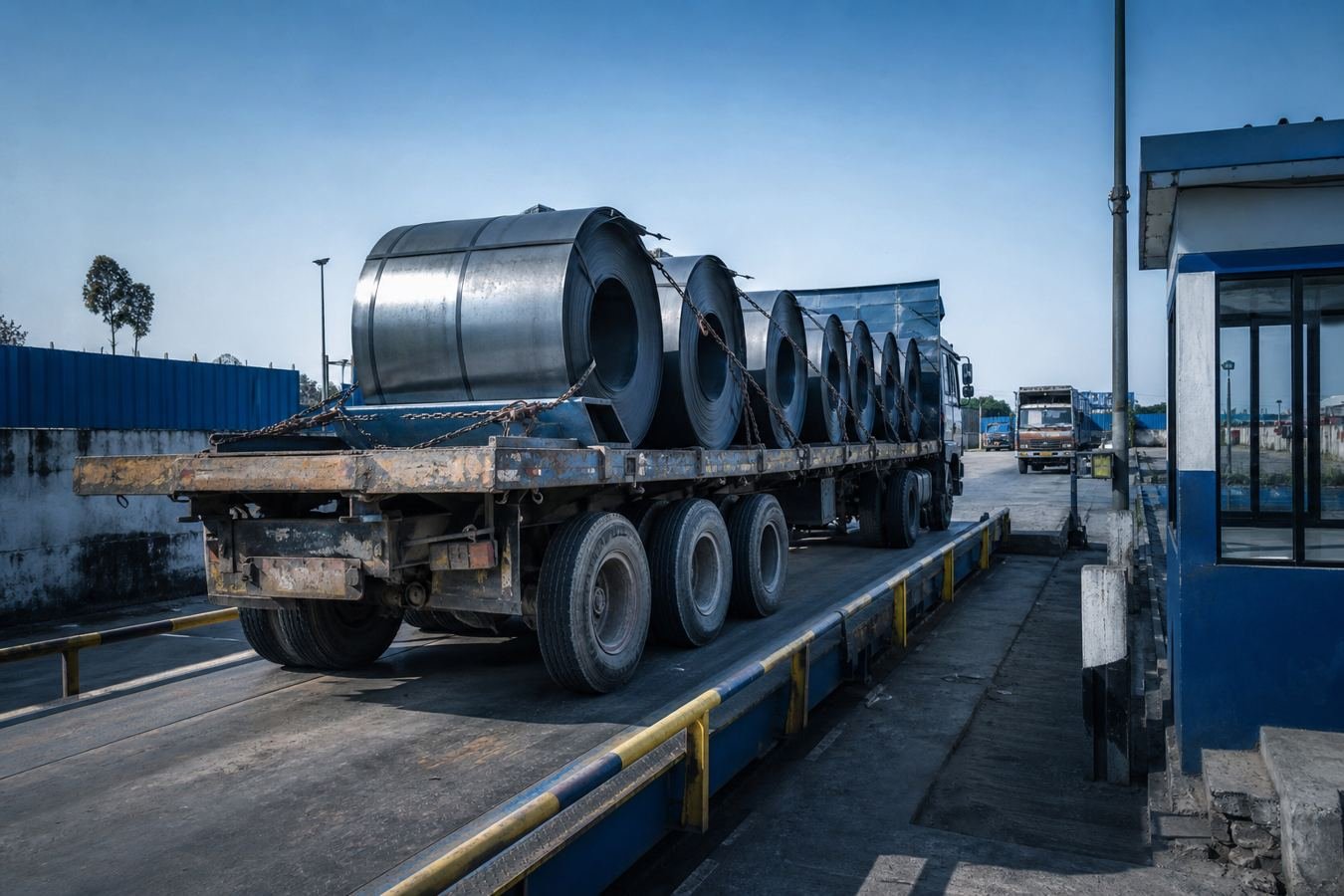
Manual slips and typed Excel are how overloaded trucks leave the plant. Progressive sites put tare, payload instruction, gross, and e-Way Bill tolerance into one fail-closed loop before the barrier opens.
Max allowed payload is not a vibe. It is registered GVW minus captured tare, then checked again at gross against GVW, distribution rules, and declared e-Way Bill weight. If any check fails, the gate pass stays locked and dispatch gets an alert. If a vendor cannot fail a truck in the demo, they will not fail it on a busy Saturday.
For how this sits inside a wider TMS scorecard, see the TMS evaluation guide for Indian manufacturers. This article stays on axle and GVW control.
- 01
Gate
Confirm identity and RC-backed axle / GVW master data before entry.
- 02
Tare
Empty weight from the indicator over IP or serial. No typed numbers.
- 03
Bay limit
Show the loader a max payload from GVW minus tare.
- 04
Gross
Capture loaded weight. Check GVW and distribution rules.
- 05
Docs
Compare net to e-Way Bill tolerance before LR print.
- 06
Exit
Open the gate only when weight and papers clear. Fail closed.
Plant control loop. A highway map cannot replace these checks.
09
Paper slips vs industrial plant control
A map pin does not know your tandem limit. Paper registers and typed Excel leave override risk on the clerk. Put the comparison on one slide for the plant walk.
Axle and GVW rules
Paper / Excel
Operator memory and a laminated chartIndustrial plant control
RC-backed limits in the dispatch systemWeighbridge capture
Paper / Excel
Typed slipsIndustrial plant control
IP or serial from the indicatorOverride risk
Paper / Excel
High. A clerk can clear a bad loadIndustrial plant control
Blocked. Fail the gate passe-Way Bill check
Paper / Excel
Manual after the factIndustrial plant control
Net vs declared before exitPoint-load templates
Paper / Excel
Tribal knowledge at the bayIndustrial plant control
Cradle / well instructions on the slipEvaluation frame for plant compliance. Not a ranked vendor score. A GPS map alone does not cover these rows.
10
A 20-point axle compliance checklist
Use this audit when you walk the gate and the weighbridge. Rate each line 1 to 5. Weight the groups: gate and masters 25 percent, weighbridge 25 percent, bay distribution 25 percent, documents 15 percent, transporter governance 10 percent. If they skip a line, score it zero. A skipped weighbridge lock is not a phase two.
- Gate and masters · 25%
- Weighbridge · 25%
- Bay distribution · 25%
- Documents · 15%
- Transporter governance · 10%
Weights for this guide: gate and masters 25%, weighbridge 25%, bay distribution 25%, documents 15%, transporter governance 10%.
Gate and masters
Weight 25%·Lines 1-5
- 1
Auto-fetch RC, axle count, and registered GVW at gate
- 2
MoRTH / RC limits live in dispatch, not only a chart on the wall
- 3
Flag modified or non-standard chassis before loading
- 4
Driver licence and fitness checks before barrier open
- 5
Identity confirm (FASTag or plate) matches the trip master
Weighbridge
Weight 25%·Lines 6-10
- 6
Weighbridge via IP or serial, not typed Excel
- 7
Manual weight override disabled for gate-pass print
- 8
Tare captured before any loading slip issues
- 9
Calibration certificates on file and in date
- 10
Gate pass blocked when gross exceeds registered GVW
Bay distribution
Weight 25%·Lines 11-15
- 11
Coil cradles / wells mandated where the load needs them
- 12
Bay gets a max payload slip from GVW minus tare
- 13
Density or ullage rules for bulkers and tankers
- 14
Crews trained on axle distribution templates
- 15
Suspension and axle integrity checked before load
Documents
Weight 15%·Lines 16-18
- 16
Net weight vs e-Way Bill tolerance before exit
- 17
Digital LR only after weight approval
- 18
ODC permits verified before modular / special trailers leave
Transporter governance
Weight 10%·Lines 19-20
- 19
Audit trail of rejected overloaded trucks
- 20
Compliance history in monthly transporter quotas
Print for the plant walk. A skipped weighbridge lock is not a phase two.
11
A six-week compliance rollout
You do not need a big-bang cutover. Keep the plant running. Connect the indicator, load RC-backed GVW masters, and notify transporters before you fail-close the gate. Lock one high-volume site first. Expand only when clerks stop typing weights as the real system.
Weeks 1 to 2
Hardware and rules
Bridge indicators, RC/GVW masters, e-Way Bill tolerance, transporter notice.
Weeks 3 to 4
One plant
Tare and gross capture, bay payload slips, fail-closed gate on overload.
Weeks 5 to 6
Expand
Other sites only after the pilot stops typing weights. Finance can match slips to invoices.
Field rollout pattern. Paper wins if security and bay crews reject the screens.
12
What good plants tend to show
When manufacturers replace typed weighbridge logs with fail-closed pre-dispatch controls, plant logs move in a directional way. Weighbridge cycles shorten. e-Way Bill weight fights get quieter. Roadside offloads become rare when overloaded trucks cannot leave. These are planning bands, not a contract SLA and not a promise of zero highway events forever. Measure your last 90 days first.
Weighbridge processing time
40-60 % shorter
When slips stop being typed and IP capture is mandatory.
e-Way Bill weight discrepancy noise
70-95 % lower
When net vs declared is checked before gate-out.
Roadside offload events
Toward rare when overloaded trucks cannot leave the plant. Not a promise of zero forever.
Planning ranges from industrial weighbridge and coil-dispatch work, including ZAFTYS corridor experience. Measure your last 90 days before anyone writes a penalty clause.
13
How we would use this at ZAFTYS
We run heavy industrial freight and we dispatch on ZAFTYS TMS. Axle and GVW discipline has to survive the weighbridge and the bay, not only a slide. Login for operators is at app.zaftys.com.
For dedicated flatbed, multi-axle, and heavy-haul programs, start from steel and metals logistics or services. When company trucks are not enough, TranZfort is the overflow rail. Listing and search are free. A broker fee applies on booked loads.
Bring the checklist to a plant walk. After the weighbridge lock, the full plant stack is gate → weigh → documents → ePOD → pay - see the industrial TMS control stack for India. Ask to see tare, gross, a refused overload, and an e-Way Bill tolerance check. Pair it with steel coil transport basics, cement plant loading windows, and planning commercial shipments so the software is not asked to fix a load that was never specified.
14
References
Public sources below are for orientation. They are not ZAFTYS audited financials. Read the originals before a number goes into a board pack.
- Ministry of Road Transport and Highways: Gazette notifications S.O. 3467(E) (16 July 2018) and S.O. 4353(E) (6 August 2018) on revised axle-load framing. Confirm against the vehicle RC.
- Motor Vehicles (Amendment) Act: Section 194 overloading and offloading provisions. Verify current text and state practice.
- NITI Aayog, RMI, and RMI India, Transforming Trucking in India (September 2022).
- ZAFTYS operations: dispatch and yard logs on industrial lanes, 2024 to 2026. Directional and site-specific.
- ZAFTYS TMS · steel coil transport · TMS evaluation guide
Frequently asked questions
Can a truck be fined if total GVW is legal but one axle is overloaded?
Yes. MoRTH enforcement looks at axle groups as well as overall GVW. An overloaded tandem can stop a trip even when net payload looks fine. Use cradles, wells, and bay templates so weight sits where the trailer was designed to carry it. See steel coil transport basics.
What is the overloading fine under Section 194?
Ops rooms commonly cite a base fine around ₹20,000 plus about ₹2,000 per excess tonne, with mandatory offloading before the vehicle proceeds. Confirm the current Motor Vehicles Act text and state practice before you put a number in a board pack. Offloading and re-handling cost sits with the parties on the trip.
What tolerance applies between weighbridge net weight and the e-Way Bill?
GST does not publish one universal percentage for every commodity. Many plants and checking posts work with a small band, often discussed around 1 to 2 percent, to cover calibration and moisture. Treat that as practice, not a free pass. Large variances still trigger audit noise.
How should ODC and modular trailers be handled?
Do not force them into a standard rigid GVW row. Confirm MoRTH modular or special permits, axle-line ratings, and route clearances before gate-out. If the paperwork is missing, the gate should stay closed.