Chapter 01
Start here
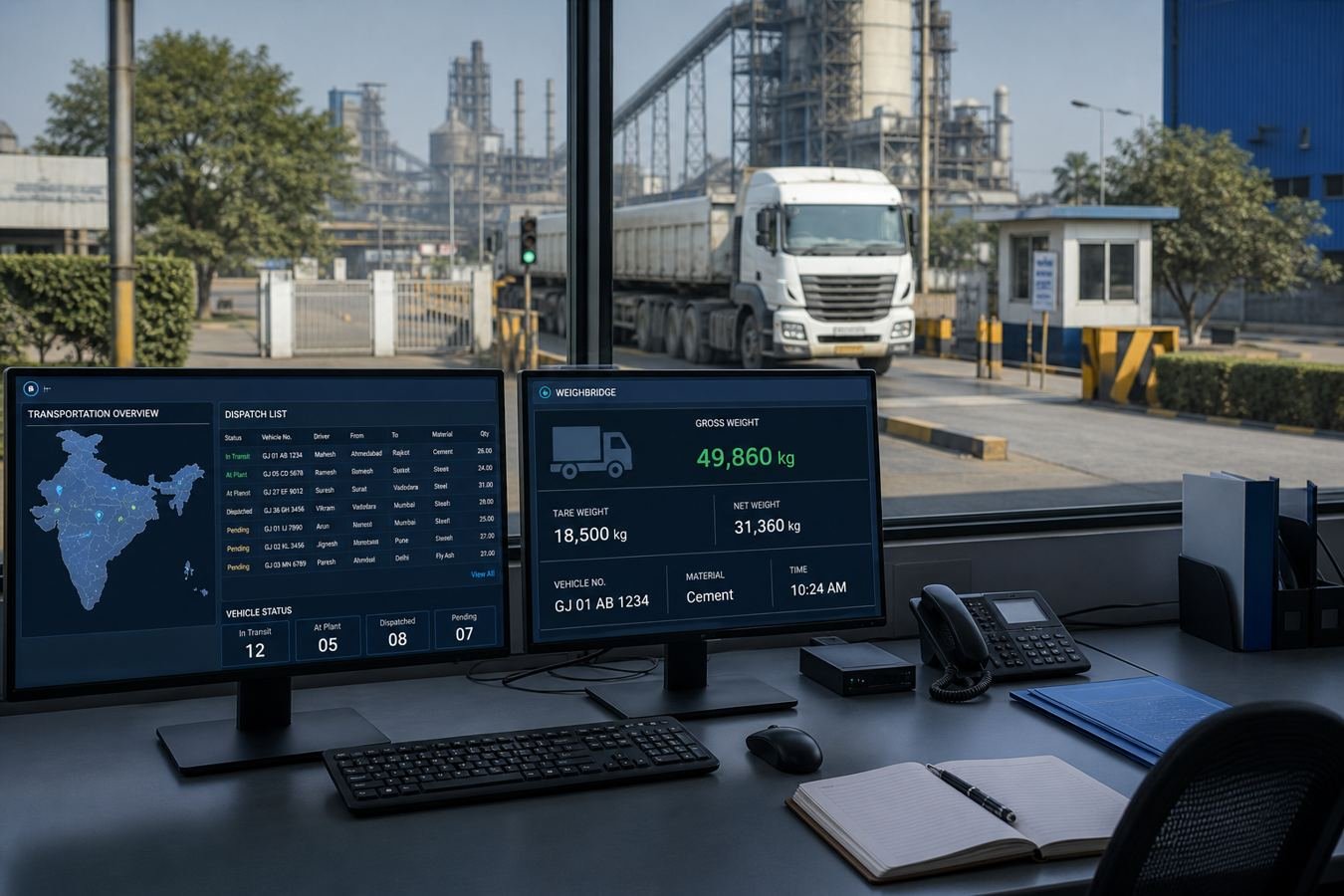
If you run a busy Indian plant, you already know this: a glowing map pin does not run the yard. An industrial TMS has to own gate identity, locked weight, documents, delivery proof, and pay. Trucks wait at the gate. Weight gets typed. Papers get updated after the truck left. Delivery photos live in chat. Finance pays late because three files never agree.
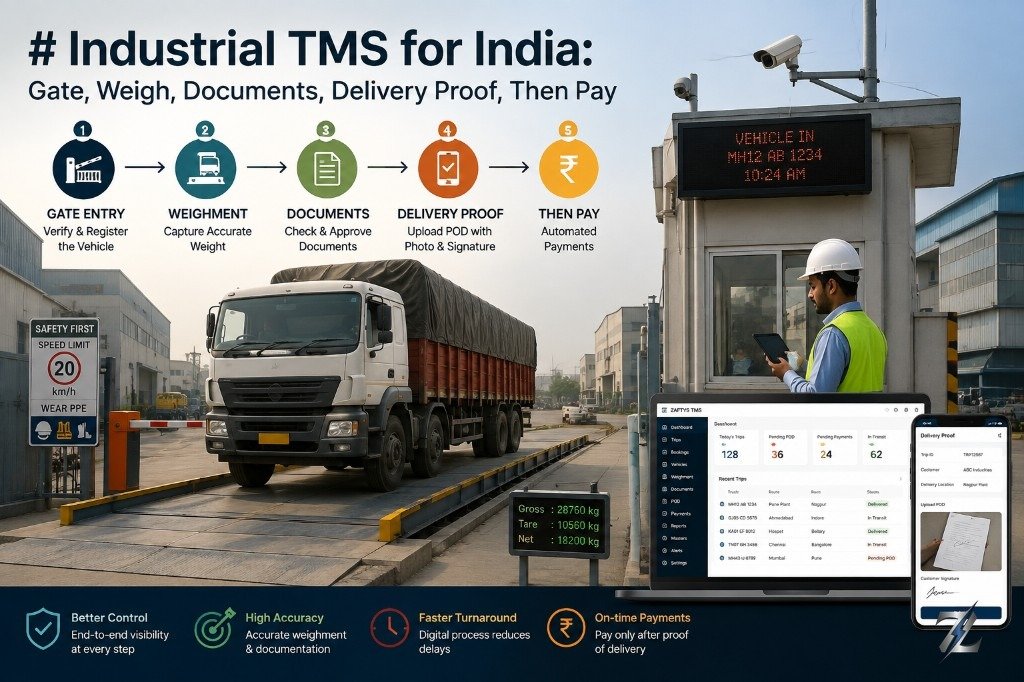
Industrial TMS (India plant): gate identity → locked weighbridge → LR / e-Way Bill → ePOD → freight pay. Not GPS-only - one trip identity through all five stages.
This guide is for plant, logistics, and finance leads who want one trip story from boom open to payment. Time inside the plant is in hours. Weight is in tonnes under MoRTH rules. Money examples are in rupees and teaching-only until your contract says otherwise.
Look at the five-stage picture first. Then who owns each stage. Then the donut. On many industrial days, a lot of truck time still burns inside the boundary - not on the highway. Bay and loading often eat the largest idle slice. That wait is real - and it belongs with production readiness and yard slots. This guide owns the control seams around it: gate, weigh, documents, delivery proof, and pay. Pair bay work with our plant detention and TAT post.
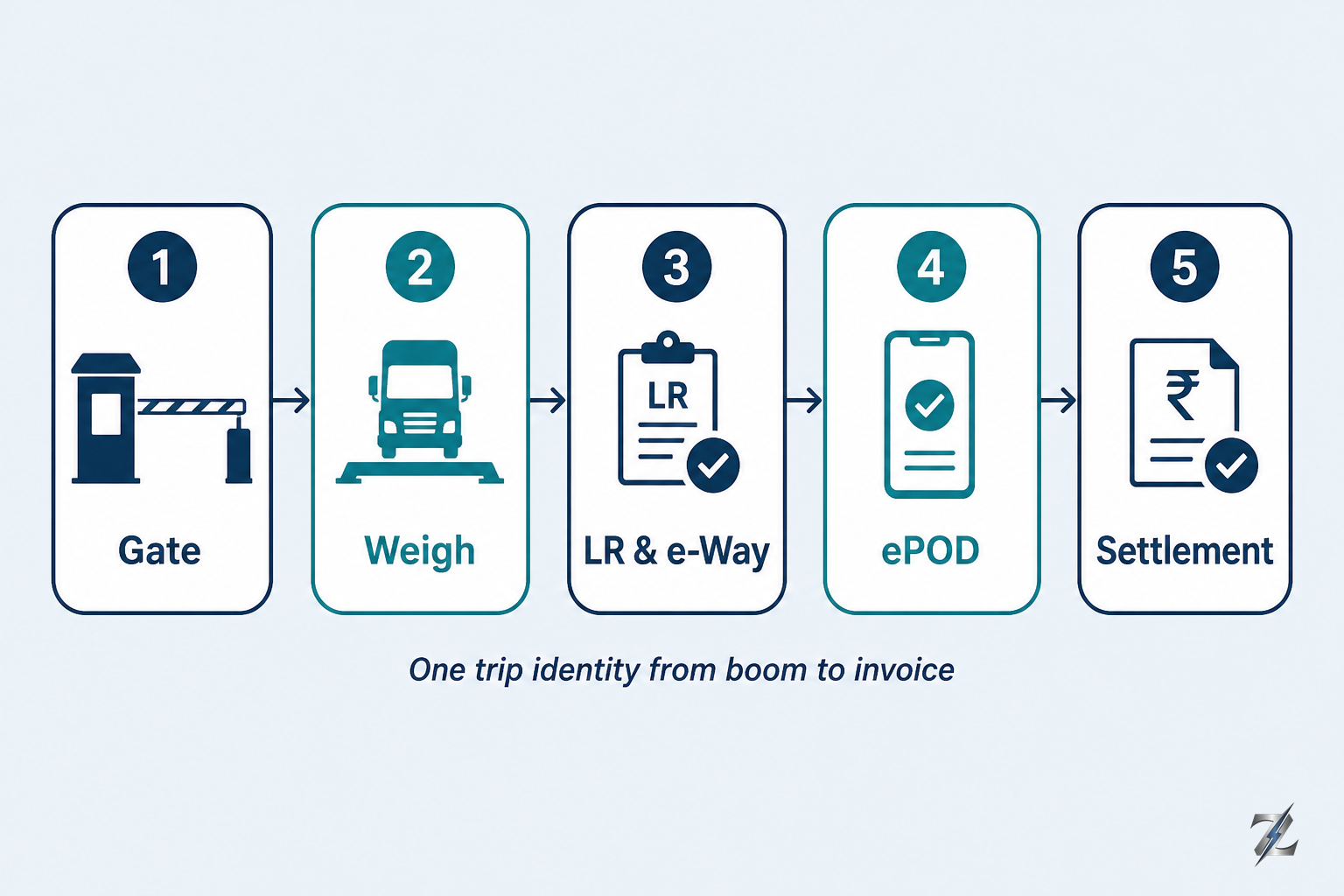
Gate → weigh → documents → delivery proof → settlement. Bay and loading still burn time, but they sit with production / yard management - this guide owns the control seams around them.
01
Gate
Security + transporter desk. Identity, override log, queue.
02
Weigh
Weighbridge / plant ops. Locked net, anti-cheat, overload block.
03
Documents
Dispatch + tax. LR, e-Way Part B timing, night peak queue.
04
Delivery proof
Dispatch + customer service. Link close, seals, shortage.
05
Settlement
Finance + commercial. Fuel, detention, four-way match.
Titles vary by plant. The point is one named owner per seam - not 'everyone and no one.'
- Inside the plant · 55%
- On the road · 30%
- Unload / POD chase · 15%
Not your exact plant. Useful for a workshop: a lot of truck time is still inside the yard.
Chapter 02
Why yards still leak money
RFPs still fall in love with long-haul GPS. On steel, cement, chemical, and manufacturing desks, money often leaks earlier: gate, scale, documents, delivery proof, and accounts payable each keep their own truth.
Picture 200 to 500 heavy trucks in a day. Security has a register. The weighbridge has a print. GST sits in a browser tab. POD is a WhatsApp photo. The transporter invoice is Excel. Queues stretch. Inventory argues. e-Way Bills lag. Bills sit for weeks.
One industrial TMS keeps one trip identity through all five stages. Inbound raw material and outbound finished goods use the same spine - but the fights differ. Use both tables below. The idle-hour bars are workshop tools; swap in your last 90 days before anyone talks savings.
Gate
What you see
Paper register, long queueWhat good looks like
Truck ID tied to a real open orderWeighbridge
What you see
Typed weight, arguments laterWhat good looks like
Scale feeds the system; edits are lockedDocuments
What you see
e-Way updated after the truck leftWhat good looks like
Vehicle details set before gate-outDelivery
What you see
POD photo lost in chatWhat good looks like
Proof tied to the same trip, with shortage rulesPayment
What you see
Three files, three truthsWhat good looks like
Four documents match - or a clear exceptionWalk one outbound lane with operations and finance. Ask who can still edit each record.
Gate
Inbound (raw / purchase)
PO / indent check; priority when stock is lowOutbound (finished goods)
SO / packing readiness; avoid morning surgeWeigh
Inbound (raw / purchase)
Tare first, then gross; purchase weight fightsOutbound (finished goods)
Gross then tare; overload risk before highwayDocuments
Inbound (raw / purchase)
Supplier / GST inbound rulesOutbound (finished goods)
LR + e-Way Part B before gate-outProof
Inbound (raw / purchase)
Plant receives; quality / moisture often matterOutbound (finished goods)
Customer receives; seals and shortage rulesPay
Inbound (raw / purchase)
Freight may sit with inbound logistics or vendorOutbound (finished goods)
Four-way match before transporter paymentSame five stages. Different fights. Do not copy one playbook onto the other without checking.
- Waiting at gate2.5 hours
- Weigh / reposition fights1.2 hours
- Bay wait + loading3 hours
- Paper / e-Way at exit0.8 hours
Teaching numbers. Bay wait is real - it belongs to production and yard slots, not to the five control stages below. Still measure it; fix it on a parallel track.
Map vs control
A map answers where the truck is. Control answers whether the plant may release it. That needs an open order at the gate, locked net weight, vehicle details on the e-Way Bill before exit (when required), proof a receiver will stand behind, and settlement finance can audit without a phone tree.
If you still need a demo scorecard, use the TMS evaluation guide. For the short version of 'beyond GPS,' see TMS for heavy haul. This piece stays in the yard.
Walk one outbound lane next week
Take operations and finance together. At each break point ask: who just wrote the record, who can still edit it, and what happens when the next stage disagrees. If the answer is 'we call the transporter,' that stage is still manual - even if a camera exists.
Do not average the five scores. Clean payment sitting on editable weight is still a broken scale. If your pain is mostly inbound purchase weight, walk an inbound lane the same way - do not assume outbound rules transfer.
Chapter 03
Gate: know the truck before the boom opens
The gate is identity. When guards alone copy plates, check licences, and hunt open indents, you invent the first queue of the day - worse when inbound and outbound share one muddy lane at shift change.
A solid stack tries more than one path: plate camera at crawl speed, plant RFID where you issue tags, and FASTag as a second chance when the plate is dirty. FASTag has been mandatory on commercial classes for toll since 2021. That helps at the plant gate. It does not mean every spot hire arrives tagged and alive.
Spot trucks without plant tags still need a logged QR or WhatsApp pass after licence checks. Never a silent paper exception. Ask the vendor what happens when camera and tag both fail at 2 AM. If the answer is 'the guard writes it down,' you bought a camera, not control.
01
Number plate camera
Reads the plate when the truck crawls in. Mud and broken fonts will still beat it sometimes.
02
FASTag / plant RFID
Second chance when the plate is dirty. FASTag is mandatory on commercial classes for toll - useful at the gate too.
03
QR / WhatsApp pass
For spot trucks and failed reads. Still logged. Never a silent paper exception.
04
Order check
No open indent? Boom stays down. Override only with a name and a reason.
You do not need every gadget on day one. You do need a logged fallback when cameras fail at 2 AM.
Show me failure
Ask what happens when the plate cannot be read and the tag is dead. If the answer is 'guard writes it down,' you bought a camera, not control.
Show me the log
Every override should leave a trail finance and security can replay later.
ANPR and FASTag plant gate identity
Plate camera at crawl speed plus FASTag as failover, with a logged QR or WhatsApp pass when both fail - never a silent paper exception. Where ULIP or similar authorised links are live, you can check driver and vehicle fitness signals against government masters. That needs onboarding - it is not a free public search.
Failed checks keep the boom down, alert the desk, and send the truck to staging. Managers can still override for real exceptions - with a log security and finance can replay later.
One lane, two directions
Plants that reverse inbound and outbound on one approach without sensors invent their own accidents. Directional loops, separate camera profiles, and priority for critical inbound raw materials stop two queues fighting for the same boom.
Adding one more guard rarely beats a second identity lane or honest slot windows. Your TMS should show queue depth and wait by hour - the same numbers you will freeze when you score maturity.
Chapter 04
Weighbridge: the plant cash register
Every accepted kilogram feeds inventory, cost of goods, and freight pay. Typed weights in a browser invite ghost tare slips and month-end inventory theatre.
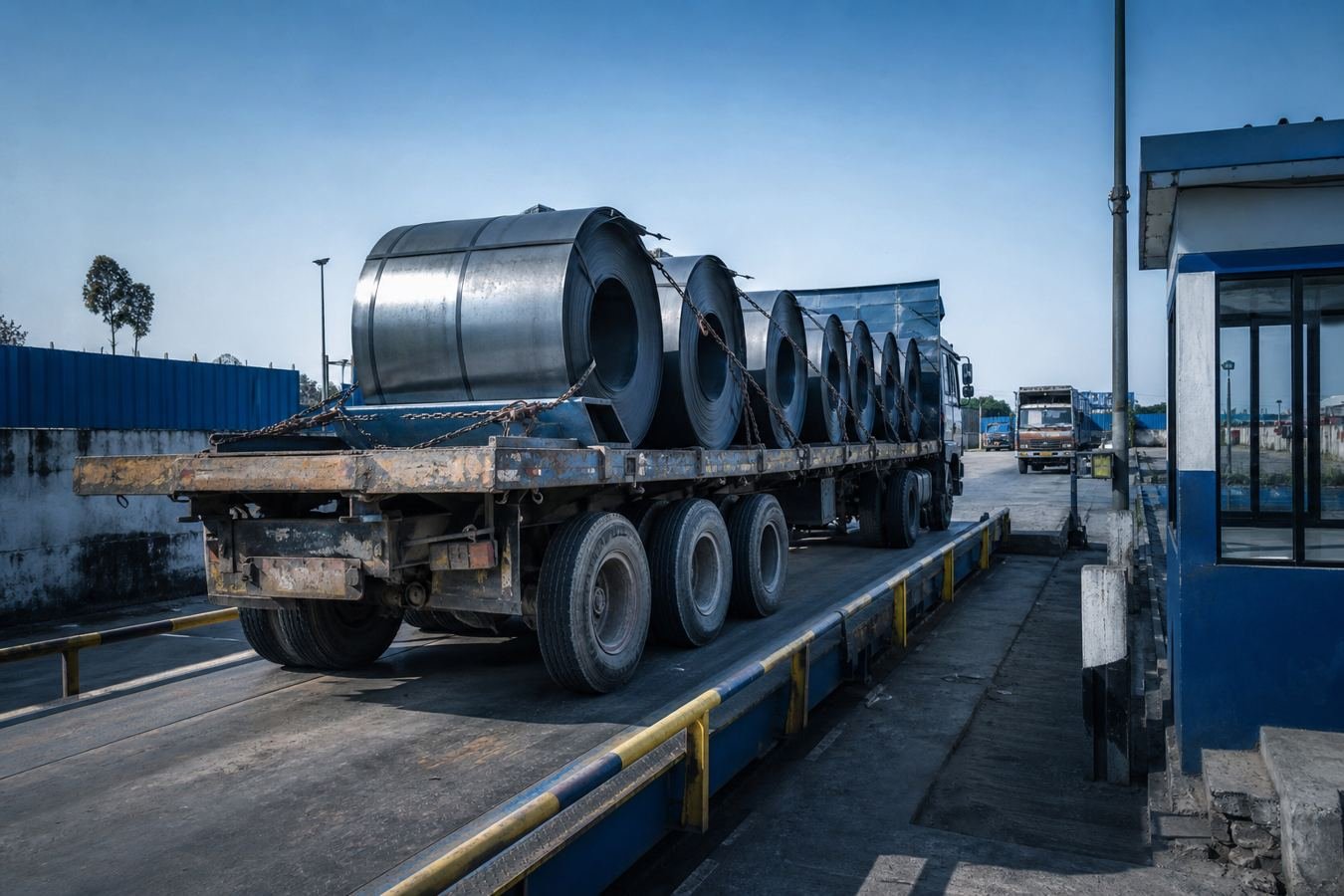
Pull weight from the indicator. Accept only a stable reading. Block capture when the truck is half on the deck. On outbound, force gross then tare. On inbound purchase weighment, tare first then gross - and keep the same anti-cheat rules. Kill old light slips when the truck leaves. Only then compare recorded weight to the legal class for that axle layout before anyone prints a clean gate-out.
The bar chart shows planning ceilings many plants use. Mid axle configs and full tables live in our axle load and GVW guide. Confirm OEM ratings and air suspension before you treat any tonne figure as dispatch law. Blocking overload inside the plant is cheaper than a highway stop.
- 2-axle rigid18.5 t
- 3-axle rigid28.5 t
- Rigid ceiling49 t
- Tractor-trailer ceiling55 t
MoRTH 2018 framing for common classes. Mid configs (4-axle / 5-axle rigid and more) live in the axle load guide - encode by layout, not one magic number.
01
Truck fully on the deck
Beams or sensors catch half-on wheels before you accept a weight.
02
Stable reading only
Ignore bouncing numbers. Wait for a stable signal from the indicator.
03
Tare has an expiry
Old light tare slips should die after a set window or when the truck leaves.
04
Over legal weight?
Block gate-out and offload inside the plant. Cheaper than a highway stop.
Weighbridge lock in a TMS
A weighbridge lock accepts the indicator feed, blocks typed weight, and fails closed at gate-out when the net is illegal - encode MoRTH axle and GVW ceilings here (axle load and GVW guide). Keep Legal Metrology stamps and recalibration dates in the master data. A clever workflow on an unstamped deck still fails audit.
Common tricks: wheels off the platform, helpers on the deck during tare, recycled light slips, bumper transfer between trucks. Beams, stability windows, camera snaps, and tare expiry beat slogans. Kilogram thresholds are your plant policy - not a national statute.
MoRTH ceilings and overload risk
S.O. 3467(E) is the axle and GVW framing many yards teach as about 49 tonnes rigid and 55 tonnes tractor-trailer. Air suspension can add where the notification allows - confirm layout before coding a bonus.
Section 194 frames overload penalties. Many yards also set a small plant tolerance before hard lock. Encode that as policy; do not market it as a legal +5% right.
Chapter 05
Documents: LR and e-Way Bill
Once net weight is locked, bind the carriage paper (LR / bilty) and the GST e-Way Bill when movement needs one. Tax invoice duties sit under Section 31 and Rule 46. E-invoicing under Rule 48 is a different track for notified businesses - do not confuse it with bilty generation.
Rule 138 is the e-Way engine: Part A for consignment details, Part B for the vehicle. Normal cargo uses about 200 km per day of validity. Oversize work uses about 20 km per day. Not every truck movement needs an e-Way Bill - value thresholds, some goods, and certain short or exempt cases skip it. Ask tax, then encode skip rules so the TMS does not invent fake bills.
If your dispatch leads cannot explain Part A vs Part B in one minute, automating documents only speeds up confusion. Use the validity picture with them.
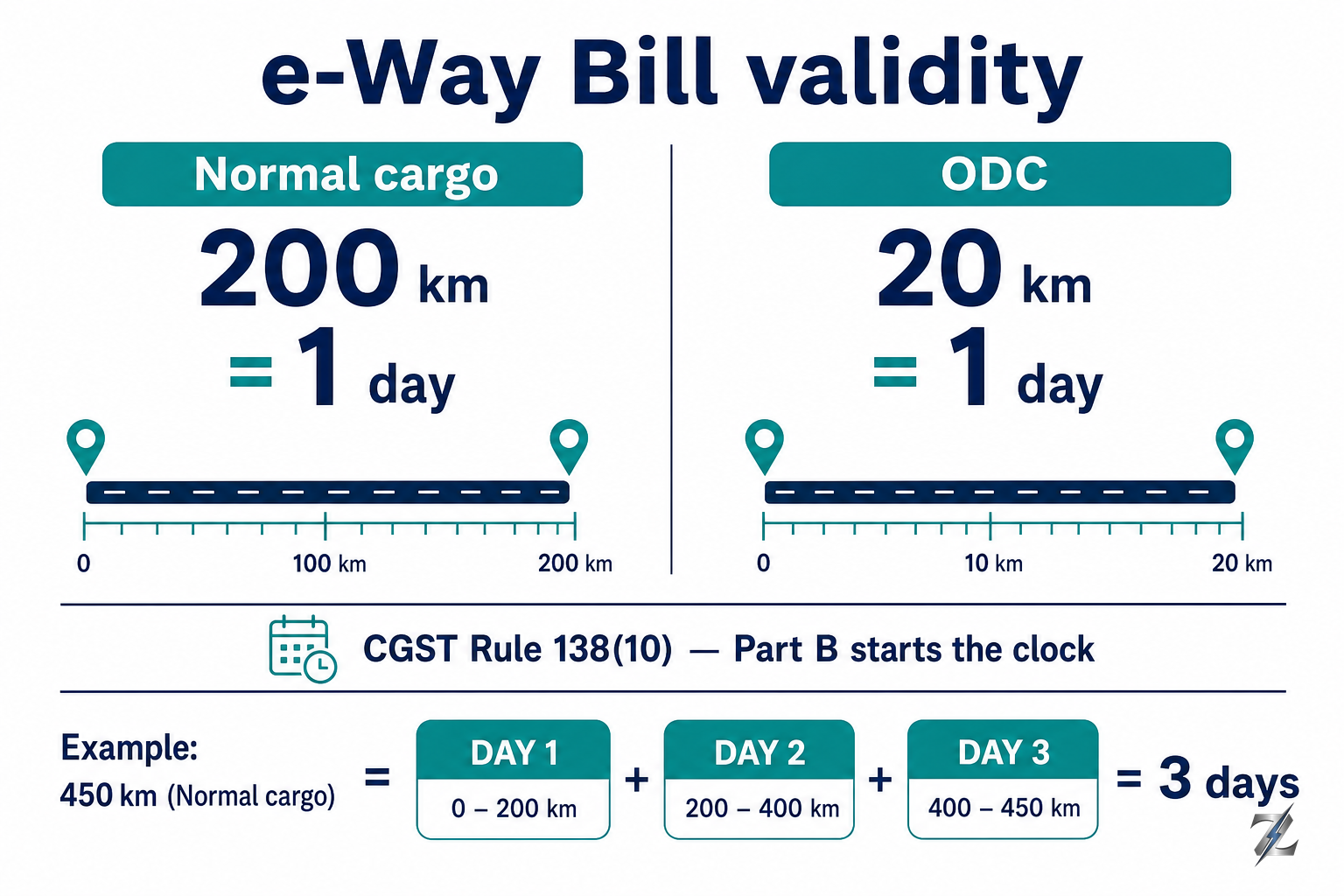
CGST Rule 138(10). Normal cargo uses 200 km per day. Oversize work uses 20 km per day. The vehicle details (Part B) are what start the useful clock. Not every movement needs an e-Way Bill - confirm threshold and exemptions with tax.
- 01
Weight is locked
Net comes from the scale, not a typed field someone can 'fix.'
- 02
LR / bilty
Carriage document for the transporter - tied to that net.
- 03
e-Way Part A
Consignment details when an e-Way Bill is required. Waiting for a truck is fine.
- 04
e-Way Part B
Put the real vehicle number before the truck leaves. Then the distance clock makes sense.
01
Parent trip
One truck, one locked scale net for the whole load.
02
Child LRs
Separate carriage lines per consignee / drop.
03
Child e-Way Bills
Separate bills when required - vehicle number stays consistent.
04
Weight check
Child weights must sum to parent net. If not, stop and fix.
One registration, one certified net, child documents that still add up.
Ask tax, then encode the rule
Value thresholds, certain goods, and some short / exempt movements do not need an e-Way Bill. Your TMS should skip generation cleanly - not invent a fake bill to 'complete the flow.'
Night peak without lockouts
Do not hammer the GST portal in a tight loop at 23:00. Queue vehicle updates, retry calmly when the portal is busy, and keep a human path for stuck bills.
e-Way Bill Part B before gate-out
Do not start movement on Part A alone when an e-Way Bill is required. Put the real vehicle number before gate-out so the distance clock makes sense. If yard wait burns validity, alert early. Software may extend only inside the legal window (within about eight hours of expiry) and only for allowed reasons. Unlimited auto-extend is a compliance risk, not a feature.
Multi-drop work needs child L₹and separate e-Way Bills per consignee while one registration moves the set. Child weights must still sum to the one certified net. If they do not, you invented a second inventory. Use the multi-drop flow below with dispatch before you automate splits.
Night peak without portal lockouts
Cement and steel night peaks are when 'integrated GST' either works or fails. Queue vehicle updates. Retry calmly when the portal is busy. Keep a human path for stuck bills. Do not hammer the portal in a tight loop.
Confirm current GSTN behaviour at go-live. Portals change faster than blog posts.
Chapter 06
Delivery proof without another app war
Delivery is not done when the truck leaves your gate. Proof has to survive shortage, seal, and receiver disputes. Forcing every market driver to install another app usually fails. A WhatsApp or SMS link with a location check closes more trips.
Simple flow: truck near site, open the link, capture signed paper and seal photos, receiver confirms, compare factory net to customer weight when the commodity needs it. Over contract tolerance becomes a debit on the same trip - not a quiet deduction in month-end.
Encode shortage and seal rules once with commodity managers. The shortage picture below is a teaching example - swap in your tolerance and rate, then stop renegotiating in chat. Spot-heavy lanes should lead with a link; dedicated fleets can still use an app.
- 01
Near the site
System sees the truck close to the unloading point.
- 02
Open a link
WhatsApp or SMS - no forced heavy app for one plant.
- 03
Capture proof
Signed paper, seal photos, optional customer weight.
- 04
Receiver confirms
OTP or clear acceptance closes the trip.
- 05
Shortage?
Over the contract tolerance → debit on the same trip, not a side chat.
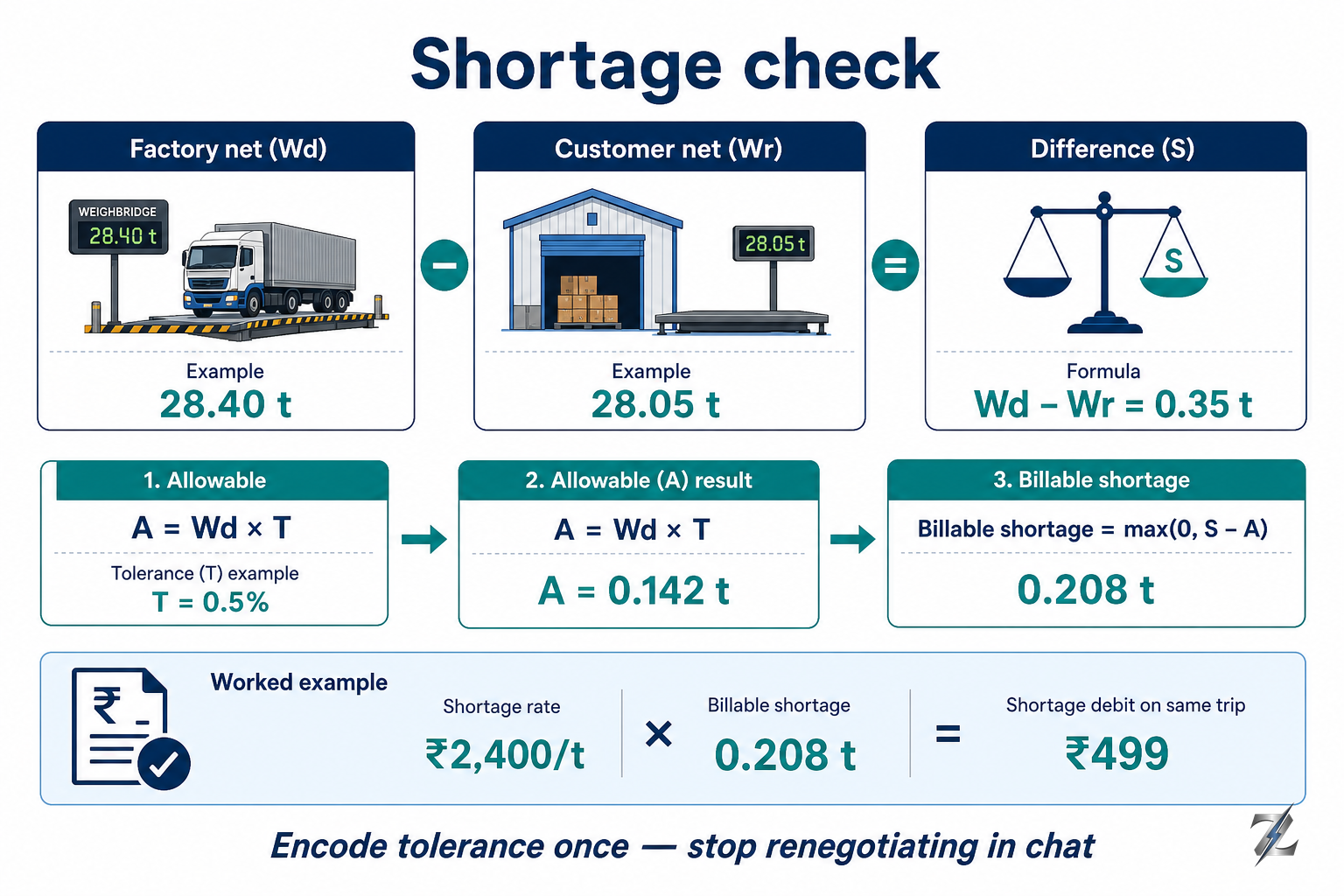
Swap in your commodity tolerance and rate. Encode once with commodity managers - stop renegotiating in chat.
Spot-heavy lanes
Many drivers will not install another app for one plant. Lead with WhatsApp or SMS session links.
Dedicated fleets
A proper driver app can still win when the same fleet lives inside your programme every day.
Shortage and seals
Bulk cargo moves moisture and scale difference. Contracts often allow a small percentage before penalty. Write factory net, customer net, tolerance, and billable shortage into the system. Never mix bags and tonnes silently.
Seal number mismatch against the LR should hold freight clearance. That one rule prevents many 'delivered but disputed' fights. More billing detail sits in the ePOD and e-Way Bill guide.
Chapter 07
Settlement: fuel, detention, four-way freight matching
Four-way freight matching means rate card + certified scale net + approved ePOD (minus claims) + transporter bill agree before you pay. Settlement turns timestamps and weights into money. Almost every industrial rate card has diesel escalation and plant detention. The two pictures below show the shape - swap in your contract numbers.
Before you pay: rate card, scale net, approved delivery proof (minus claims), transporter bill. The match table shows what each document must prove and who owns a mismatch. Small variance under finance tolerance can clear with an audit note.
On SAP landscapes, prefer S/4HANA Transportation Management for new builds over legacy LE-TRA habits. The short object map below is the shape finance and IT should agree on - order, trip with locked weight, goods or service confirm, then invoice match. Confirm transaction names with your SAP partner.
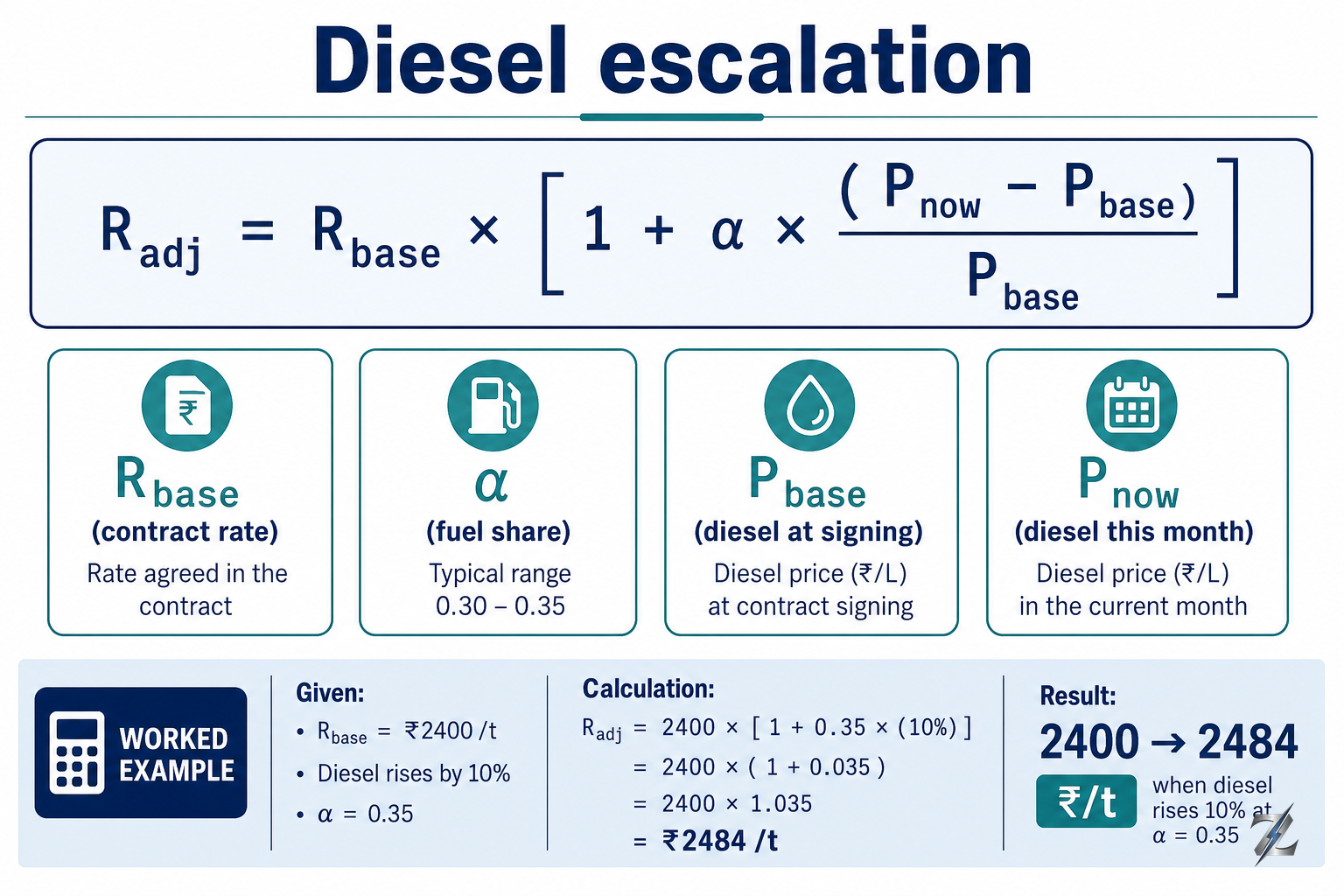
α is usually negotiated around 0.30–0.35. Lock the base diesel city and the formula in writing. Rupee example is teaching only.
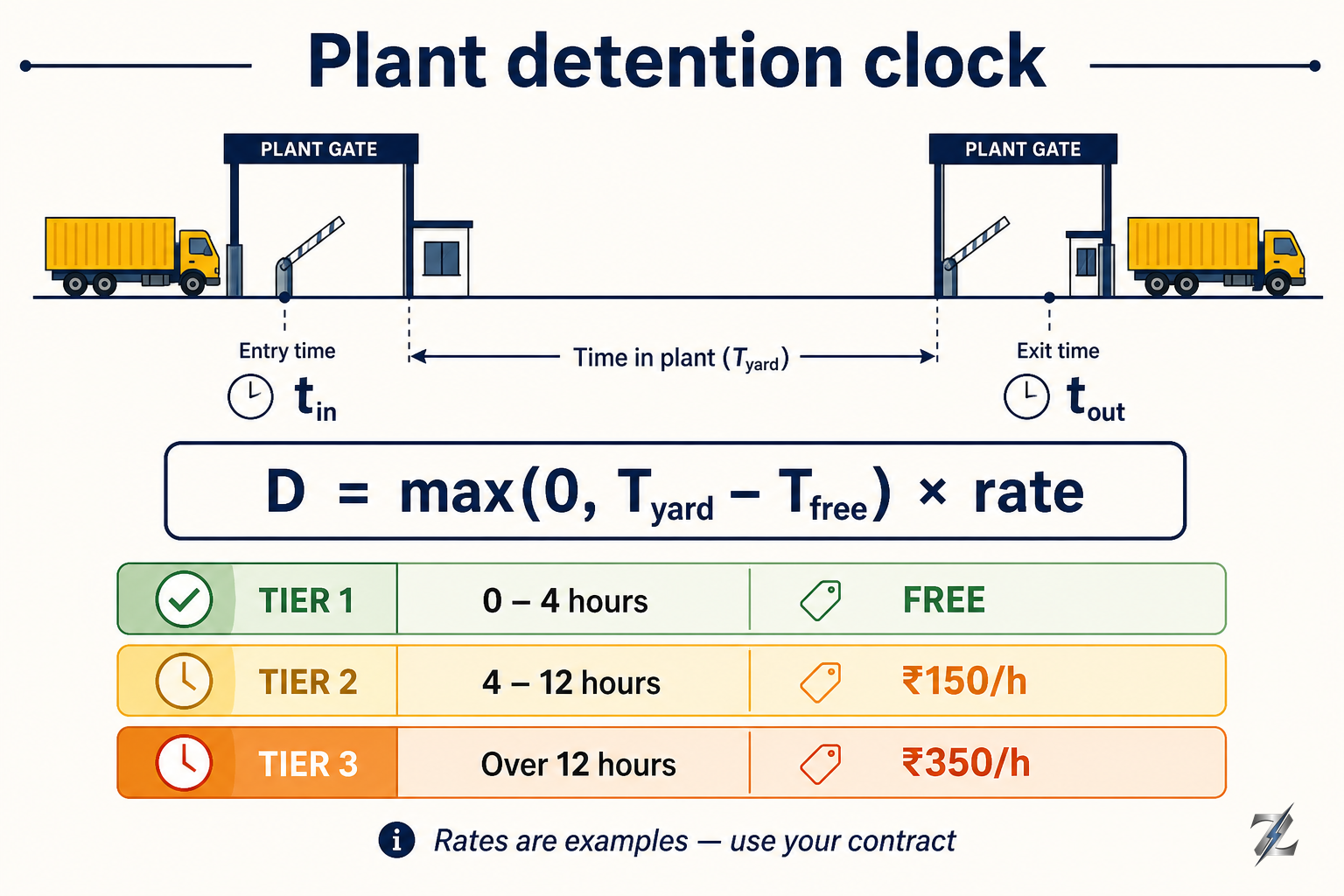
Use gate-in and gate-out from the same identity system. The ₹/hour bands are examples - swap in your rate card.
Rate card
Must show
Lane, fuel α, detention tiersIf it disagrees
Hold line → procurement / commercialScale net
Must show
Certified gross / tare trailIf it disagrees
Hold pay → plant weigh + transporter deskDelivery proof
Must show
Closed POD, seals, shortage debitIf it disagrees
Hold pay → dispatch / customer serviceTransporter bill
Must show
Same trip, same mathsIf it disagrees
Clear rest after debit / fix → financeAll four must agree before you pay. Named exception + owner beats a blocked payment run nobody owns.
- 01
Order / delivery
Sales or purchase order and delivery / shipment object that the gate can check.
- 02
Freight / trip
TMS trip or freight order carrying gate stamps, locked net, and documents.
- 03
Goods / service confirm
Plant goods movement or service confirmation that finance will trust.
- 04
Invoice match
Four-way clear (or coded exception) before payment run - MIRO-style on SAP.
Names vary by landscape. The point is one trip identity through weight, service entry, and invoice match - not a slide full of transaction codes.
Own fleet vs labeled overflow
ZAFTYS runs owned heavy vehicles, contract programmes, and labeled partner overflow. The five stages do not change. Settlement must still show which capacity moved the trip so finance never books overflow as company fleet.
Marketplace listing and search on TranZfort stay free; a broker fee applies on booked loads. For one desk on the whole stack, start at industrial freight or contact.
Fuel and detention without folklore
Derive diesel share from the lane's diesel ₹/km divided by basic freight ₹/km. Then lock that number, the base city, price source and review date in a written diesel surcharge clause. Detention free time and hourly rates must use the same gate clocks that opened the boom. 'We waited twelve hours' is not an input.
Post fuel surcharge and detention as separate lines when the contract separates them. Burying both inside base freight is how disputes come back after you thought matching was done.
Chapter 08
How mature is your yard?
Skip vanity scores out of 100. Place gate, weigh, documents, delivery proof, and payment in Manual, Half-digital, or Under control using the last 90 days of proof. A live map with editable weights is still Manual integrity.
Rank the weakest gap that blocks the next step. Most Indian industrial shippers sit in Half-digital: cameras and portals exist, but one trip identity does not survive into payment.
Paper book
Weight ·Lines Gate-Gate
- Gate
Camera, no order link
Typed slip
Weight ·Lines Weigh-Weigh
- Weigh
Print, still editable
Portal after exit
Weight ·Lines Documents-Documents
- Documents
Vehicle details late
Photo in chat
Weight ·Lines Delivery-Delivery
- Delivery
App nobody opens
Excel fight
Weight ·Lines Payment-Payment
- Payment
Three-way leaks
Use the last 90 days of proof. Do not average five scores into one happy label.
How to run the review
Bring plant, dispatch, procurement, and finance into one room. For each area demand evidence: gate wait chart, scale near-miss log, sample vehicle-update timing, days to delivery proof, exception age in accounts payable. No pack means Half-digital at best.
Do not average the five areas into one happy label. Clean payment on paper L₹is still Manual cash. Clean maps with no weight lock are still Manual payload risk.
Chapter 09
Build in the right order
Six-week posters stall when the weighbridge vendor, security, and transporters disagree. Keep the order fixed: measure first, fix gate and scale, then documents, then delivery proof and money.
Pilot one plant corridor with real truck volume. Freeze your denominators - the same units for 90 days: gate wait hours, weight-fight counts, document-miss rate, days to POD, days to pay. Prove you clear exceptions. Then widen. National rollouts of half-wired stacks only multiply chat - and the cost of untangling nets you already paid against.
1
Measure first
Gate waits, weight fights, document misses, days to POD, days to pay.
2
Fix gate + scale
Identity and locked weight before you celebrate a live map.
3
Documents
LR and e-Way discipline, including night peak queues.
4
POD then money
Close delivery proof, then fuel, detention, and four-way match.
Calendars slip. This order should not.
01
Gate wait (hours)
Median and 90th percentile from identity clear to leave staging / enter bay.
02
Weight fights (count)
Typed overrides, reposition reweighs, overload blocks per 100 trips.
03
Document misses (%)
Trips that left without vehicle details set when e-Way was required.
04
Days to POD / pay
Gate-out to closed proof; closed proof to cleared transporter bill.
Same units for 90 days. No mixing median with best-day hero stories.
Buying a TMS?
Score demos with /blog/tms-evaluation-guide-indian-manufacturers before you buy hardware theatre.
Axle and GVW
Hardcode weight rules only after /blog/india-axle-load-gvw-limits-heavy-freight.
Yard time and billing
Neighbour posts: /blog/plant-detention-tat-yard-gate-india and /blog/epod-fastag-eway-bill-billing-india.
Why calendar-first programs stall
Teams buy a demo, schedule six weeks, and skip baseline. Or finance demands automated invoices before gate timestamps exist. Or sales promises detention savings while free-time clocks are still verbal.
Dependency-led builds feel slower in month one and faster by month three because rework drops. Use week bands for planning after IT and plant security say yes - not as a go-live date printed without hardware lead times.
Chapter 10
What to do next
When manufacturers close the five stages, yard waits, shortage fights, document misses, and invoice cycle time usually move in the right direction. Treat any percentage claim as a planning band until your 90-day baseline exists - never as a guaranteed return, and never as 'zero fraud / perfect match' marketing.
Take the ten demo questions below into the next vendor meeting. Keep reading plant detention and TAT, axle load and GVW, and ePOD billing. Operator login for ZAFTYS TMS is at app.zaftys.com.
- 01
Gate fail
Show plate fail + dead tag. What happens at 2 AM?
- 02
Override log
Show name, reason, and replay for security / finance.
- 03
Half-on deck
Show weigh capture blocked when the truck is not fully on the scale.
- 04
Tare expiry
Show old light slips die after gate-out or policy window.
- 05
Part B timing
Show vehicle details set before gate-out when e-Way is required.
- 06
Portal busy
Show calm retry - not a tight loop - when GST is slow at night.
- 07
Link POD
Show WhatsApp/SMS close without forcing an app install.
- 08
Shortage debit
Show tolerance math and debit on the same trip identity.
- 09
Four-way mismatch
Show a named exception with an owner, not a silent short-pay.
- 10
Capacity label
Show own fleet vs labeled overflow on the settlement line.
If they cannot answer live, park the glossy map slide.
Appendix
Frequently asked questions
What is an industrial TMS for Indian plants?
An industrial TMS for Indian manufacturing plants runs the control stack from gate identity through locked weighbridge, LR and e-Way Bill, delivery proof (ePOD), and freight settlement - not only a GPS pin on the highway. This post is that ops walk. For buying scorecards, see the TMS evaluation guide.
How is this different from a TMS evaluation checklist?
The TMS evaluation guide helps you score demos. This piece is what must work after you buy: gate identity, locked weight, e-Way Bill clocks, delivery proof, and invoice match.
Is FASTag mandatory for plant gates?
FASTag is mandatory for M and N class vehicles on national electronic toll collection from 1 January 2021. Plants can use it as a second identity signal. Spot trucks still need a logged fallback when the tag fails.
What weight ceilings should a TMS encode?
Many plants plan around MoRTH framing of about 49 tonnes for rigid vehicles and 55 tonnes for tractor-trailers. Encode by axle layout, not one magic number. See our axle load and GVW guide.
What is the e-Way Bill distance rule?
Under CGST Rule 138(10), normal cargo gets about one day of validity per 200 km (or part). Oversize cargo uses about one day per 20 km. The useful clock follows the vehicle details (Part B) - confirm current portal behaviour at go-live.
Can software auto-extend every e-Way Bill?
No. Extensions are for exceptional cases and only inside the legal window (within about eight hours of expiry). Build early alerts and human review. Do not sell unlimited auto-extend.
Why WhatsApp delivery proof instead of a driver app?
Many drivers will not install another app for one plant. A WhatsApp or SMS link with a location check and receiver confirmation usually closes more trips. Dedicated fleets can still use a proper app.
What is four-way freight matching?
Before you pay: rate card (including fuel clauses), certified scale net, approved delivery proof minus shortage or damage, and the transporter bill. Mismatches become named exceptions - not silent short-pay fights in chat.
Should new plants still build on SAP LE-TRA?
For new TMS-to-ERP work, prefer SAP S/4HANA Transportation Management over legacy LE-TRA. Confirm support dates with your SAP partner.
How do own fleet and network capacity show up?
The five stages stay the same. Settlement must still label the trip: company-owned, contract-reserved, or partner overflow. Never present labeled overflow as owned fleet.
Does the same stack apply to inbound raw material?
Yes - gate, weigh, documents, proof, pay - but the fights differ. Inbound usually tare-then-gross and purchase-weight disputes. Outbound usually gross-then-tare and overload risk before the highway. Walk both lanes separately.
Does every movement need an e-Way Bill?
No. Value thresholds, some goods, and certain short or exempt cases skip it. Ask tax, then encode skip rules so the TMS does not invent fake bills to complete a workflow.
How should shortage be calculated?
Compare factory net to customer net, apply contract tolerance, then bill only the excess on the same trip. Encode the tolerance and rate once - do not renegotiate in chat. Teaching example is in the shortage exhibit in this post.
Where do ULIP and Vahan fit?
ULIP can expose vehicle and licence data to onboarded applications. Useful at the gate when your agreements are live - not a free public lookup.
What is a weighbridge lock in a TMS?
A weighbridge lock accepts weight from the indicator, blocks typed overrides, and fails closed at gate-out when the net breaks axle or GVW rules. Encode MoRTH ceilings by axle layout - see the axle load and GVW guide.
When should e-Way Bill Part B be updated?
Before the truck leaves the plant when an e-Way Bill is required. Part A is consignment detail; Part B is the vehicle. Starting the trip on Part A alone makes the distance clock meaningless and creates portal fights later.
What is four-way freight matching in industrial TMS?
Before you pay: rate card (including fuel clauses), certified scale net, approved ePOD minus shortage or damage, and the transporter bill. Mismatches become named exceptions - not silent short-pay fights in chat.
What is ANPR at a plant gate?
Automatic Number Plate Recognition reads the plate at crawl speed so the gate can match an open order. Pair it with FASTag failover and a logged QR or WhatsApp pass when cameras and tags both fail - never a silent paper exception.
Sources
References and data sources
Public sources below are for orientation. They are not ZAFTYS audited financials. Read the originals before a number goes into a board pack.
- [1]MoRTH S.O. 3467(E) (2018) on axle weight and GVW / GCW ceilings - confirm current gazette text.
- [2]Motor Vehicles Act Section 194 on overload penalties - confirm current notified amounts with counsel.
- [3]CGST Rule 138 / 138(10) on e-Way Bills: Part A / Part B, 200 km and 20 km slabs, extension window near expiry.
- [4]CGST Act Section 31 and Rule 46 on tax invoices. Rule 48 is e-invoice for notified businesses - a different track.
- [5]NETC / FASTag: mandatory for M and N class vehicles from 1 January 2021 (MoRTH / IHMCL).
- [6]ULIP / DPIIT for authorised vehicle and driver data access when your application is onboarded.
- [7]Legal Metrology / OIML R76 Class III for industrial weighbridges - keep stamps and recalibration dates.
- [8]SAP LE-TRA toward S/4HANA Transportation Management - confirm support dates with your SAP partner.
- [9]ZAFTYS plant and corridor work, 2024–2026 - directional, not a national survey.
Related reading