Chapter 01
Why the rate card goes stale in ninety days
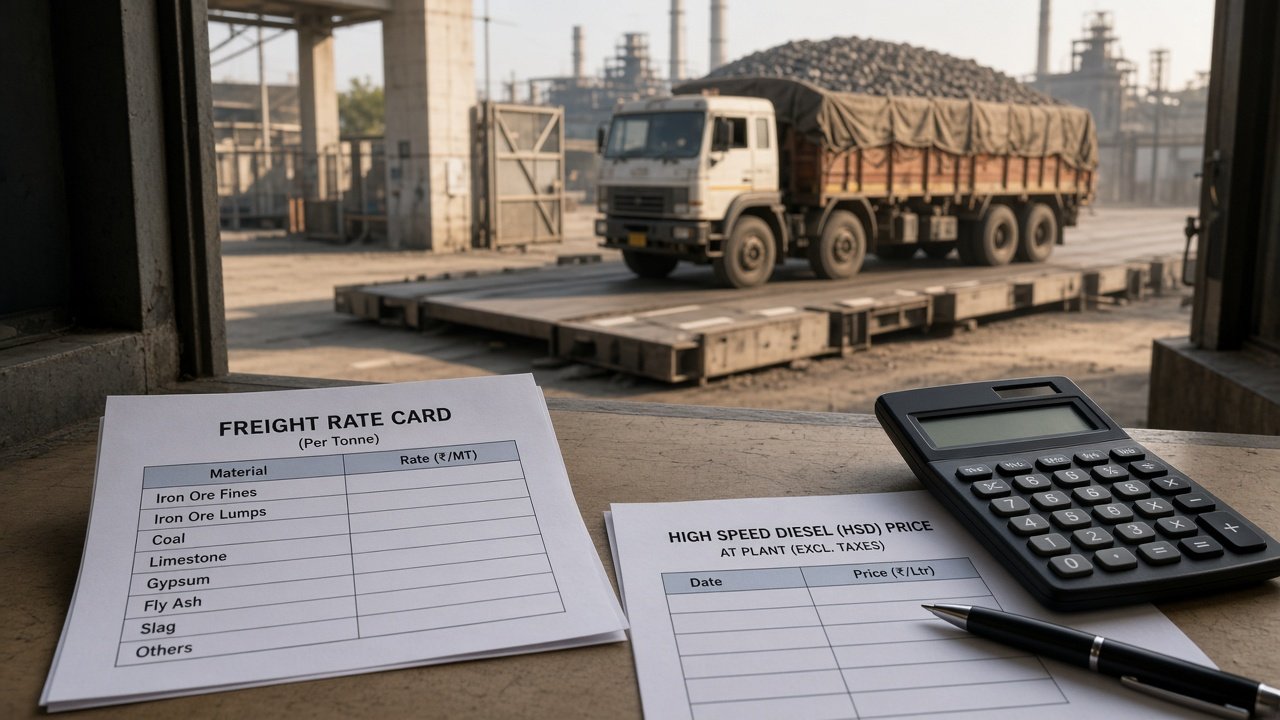
A plant signs ₹X per tonne or ₹Y per km in April. Diesel moves before the quarter is over. The transporter sends a revised bill. Procurement says the contract is fixed. The transporter says the truck cannot run at April diesel. Dispatch still needs the vehicle on Thursday, so someone approves a round number on WhatsApp and finance discovers it at month-end.
This is a commercial drafting guide, not legal or tax advice. Use it to prepare the operating brief, then have counsel and finance review the final diesel escalation and de-escalation clause.
That fight is a missing clause. The contract named a freight number and forgot six things: which city's diesel is the base, which date that price was taken, which published table both sides will open later, the formula that turns a diesel change into a freight change, how often the clause may fire, and what it does not cover. Without those lines, every diesel headline becomes a fresh negotiation. With them, month-end is arithmetic a clerk can check.
From 15 May 2026 to 8 Oct 2026, Delhi high-speed diesel moved from ₹90.67 to ₹95.20. That is ₹4.53 on a price both sides can look up. Mumbai moved from ₹93.14 to ₹97.83, up ₹4.69. A contract that froze the spring rate and said nothing about diesel has already spent a quarter either arguing, quietly overpaying, or losing the better trucks to someone who will talk about fuel.
The expensive version of silence shows up at the next tender, not on this month's bill. The transporter folds last quarter's diesel into a higher base rate. Procurement celebrates a 'fixed' card. There is still nothing to audit when the pump moves again. A written clause is how you keep the diesel rupee visible instead of burying it.
Day 0
The card is signed
Both sides freeze base diesel and base freight. City, date, and formula are either written or missing. This is the only cheap moment to write them.
Day 30-90
The print moves
Diesel changes. Nobody opens a clause because the review window was never written. Dispatch still needs the truck on Thursday.
Bill day
WhatsApp percent
One side applies a number from a forward. The other rejects it. Finance cannot audit a sentence that was never in the PDF.
Next tender
The pain hides in the base
The transporter folds last quarter's diesel into a higher base rate. The shipper thinks they negotiated diesel away. There is still nothing to audit.
Teaching sequence for a quarterly industrial FTL contract. Not a case file.
Chapter 02
What actually sits inside a truck rupee
Read this before any formula. People who skip it put toll and diesel in the same sentence and then argue for a year. The fuel clause may touch diesel inside base freight. It does not touch FASTag, tyre and repair, detention after free time, or an empty return.
Those other leaks already have their own pages. Gate hours sit on the plant TAT guide. Deadhead sits on the empty return guide. The wider bill, from yard dwell to weighbridge variance, sits on the cost leaks guide. This page is only the diesel line. If you let it swallow the rest, you will not be able to tell a fuel hike from a bad gate.
A useful way to set the share, before you copy anyone's headline, is litres on your own lane. The earlier workshop bench puts diesel at about ₹19 to ₹24 per km inside a variable band of about ₹26 to ₹37 per km. At a Delhi price near ₹95 per litre, ₹19 per km is about 0.20 litre per km, roughly 5 km per litre. ₹24 per km is about 0.25 litre per km, roughly 4 km per litre. If the contracted rate is ₹48 per km and diesel is ₹22 of that, diesel is about 46% of the rate. That 46% is a candidate for S. It is not 65%, and it is not 42%. Ask the transporter for litres per km on this body and this lane, then write the percent you both can defend.
Three published shares still get quoted as if they were one number. They are not, and the donut above is not one of them. The donut is only the workshop variable split, and the slices add to 100% of that variable band. The published figures are different pies. NCAER, via Crisil in June 2026, puts fuel at about 42% of road transport cost. Crisil's April 2026 freight note puts fuel at nearly 50% to 60% of a transporter's operating expenses, and says a ₹5 per litre move needs about 2.5% to 2.8% on freight to hold margin. The AITWA circular of 19 May 2026 describes diesel as about 65% of truck running cost. Finance will reach for 42%. The transporter will reach for 65%. The contract has to say which denominator the percent uses.
- Diesel · 50%
- Toll · 18%
- Tyre and maintenance · 16%
- Other variable · 16%
Directional long-haul bench used on earlier ZAFTYS posts: variable about ₹26 to ₹37 per km. Diesel about half of that band. Not a Crisil pie and not your lane until you have litres per km.
- Road transport cost (NCAER)42 %
- Operating expenses, low end (Crisil)50 %
- Running cost (AITWA)65 %
Do not average these into 52%. NCAER via Crisil June 2026 is road transport cost. Crisil April 2026 low end is operating expenses. AITWA 19 May 2026 is running cost.
42% is the wide pie
NCAER, via Crisil June 2026: fuel about 42% of road transport cost. Useful context. A poor default for S on one lane unless you have litres per km.
50% to 60% is operating cost
Crisil April 2026: fuel is nearly half to three-fifths of transporter operating expenses. A ₹5 per litre move needs about 2.5% to 2.8% freight to hold margin.
65% is the association running-cost line
AITWA circular, 19 May 2026: diesel about 65% of truck running cost, turned into a 0.65 card. If you also set S = 0.65 in a second formula, you have hiked twice.
Published notes, checked 8 Oct 2026. Not a ZAFTYS national index.
City
Delhi
15 May 2026 (AITWA base date)
₹90.67 / litre
8 Oct 2026
₹95.20 / litre
Move
+₹4.53
City
Mumbai
15 May 2026 (AITWA base date)
₹93.14 / litre
8 Oct 2026
₹97.83 / litre
Move
+₹4.69
| City | 15 May 2026 (AITWA base date) | 8 Oct 2026 | Move |
|---|---|---|---|
| Delhi | ₹90.67 / litre | ₹95.20 / litre | +₹4.53 |
| Mumbai | ₹93.14 / litre | ₹97.83 / litre | +₹4.69 |
15 May 2026: Times of India, Business Standard, The Hindu BusinessLine. 8 Oct 2026: India Today and The Hindu BusinessLine. Re-read the named table on bill day.
Chapter 03
Three diesel escalation formulas for freight contracts
Put all three formulas on the table, with the cards below, then pick one and delete the others from the draft. Stacking them is a second hike. The new rate, whichever formula you pick, is base rate times (1 + fuel uplift percent / 100). Apply that only to the base freight line.
If you want a card a transporter will recognise from the May 2026 circular, use Formula 1 and negotiate the 0.65 against lane evidence. If you know litres per km and want the percent to follow the diesel price, use Formula 2 and derive S from the lane. If you want the quieter percentage-of-percentage language in archived buyer samples, use Formula 3. The comparison table applies all three to the same Delhi move.
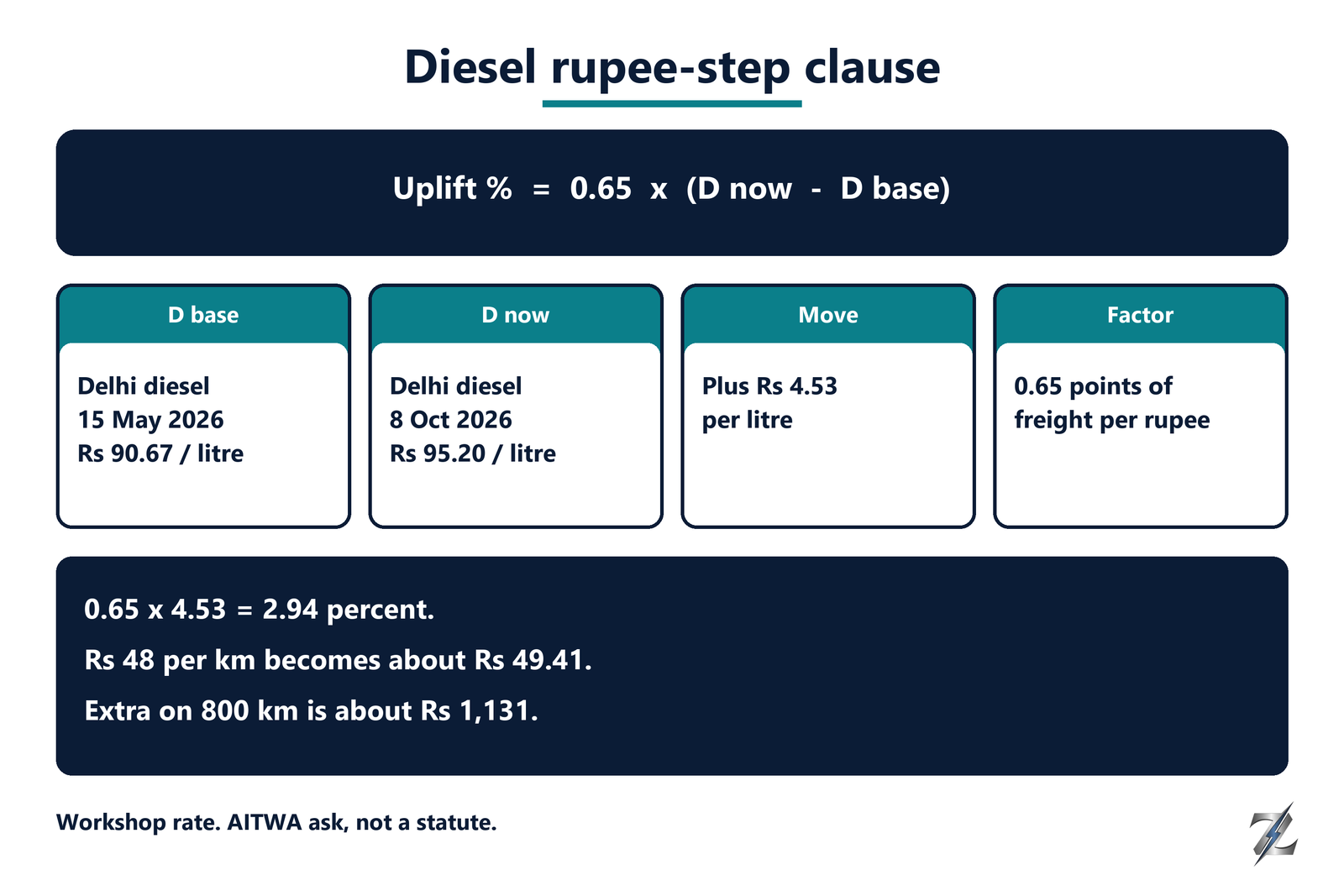
AITWA circular of 19 May 2026, as reported. Delhi prints 15 May and 8 Oct 2026. ₹48/km is a workshop rate, not a corridor quote.
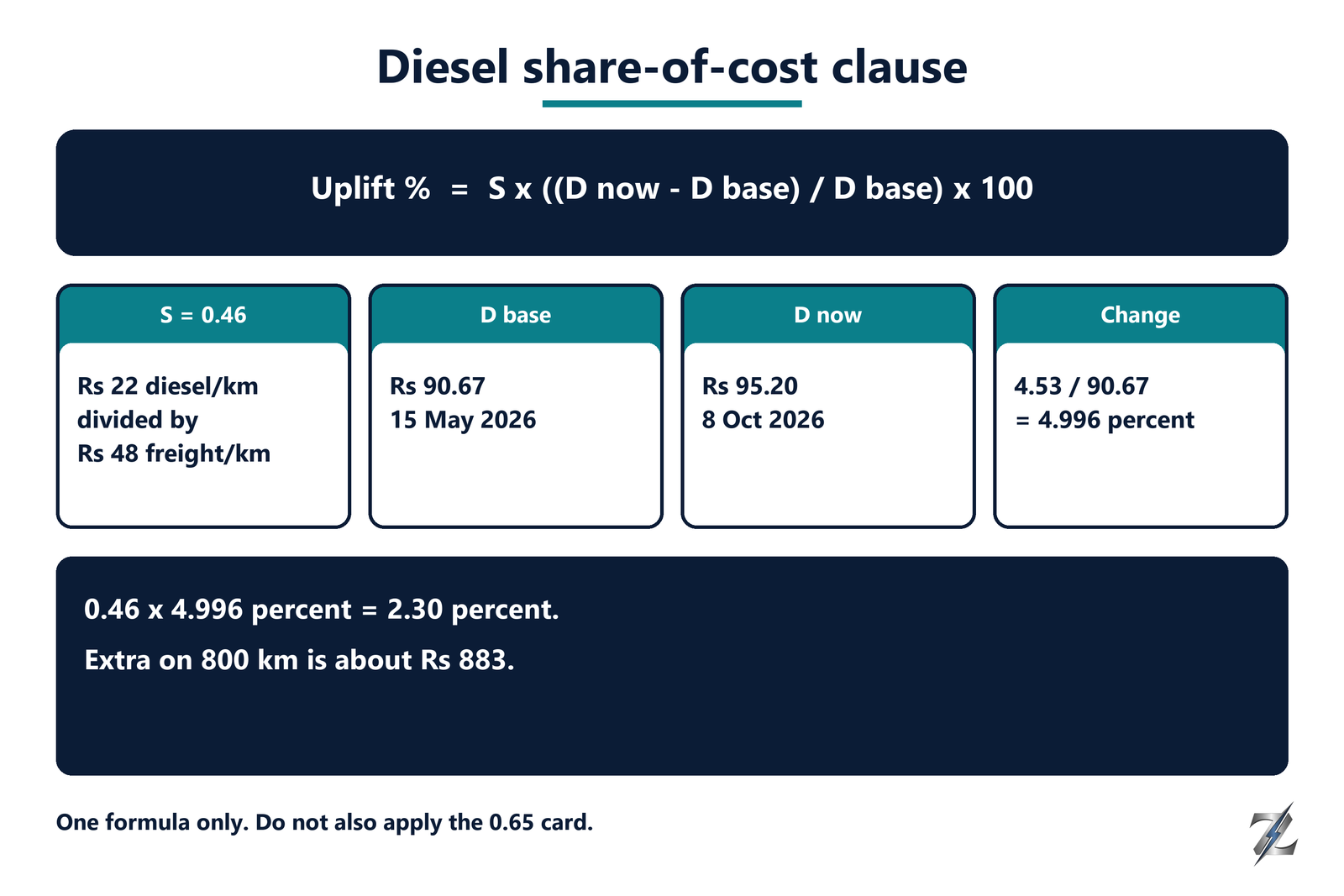
Workshop lane share: ₹22 diesel per km divided by ₹48 basic freight per km gives 0.458, rounded to S = 0.46.
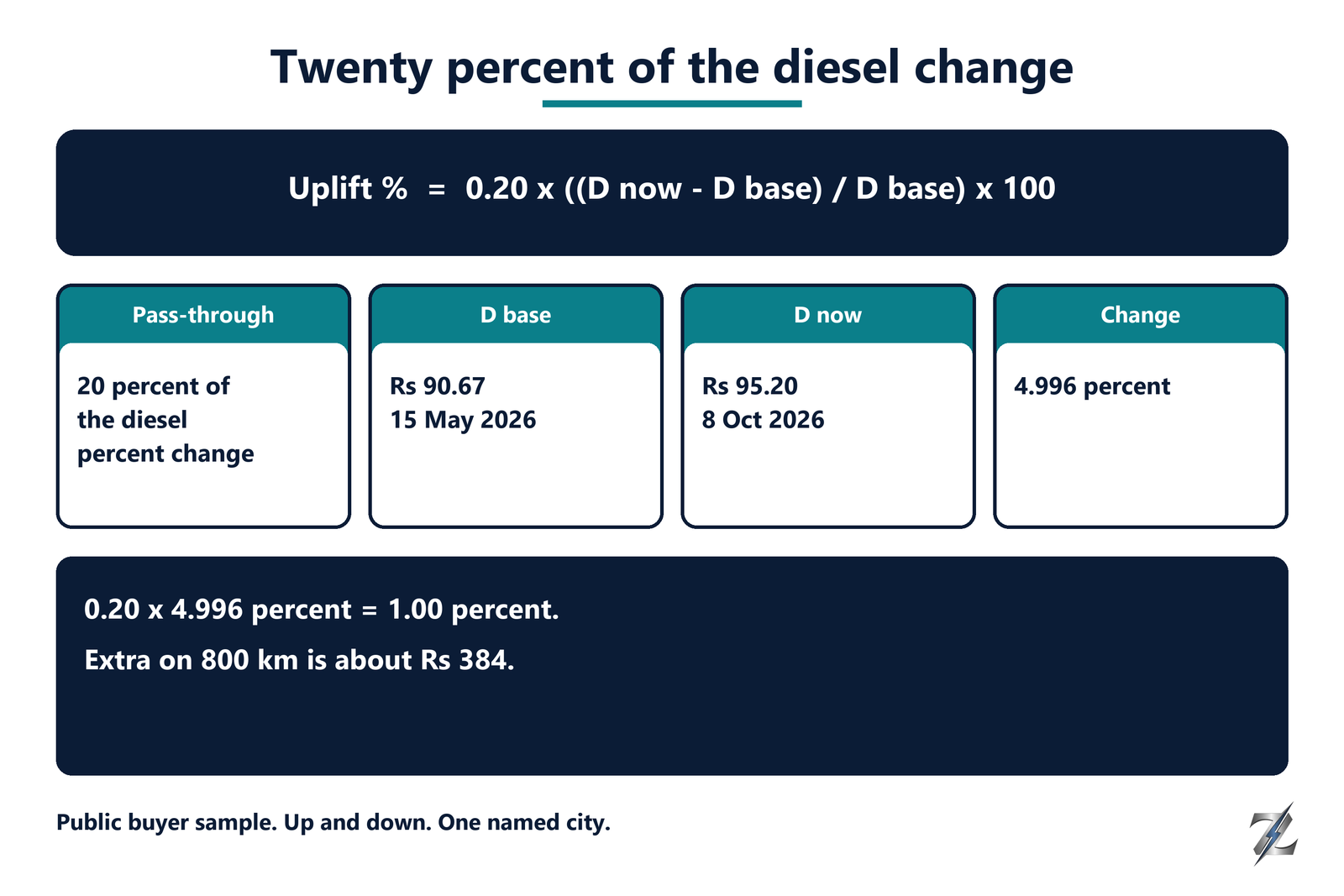
Public BHEL-style samples pass 20% or 30% of the IOCL percent change, up and down, for one named city.
Constant
Formula 1: ₹ per litre
0.65, or a negotiated 0.40 to 0.50
Formula 2: share of percent
S agreed in the contract
Formula 3: 20% of percent
0.20 or 0.30 in the public samples
Delhi +₹4.53
Formula 1: ₹ per litre
2.94% at 0.65
Formula 2: share of percent
2.30% if lane-derived S = 0.46
Formula 3: 20% of percent
1.00% if S = 0.20
Needs a city table?
Formula 1: ₹ per litre
Yes
Formula 2: share of percent
Yes
Formula 3: 20% of percent
Yes. Samples name IOCL.
Main risk
Formula 1: ₹ per litre
Signing 0.65 because a circular said so
Formula 2: share of percent
Setting S from the wrong pie
Formula 3: 20% of percent
Copying 0.20 onto a lane that cannot recover diesel
| Formula 1: ₹ per litre | Formula 2: share of percent | Formula 3: 20% of percent | |
|---|---|---|---|
| Constant | 0.65, or a negotiated 0.40 to 0.50 | S agreed in the contract | 0.20 or 0.30 in the public samples |
| Delhi +₹4.53 | 2.94% at 0.65 | 2.30% if lane-derived S = 0.46 | 1.00% if S = 0.20 |
| Needs a city table? | Yes | Yes | Yes. Samples name IOCL. |
| Main risk | Signing 0.65 because a circular said so | Setting S from the wrong pie | Copying 0.20 onto a lane that cannot recover diesel |
Delhi diesel +₹4.53 from 15 May 2026 (₹90.67) to 8 Oct 2026 (₹95.20).
Formula 1: rupee steps (the AITWA card)
The All India Transporters Welfare Association circular dated 19 May 2026, reported by Moneylife, India Today, and ABP, asked for a fuel adjustment from 20 May 2026. The arithmetic is simple: fuel uplift percent = 0.65 times (diesel now minus diesel base), with diesel in rupees per litre. If the parties adopt that circular, the base is the named city's price on 15 May 2026.
Each extra rupee per litre adds 0.65 percentage points of freight. It does not add 0.65% of the diesel price. India Today's reading of the same circular: plus ₹5 is plus 3.25% freight, plus ₹10 is plus 6.5%, plus ₹15 is about plus 10%. The circular also said the factor comes down if diesel comes down. A clause that only rises is an escalator, not a fuel clause.
This is an association ask, not a statute. ITL Logistics, quoting the association side later, said most customers still accept 0.40 to 0.50 per ₹1, not 0.65. Crisil's ₹5 band of 2.5% to 2.8% is about 0.50 to 0.56 per ₹1. So 0.65 is the opening card. 0.40 to 0.56 is the range a plant can defend with a published source. Write the number you sign. Do not write as per AITWA and hope both sides remember the same circular.
Formula 3: what a large shipper has actually written
Public clause samples used by large buyers (BHEL transporter terms, as collected on Law Insider) do something quieter. Diesel comes from the IOCL website for one named city. The samples use Dehradun. The latest IOCL rate available by the 15th applies from the 16th to the 15th of the next month, on goods receipts in that window. The uplift is 20% of the percent change in diesel in one sample, and 30% in another. Up and down.
A 10% diesel hike with the 20% sample pays 2% extra on basic freight. With the 30% sample it pays 3%. On the Delhi 4.996% move, a 20% pass-through pays about 1.00% of freight. That is far below the AITWA ask. Show it in the negotiation so procurement sees the gap, not only the association headline. Copying 0.20 onto a long lane that burns a lot of diesel will under-recover. Copying 0.65 because a circular said so will overpay if your litres per km are ordinary.
The new rate, whichever formula you pick, is base rate times (1 + fuel uplift percent / 100). Apply it to the base freight line only.
Chapter 04
How to write a fuel adjustment factor clause
Write these as contract sentences, not as a slogan. The template below is a workshop for counsel to edit. It is not a ZAFTYS rate or legal advice.
Copy-ready structure: Basic freight is [₹/km, ₹/MT or ₹/trip] for [vehicle body] on [origin, destination and mandatory via], calculated on [loaded kilometres only / round-trip kilometres]. Base diesel is [high-speed diesel price] for [city] on [base date], from [IOCL or PPAC URL]. On [review day], both sides read the same table. The signed formula is [write it in full]. The factor is [number]. The adjustment moves up and down and applies to trips loaded from [effective day]. A negative adjustment is shown as [a deduction on the same invoice / a credit note within X days]. Toll, detention, tyre, AdBlue, permits and empty kilometres are excluded unless the signed kilometre basis expressly includes them. The source print must be attached by [deadline], or the basic rate remains payable pending resolution.
That paragraph already holds the seven lines. Pull them apart so legal does not bury one.
Base freight: the number, the unit (₹/km, ₹/MT, or ₹/trip), the body type, and the lane, including any mandatory via. One card does not cover a 32 ft truck and a bulker. A tipper and a trailer do not share a diesel burn, so they should not share a factor.
Base diesel: city, high-speed diesel, and a source both sides can open without calling the driver. IOCL retail for one named city is what the public samples use. PPAC daily state prices suit a long lane that refuels in more than one state, weighted by where the litres are bought. The driver's pump slip is a poor base. It is not shared, and it moves with local stock.
Formula: one of the three, written in full, with 0.65 or a negotiated 0.40 to 0.50 or S as a number. Do not write 'as per market' or 'as per AITWA' unless the number is copied into the clause. Direction: up and down. Review cadence: one fixed day each month or quarter.
Trigger: trips whose loading date falls after the review date. Not all open bills since April. A truck that loaded on the 10th does not pick up a price you read on the 15th. Exclusions: toll, tyre, driver bata, detention, ODC permit, and empty kilometres, unless a different clause prices them. Evidence: the diesel print for the review date, attached to the bill. No print, no uplift.
If the lane is stable enough to contract, put the clause on the contract logistics rate card. A dedicated fleet on a repeating lane should not be rebid every diesel headline. That capacity split is explained in the spot versus dedicated guide.
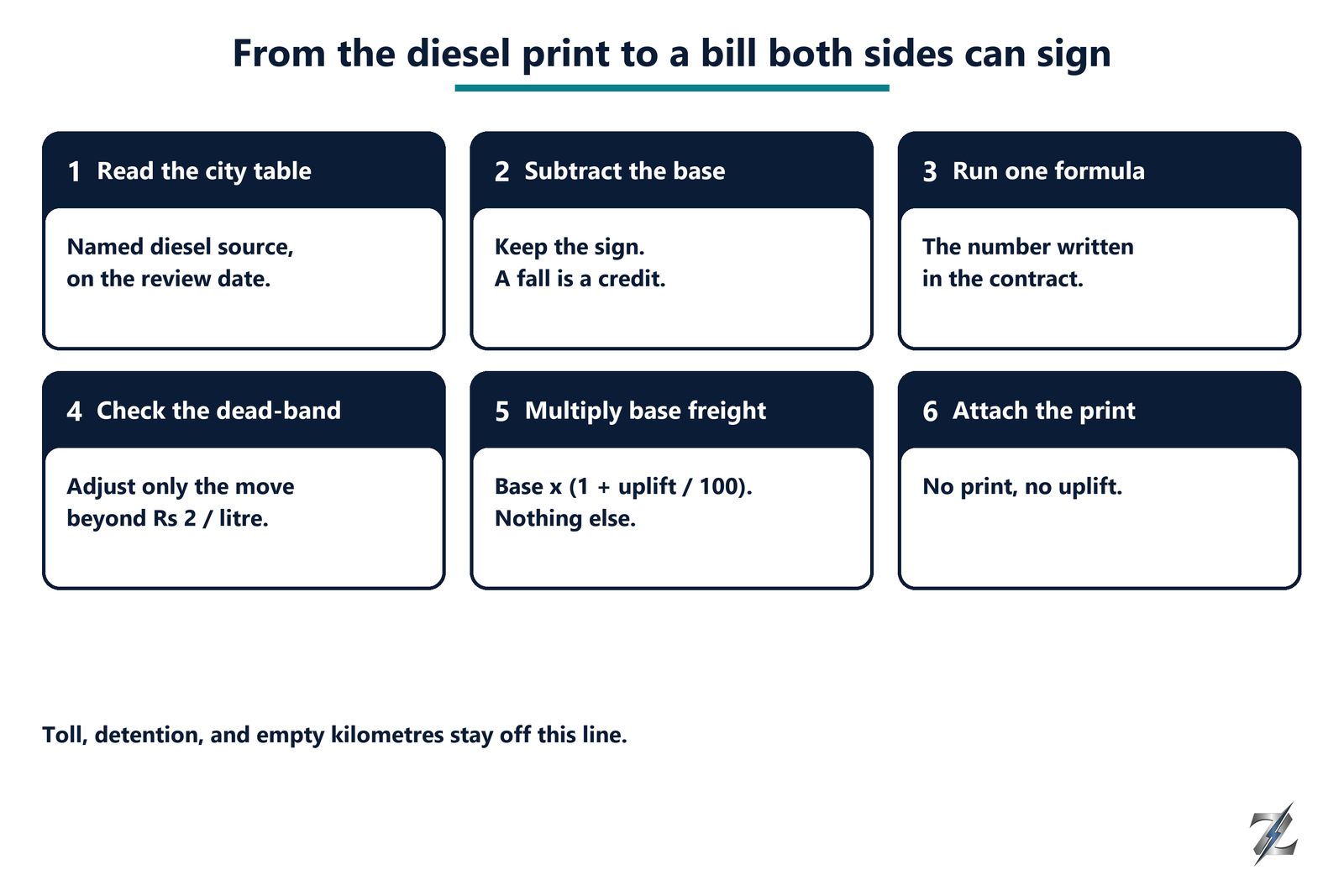
Six checks before the percent touches base freight. Toll, detention, and empty kilometres stay off the line.
- 01
Base freight
The number, the unit (₹/km, ₹/MT, or ₹/trip), the body type, and the lane.
- 02
Base diesel
City, high-speed diesel, the public table both sides will read, and the base date. Not the driver's pump slip.
- 03
One formula
Formula 1, 2, or 3, with the constant written as a number.
- 04
Both directions
Up and down. A floor and a ceiling if finance needs one.
- 05
Trigger and lag
Trips whose loading date falls after the review date. Not every open bill since April.
- 06
Exclusions
Toll, tyre, driver bata, detention, ODC permit, and empty kilometres, unless a different clause prices them.
- 07
Evidence
The diesel print for the review date, attached to the freight bill.
Contract language, not a slogan.
Diesel move
+₹4.53
Eligible movement
+₹2.53
Freight adjustment
+1.1385%
On ₹38,400
about +₹437
Diesel move
+₹1.50
Eligible movement
₹0.00
Freight adjustment
0.00%
On ₹38,400
₹0
Diesel move
-₹4.53
Eligible movement
-₹2.53
Freight adjustment
-1.1385%
On ₹38,400
about -₹437
| Diesel move | Eligible movement | Freight adjustment | On ₹38,400 |
|---|---|---|---|
| +₹4.53 | +₹2.53 | +1.1385% | about +₹437 |
| +₹1.50 | ₹0.00 | 0.00% | ₹0 |
| -₹4.53 | -₹2.53 | -1.1385% | about -₹437 |
Workshop arithmetic. Eligible movement = sign of the move x max(0, absolute move minus ₹2).
Dead-band, cap, rounding and reset rules
A dead-band must not create a cliff. If B is ₹2 per litre, define eligible diesel movement as sign(delta) x max(0, absolute delta minus B). On a +₹4.53 move, only ₹2.53 is eligible. On a -₹4.53 move, the eligible movement is -₹2.53. If the parties instead want the whole movement to apply once the trigger is crossed, say that expressly and accept the jump at the boundary.
Write any cap as a ceiling on the fuel adjustment, not as a vague cap on freight. Example: the monthly fuel adjustment cannot exceed +4% or fall below -4%; any unrecovered balance is reviewed at the next quarterly reset. A cap without a reset shifts cost rather than removing it.
State the rounding rule. A public BHEL rate-contract example uses two decimal places. Also state the non-publication rule: if the review day is a holiday or weekend, or the table is unavailable, use the last published price. Read the next available business-day publication and correct any difference in the next cycle. The contract should name the evidence deadline and a short dispute window.
Choose the rebasing rule explicitly. The workshop keeps one fixed base diesel during the contract term; a monthly review changes the adjustment, not the base. If the parties want monthly rebasing, the clause must say that the current review price becomes next month's base and explain how any cap balance is handled.
At renewal, reset both the basic freight and base diesel to the same date, then restart the formula at zero. Otherwise an old base keeps carrying years of fuel history into a newly negotiated rate.
Chapter 05
Diesel surcharge calculation using Delhi fuel prices
The diesel move is real. The freight rate is a workshop, so we do not invent a corridor quote. Base ₹48 per km. One loaded leg of 800 km. That is ₹38,400 of base freight before any fuel line. Delhi retail diesel was ₹90.67 on 15 May 2026 and ₹95.20 on 8 Oct 2026. Difference ₹4.53. Percent change 4.53 / 90.67 = 4.996%. Hold those two numbers. Every example below uses them. Only the factor changes.
The four-formula comparison below has no dead-band, so the formulas can be compared like for like. The separate dead-band table shows how a ₹2 incremental band changes the invoice.
Example A, the AITWA card. 0.65 times 4.53 = 2.9445%, which we round to 2.94% on the card. New rate is 48 times 1.029445, about ₹49.41 per km. Extra on 800 km is about ₹1,131. That ₹1,131 is the fuel line only. It is not permission to add a second 'market adjustment' on the same bill. The formula card at the top of the previous chapter is this example drawn out.
Example B, the lane-derived share. The workshop diesel cost is ₹22 per km against ₹48 per km of basic freight, so S = 22 / 48 = 0.458, rounded to 0.46. Then 0.46 times 4.996% = 2.30%. Extra on 800 km is about ₹883. Change the vehicle, lane or diesel burn and you must recalculate S.
Example C, the factor many shippers sign. ITLN reported customers on 0.40 to 0.50 rather than 0.65. The midpoint, 0.45, times 4.53 is 2.04%. Extra on 800 km is about ₹783. If your negotiation lands at 0.40, the same trip is about ₹696. At 0.50 it is about ₹870. Write the factor you actually agreed. 'About half a percent per rupee' is how two finance teams reach different bills.
Example D, the 20% pass-through used in public buyer samples. 0.20 times 4.996% = 1.00%. Extra on 800 km is about ₹384. A 30% sample on the same diesel move would be about 1.50%, or about ₹576. That is still well under the AITWA ask. Show both numbers in the room so nobody thinks 20% of the diesel percent means 20% of freight.
Same trucks, same diesel, four bills, and a fifth bar at zero if the contract is silent. The gap from ₹384 to ₹1,131 is the negotiation. It is not a rounding error. In Union of India v Freight Carriers, Gauhati High Court, decided 30 April 2008, (2008) 4 Arb LR 443, the court set aside an escalation award where the fixed-rate contract had no price-escalation clause. The practical lesson is to write the operating rule before the diesel move and have counsel approve it.
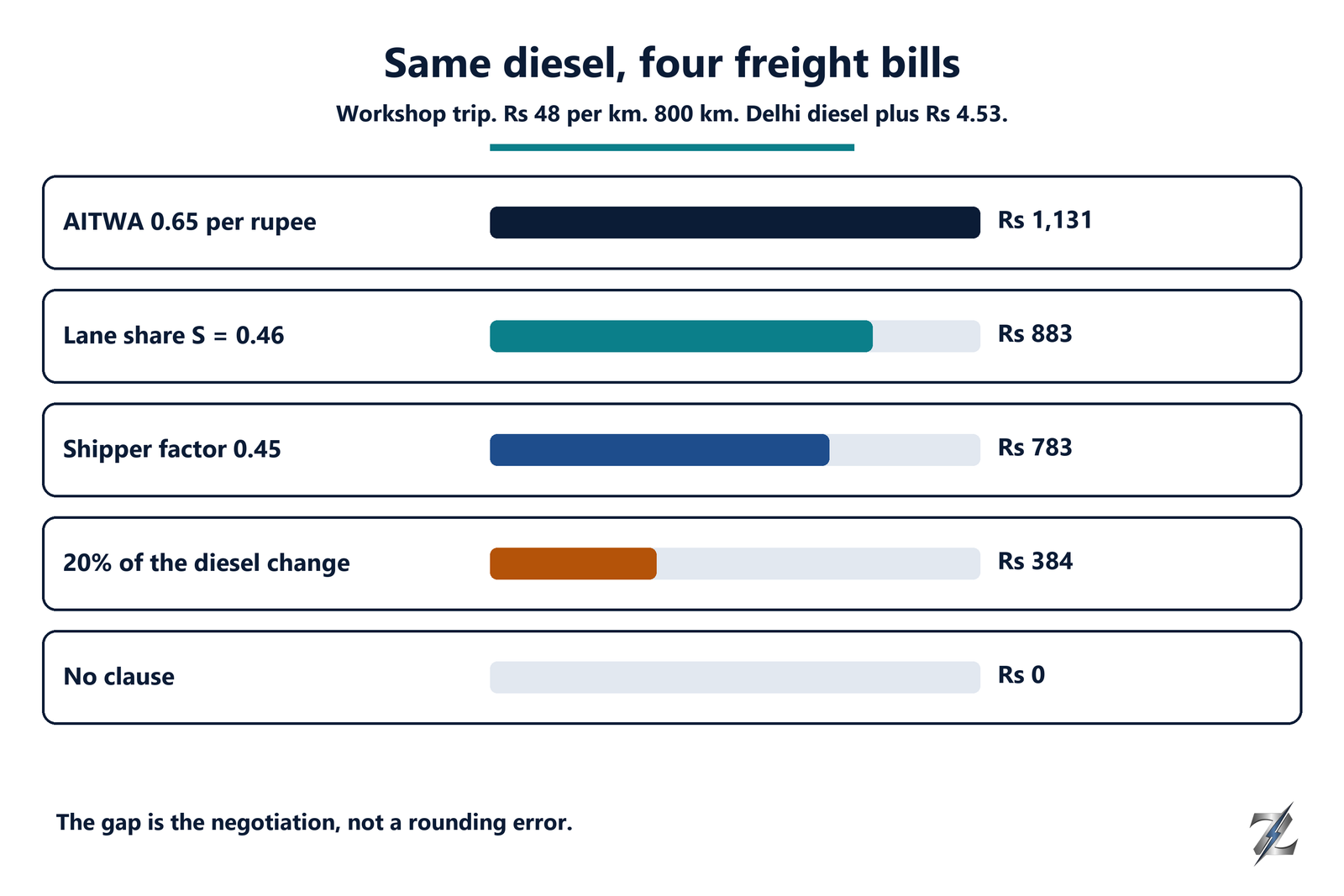
Workshop only: ₹48 per km, 800 km, Delhi diesel +₹4.53 from 15 May 2026 to 8 Oct 2026.
Example
A
Rule
0.65 per ₹1
Uplift
2.94%
Extra on 800 km
about ₹1,131
Example
B
Rule
Lane-derived S = 0.46 of the diesel percent
Uplift
2.30%
Extra on 800 km
about ₹883
Example
C
Rule
0.45 per ₹1 (middle of 0.40 to 0.50)
Uplift
2.04%
Extra on 800 km
about ₹783
Example
D
Rule
20% of the diesel percent
Uplift
1.00%
Extra on 800 km
about ₹384
| Example | Rule | Uplift | Extra on 800 km |
|---|---|---|---|
| A | 0.65 per ₹1 | 2.94% | about ₹1,131 |
| B | Lane-derived S = 0.46 of the diesel percent | 2.30% | about ₹883 |
| C | 0.45 per ₹1 (middle of 0.40 to 0.50) | 2.04% | about ₹783 |
| D | 20% of the diesel percent | 1.00% | about ₹384 |
Workshop: ₹48/km x 800 km. Delhi 4.53 / 90.67 = 4.996%.
01
April 2026 index: 100.5
Down from 101.4 in March. Crisil read that as easier truck supply after the March dispatch peak. It is not a diesel cut.
02
Delhi diesel still +₹4.53
By 8 Oct 2026 the city print was still ₹4.53 above the 15 May base. A flat index does not make that rupee disappear.
03
Two jobs, two tools
Use the index when you rebid the base rate. Use the clause on this quarter's bills. Mixing them is how the better trucks stop coming.
Crisil CRISFrex PDF, May 2026. April 2025 = 100.
The freight index did not cancel the pump
CRISFrex, Crisil's pan-India freight index with April 2025 set to 100, printed 100.5 in April 2026, down from 101.4 in March. Crisil read the dip as more trucks available after the March dispatch rush. That is a soft patch in freight, not a diesel cut.
By 8 Oct 2026, Delhi diesel was still ₹4.53 above the 15 May print. Procurement can use the index when the base rate is rebid. Finance uses the clause on this quarter's bills. The index is flat, so ignore diesel is how the better trucks stop coming.
Crisil's June 2026 note said retail fuel had risen about ₹7.5 per litre since 15 May, with talk of a further move. That is a June macro line. Do not paste ₹7.5 onto the Delhi row for 8 Oct. The contract example uses the city prints above. Prices will move again. The live bill should say as printed on the review date and attach that day's table.
Chapter 06
What the clause must not do
It must not swallow toll. FASTag is a separate, checkable line. The ₹3 to ₹7 per km bench is a teaching range, not your plaza list. Tolls were revised from 1 April 2026. That calendar is not the diesel calendar. What is live at a barrier-free gantry, and what GNSS still is not, sits in the FASTag and MLFF tolling guide.
It must not price empty return. If the lane has a structural empty leg, price it as its own allowance or fix it with a return load. The empty return guide is the place for that.
It must not be a spot-market escalator. Rate will follow the market is not a formula. Spot versus contract is a capacity decision.
It must not reset every WhatsApp. One review rhythm. Monthly is enough for most plant contracts. Daily diesel is a spot product.
It must not cite 65% and 0.65 and 2.8% in the same sentence as if they were one rule. And it must not absorb AdBlue or tyres. Moneylife, reporting the same AITWA note, said diesel exhaust fluid had nearly doubled over two months and tyre prices were up about 5%. Those are real. They are not litres of diesel. A fuel clause that silently absorbs them cannot be audited.
Name the city and the date, or you do not have a base.
India average, whichever pump, and date of agreement (if signature slips) all fail the audit. One city. High-speed diesel. One calendar date.
Up and down, or the peak sticks.
A rise-only clause is an escalator. When diesel falls, the shipper keeps paying the peak unless the base rate is rebid. The AITWA text itself said the factor reduces when diesel moderates.
A soft index and a higher diesel price can share a year.
CRISFrex at 100.5 and Delhi diesel ₹4.53 above the May base are both true. Keep two lines. Do not let one cancel the other.
AITWA's own May note, via Moneylife, listed AdBlue, tyres, and tolls as separate cost moves.
Cost
FASTag toll
Where it belongs
Its own reimbursed line
Why it is not diesel
Plaza rates move on a different calendar (revised from 1 April 2026)
Cost
Tyres
Where it belongs
Maintenance or a separate review
Why it is not diesel
AITWA noted about +5%. That is not a litre of diesel
Cost
AdBlue
Where it belongs
Its own line if you pay it
Why it is not diesel
Moneylife reported it nearly doubling over two months
Cost
Detention
Where it belongs
Gate timestamps
Why it is not diesel
Plant dwell is a yard problem, already covered on the TAT post
Cost
Empty kilometres
Where it belongs
An allowance or a return load
Why it is not diesel
Deadhead is a network problem, not a pump price
| Cost | Where it belongs | Why it is not diesel |
|---|---|---|
| FASTag toll | Its own reimbursed line | Plaza rates move on a different calendar (revised from 1 April 2026) |
| Tyres | Maintenance or a separate review | AITWA noted about +5%. That is not a litre of diesel |
| AdBlue | Its own line if you pay it | Moneylife reported it nearly doubling over two months |
| Detention | Gate timestamps | Plant dwell is a yard problem, already covered on the TAT post |
| Empty kilometres | An allowance or a return load | Deadhead is a network problem, not a pump price |
Site bench for toll is directional (₹3 to ₹7 per km), not your plaza list.
Chapter 07
How settlement uses the clause
The clause fails if it lives only in the legal PDF. On each bill the transporter should show the base rate from the signed card, diesel base and diesel now from the named table, the formula id, the uplift as arithmetic rather than a lump sum, toll from the FASTag statement if you reimburse it, detention from gate timestamps, and a net that is the sum of those lines.
ZAFTYS TMS is where a trip can already collect gate time, weight, and delivery proof. The fuel line belongs on that same trip record so accounts payable does not keep a side spreadsheet. The ePOD and freight-billing guide shows how that evidence reaches settlement. Storing base rate, base diesel, current diesel, and the formula id is an operating choice. It is not a promise that every old workbook will be rewritten.
Freight rate intelligence is the place to look at the base lane, with the limits of that product stated on the page. It is not a national diesel index and it is not a substitute for the clause. Owned fleet, contract fleet, and labeled network overflow keep their labels through the bill. A fuel clause does not turn a partner truck into a company truck.
Base rate
Source
Signed card for that body and laneFuel clause touches it?
Yes. This is the only line the percent multipliesDiesel base and diesel now
Source
Named table, two datesFuel clause touches it?
Yes. EvidenceFormula id
Source
The clause number you actually signedFuel clause touches it?
YesUplift percent
Source
The arithmetic, not a lump sumFuel clause touches it?
YesToll
Source
FASTag statement, if reimbursedFuel clause touches it?
NoDetention
Source
Gate timestampsFuel clause touches it?
NoNet
Source
Sum of linesFuel clause touches it?
The fuel rupee is visible inside the netIf the line is missing, accounts payable will invent a lump sum.
01
Procurement
Owns the words: city, date, formula, exclusions.
02
Dispatch
Owns the loading date that decides which rate applies.
03
Finance
Owns the bill test. No print, no uplift.
04
Trip record
Base rate, base diesel, current diesel, and formula id sit on the same trip as weight and POD.
A PDF that only legal can find will not be used on bill day.
Chapter 08
Nineteen checks before you sign
Score the draft in the room with procurement, finance, and dispatch. Sixteen to nineteen, and the clause can go to legal. Under ten, you still have a rate argument waiting for the next diesel headline.
The checks cover the commercial base and distance basis, one formula, both directions and credit handling, incremental dead-band mechanics, cap and floor, rounding, review rhythm, holiday or missing-publication fallback, fixed or monthly rebasing, loading-date rule, exclusions, evidence and dispute timing, renewal reset, and the trip's own, contract, or overflow label.
A fuel clause is a small piece of arithmetic with a city, a date, and one formula. Plants that skip it do not save the diesel money. They pay it later inside a fatter base rate, with nothing to audit. If the lane is stable enough to contract, write the clause before the next diesel move, and keep toll, detention, and empty kilometres on their own lines. Start from contract logistics.
#
1
Check
Unit and distance basis
Pass looks like
₹/km, ₹/MT, or ₹/trip, plus loaded-only or round-trip kilometres
#
2
Check
Body
Pass looks like
32 ft, trailer, bulker, or tipper named. One card does not cover all
#
3
Check
Lane
Pass looks like
Origin, destination, and any mandatory via
#
4
Check
Diesel city
Pass looks like
One city, not India average
#
5
Check
Diesel source
Pass looks like
A table both sides can open without calling the driver
#
6
Check
Base date
Pass looks like
A calendar date, filled in
#
7
Check
One formula
Pass looks like
Formula 1, 2, or 3. Not two of them added together
#
8
Check
Constant written
Pass looks like
0.65, a negotiated 0.40 to 0.50, or the share S, as a number
#
9
Check
Both directions
Pass looks like
Down moves become an invoice deduction or a credit note by a named deadline
#
10
Check
Dead-band
Pass looks like
The contract says whether only the movement beyond the band is eligible
#
11
Check
Cap and floor
Pass looks like
A signed ceiling, floor, and treatment of any unrecovered balance
#
12
Check
Rounding
Pass looks like
Price, percent, and rate precision written in advance
#
13
Check
Review rhythm
Pass looks like
Monthly or quarterly, one rhythm
#
14
Check
Holiday or missing print
Pass looks like
Last published price, then next-business-day correction in the next cycle
#
15
Check
Effective trips
Pass looks like
Loading date rule, not retroactive on delivered trips
#
16
Check
Exclusions listed
Pass looks like
Toll, detention, empty km, permits
#
17
Check
Evidence and dispute
Pass looks like
Print deadline and a short challenge window
#
18
Check
Rebasing and renewal
Pass looks like
Fixed or monthly base rule stated; freight and diesel reset together at renewal
#
19
Check
Label
Pass looks like
Own, contract, or overflow still named on the trip
| # | Check | Pass looks like |
|---|---|---|
| 1 | Unit and distance basis | ₹/km, ₹/MT, or ₹/trip, plus loaded-only or round-trip kilometres |
| 2 | Body | 32 ft, trailer, bulker, or tipper named. One card does not cover all |
| 3 | Lane | Origin, destination, and any mandatory via |
| 4 | Diesel city | One city, not India average |
| 5 | Diesel source | A table both sides can open without calling the driver |
| 6 | Base date | A calendar date, filled in |
| 7 | One formula | Formula 1, 2, or 3. Not two of them added together |
| 8 | Constant written | 0.65, a negotiated 0.40 to 0.50, or the share S, as a number |
| 9 | Both directions | Down moves become an invoice deduction or a credit note by a named deadline |
| 10 | Dead-band | The contract says whether only the movement beyond the band is eligible |
| 11 | Cap and floor | A signed ceiling, floor, and treatment of any unrecovered balance |
| 12 | Rounding | Price, percent, and rate precision written in advance |
| 13 | Review rhythm | Monthly or quarterly, one rhythm |
| 14 | Holiday or missing print | Last published price, then next-business-day correction in the next cycle |
| 15 | Effective trips | Loading date rule, not retroactive on delivered trips |
| 16 | Exclusions listed | Toll, detention, empty km, permits |
| 17 | Evidence and dispute | Print deadline and a short challenge window |
| 18 | Rebasing and renewal | Fixed or monthly base rule stated; freight and diesel reset together at renewal |
| 19 | Label | Own, contract, or overflow still named on the trip |
Plain checklist. Not a new scorecard group.
Appendix
Frequently asked questions
What is a diesel surcharge on an Indian freight contract?
A written rule that changes only the basic freight when a named diesel price moves against a named base. A diesel surcharge on freight charges is not a new spot rate, a toll claim, or permission to reopen every cost line.
What is a fuel adjustment factor on Indian freight?
A fuel adjustment factor (FAF) is the percent applied to base freight when diesel moves against a named base. The AITWA circular of 19 May 2026 asked for 0.65% of freight per ₹1 of diesel above the 15 May 2026 price, from 20 May 2026, and said the factor should fall if diesel falls. A contract may copy that arithmetic. It does not apply itself.
Is the AITWA 0.65% rule the law?
No. It was reported in May 2026 as an association proposal tied to the 15 May 2026 diesel base. Plant legal still has to write the number into the contract. Trade reporting says many shippers sign 0.40 to 0.50 per ₹1 instead of 0.65.
How much does a diesel rise add to truck freight?
On the AITWA card, each ₹1 per litre is 0.65% of freight, so ₹5 is 3.25%. From 15 May to 8 Oct 2026, Delhi diesel rose ₹4.53 (₹90.67 to ₹95.20). On a workshop ₹48/km and 800 km, that is about ₹1,131 at 0.65, about ₹883 with a lane-derived diesel share of 0.46, and about ₹384 if the clause passes 20% of the diesel percentage change.
How should a dead-band work in a diesel surcharge clause?
An incremental dead-band avoids a cliff. With a ₹2 band, eligible movement is the signed amount beyond ₹2. A +₹4.53 move leaves +₹2.53 eligible; a -₹4.53 move leaves -₹2.53. At 0.45 percentage points per rupee, either direction changes ₹38,400 of basic freight by about ₹437. The contract should say whether a negative amount is deducted on the invoice or issued as a credit note.
Should a diesel escalation clause go up and down?
Yes. A rise-only clause is an escalator. When diesel falls, the shipper keeps paying the peak unless the base rate is rebid. The AITWA text itself said the factor reduces when diesel moderates.
Does a falling freight index cancel the diesel surcharge?
No. CRISFrex was 100.5 in April 2026 (April 2025 = 100), down from 101.4 in March. That describes how easy trucks were to hire. The clause describes diesel versus the contract base. Rebid the base when the index is your evidence. Apply the clause to current bills.
Where do tolls go if diesel is in the contract?
On a FASTag line. Not inside the fuel percent. Tyres, AdBlue, detention, and empty kilometres also stay off the fuel line.
Does a diesel clause apply to spot bookings?
A one-week spot buy is usually an all-in number. The clause matters on contract volume that lives longer than a diesel move. See the spot versus dedicated guide for which volume belongs on contract.
What diesel price should a price variation clause use?
Use one city, high-speed diesel and one published table. Public plant contracts often use the Indian Oil price page for a named city, read on a fixed day. Long lanes can use the PPAC metro or state tables, with the weighting written in the contract. Do not use the driver's pump slip.
Can ZAFTYS TMS calculate the diesel uplift?
The useful version stores base rate, base diesel, current diesel, and the formula id on the trip, then shows the uplift as its own bill line. That is an operating choice on ZAFTYS TMS, not a promise that every old spreadsheet will be rewritten.
Who should own the diesel clause inside the plant?
Procurement owns the words. Finance owns the bill test. Dispatch owns the loading date that decides which rate applies. If only legal has the PDF, the clause will not be used.
What happens if the freight contract has no diesel clause?
A general bill-adjustment line may not rescue an omitted escalation term. In Union of India v Freight Carriers, Gauhati High Court, decided 30 April 2008, (2008) 4 Arb LR 443, the court set aside an escalation award under a fixed-rate contract with no price-escalation clause. Have counsel review the wording for your contract.
Sources
References and data sources
Public sources below are for orientation. They are not ZAFTYS audited financials. Read the originals before a number goes into a board pack.
- [1]Moneylife, 21 May 2026, India Today, and the AITWA follow-up chart: circular dated 19 May 2026, FAF from 20 May, 0.65% freight per ₹1 diesel above the 15 May base, about 65% running cost, and a downward adjustment when diesel falls.
- [2]Crisil Intelligence, Crisil freight index dips in April (PDF, May 2026): CRISFrex 100.5 in April 2026 and 101.4 in March, base April 2025 = 100. Fuel nearly 50% to 60% of operating expenses; about 2.5% to 2.8% freight per ₹5/litre to hold margin.
- [3]Crisil, From pumps to prices and energy-shock report (June 2026): NCAER fuel share about 42% of road-transport cost; road about 71% of freight movement; freight transport about 54% of logistics cost.
- [4]Official price tables: Indian Oil petrol and diesel prices and PPAC metro-city history. Dated snapshots: Economic Times, 15 May 2026 and Moneycontrol, 8 Oct 2026.
- [5]ITLN, Rising fuel costs reshape India's logistics economics and freight: customers were still using a 0.40 to 0.50 factor rather than the AITWA proposal of 0.65.
- [6]BHEL rate-contract PDF: an original public example using IOCL rates, monthly review, vehicle-specific per-km PVC and two-decimal rounding. Separate archived BHEL-attributed samples on Law Insider show 20% or 30% of the diesel-price percentage change, both up and down.
- [7]Union of India v Freight Carriers, Gauhati High Court, decided 30 April 2008, (2008) 4 Arb LR 443: the court set aside an escalation award where the fixed-rate contract had no price-escalation clause.
Related reading