Chapter 01
Three toll systems, and only one of them is the national default
A plant desk can hear three toll stories in one week. The transporter says the boom is gone. A circular says satellites will charge by the kilometre. Finance still has a FASTag statement with a plaza name and a rupee. Those are not the same system.
This is an operating guide, not legal advice. Use it to read a bill and a contract. Have counsel check any sentence you want to paste into a rate card, especially anything that mentions the 20 km rule.
On 8 Oct 2026 the national collection rail is still FASTag. The Press Information Bureau said on 22 July 2026 that more than 98% of user fee is collected that way. The Lok Sabha was told on 30 July 2026 that about 6.23 crore FASTags were active in June 2026. A debit runs through the plaza's toll software, the acquirer bank, NPCI as the central clearing house, and the issuer bank. If a bill cannot name that debit, it is not an electronic toll. It is an allowance.
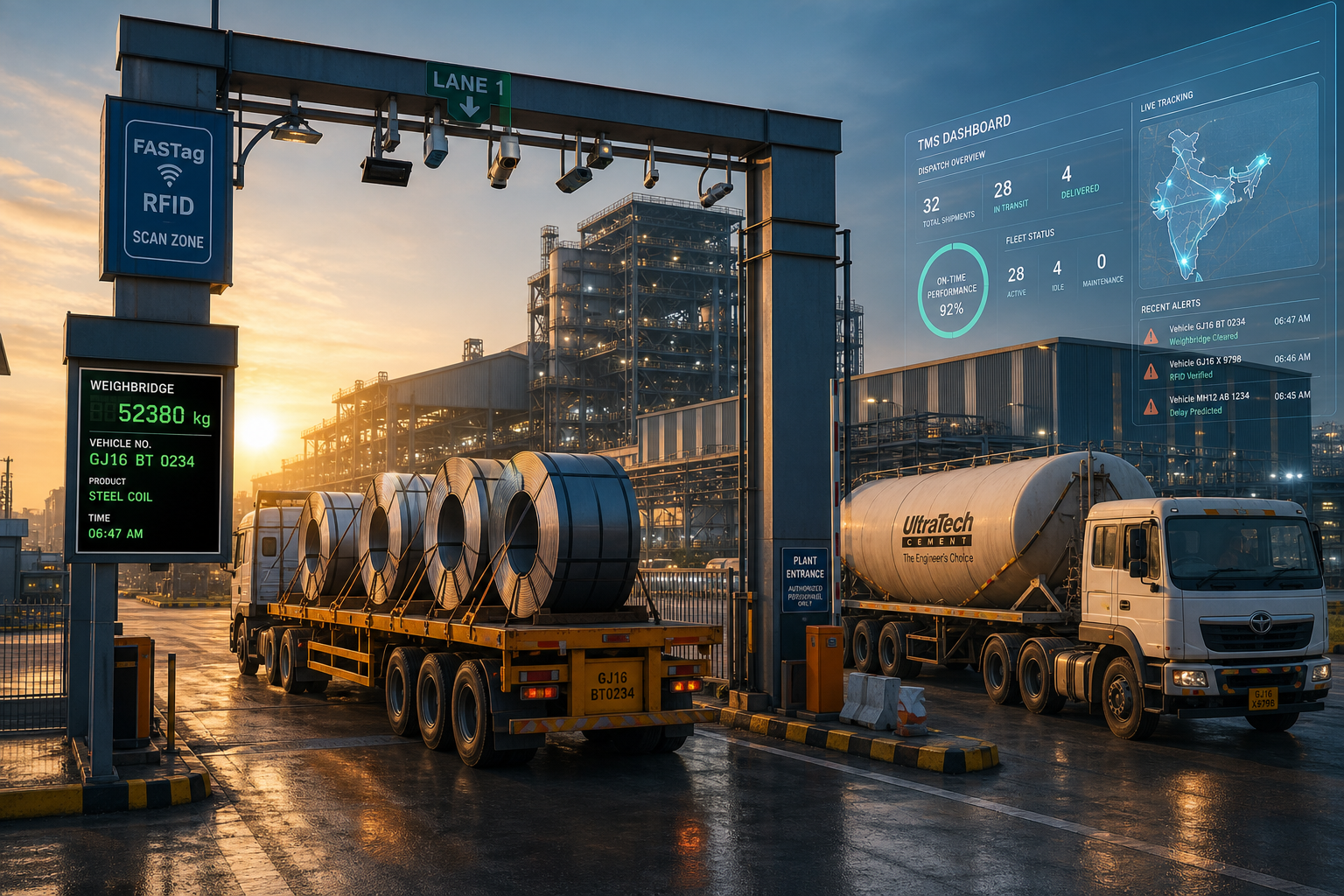
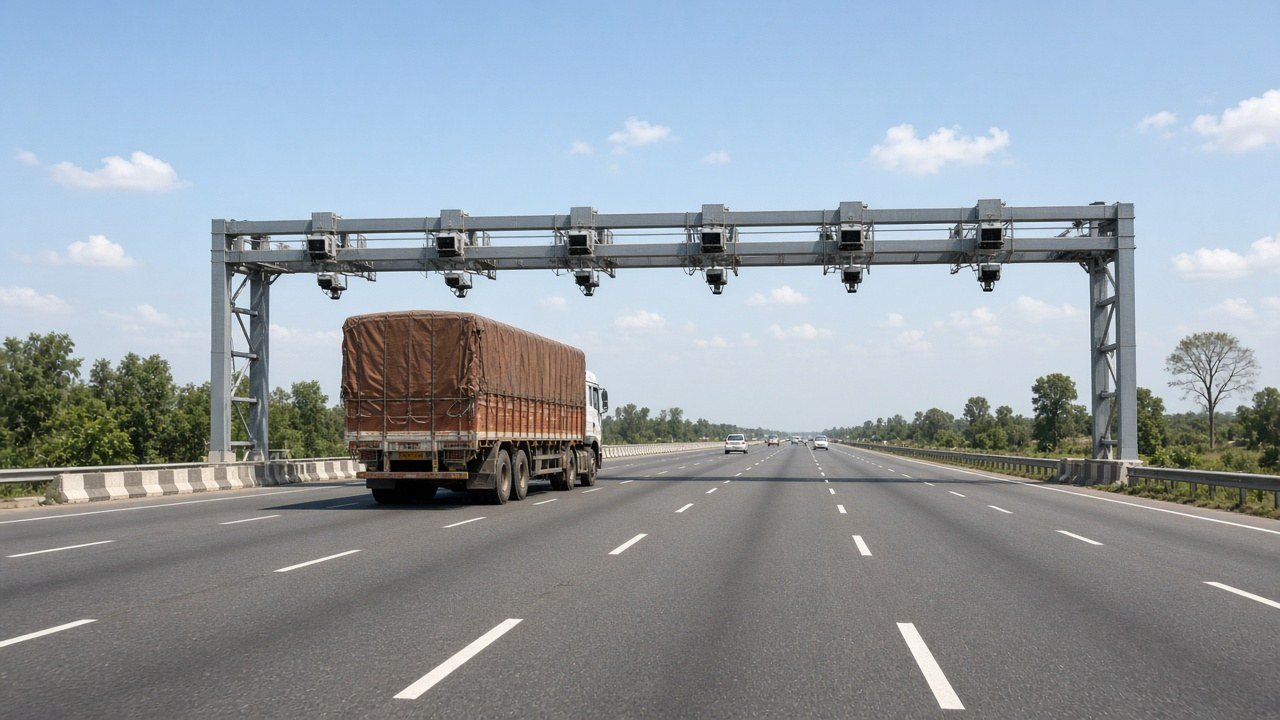
Barrier-free multi-lane free flow is the change that NHAI and IHMCL are actually switching on. A gantry reads the tag and the number plate. The truck is not required to stop, slow down, or hold a lane. The fee is still the FASTag fee for that plaza. It is not a new per-kilometre law.
GNSS, the satellite distance system, was written into the National Highways Fee Rules in September 2024. In July 2026 the same ministry said expert committees want more work on security, privacy, breach, and operational control, and that there is no timeline to replace plazas with it. Treat GNSS as a rule you should be able to read. Do not treat it as the bill you are paying this month.
One exclusion belongs in the first screen. The FASTag annual pass, ₹3,075 for 2026-27, is for non-commercial cars, jeeps, and vans. It covers one year or 200 national-highway plaza crossings, whichever comes first. By June 2026 more than 77 lakh passes had been issued. It does not cover a goods trailer. If a lane proposal leans on that pass, send it back.
June 2024
A hybrid is designed
NHAI and IHMCL describe FASTag lanes beside GNSS lanes, and an AIS-140 unit as the proposed device. This is a concept, not a fitment order.
10 Sep 2024
The distance rule is written
The fee-rule amendment, as reported, sets a 20 km zero for some vehicles and a double fee in an earmarked GNSS lane. It does not switch the country over.
15 Aug 2025
The car pass starts
The ₹3,075 FASTag annual pass is for non-commercial cars, jeeps, and vans. It does not cover a goods trailer.
22 Jul 2026
FASTag is still the rail
PIB says more than 98% of user fee is collected through FASTag, and that GPS tolling stays under deliberation.
30 Jul 2026
Parliament names the limit
About 6.23 crore active tags in June 2026. MLFF is live at five plazas. There is no timeline to replace plazas with GNSS.
1 Oct 2026
The live gantry list widens
PIB names a wider barrier-free set, including Shahjahanpur and Paranur. The debit is still FASTag.
NHAI and IHMCL, June 2024. Fee-rule reporting, September 2024. PIB, 22 July 2026 and 1 October 2026. Lok Sabha reply, 30 July 2026.
More than 98% through FASTag
PIB reports that more than 98% of national-highway user fee is collected through FASTag. That establishes the live system. It does not publish a precise split for the small remainder.
PIB, 22 July 2026. No unpublished remainder is inferred.
01
Plaza software
The gantry or the barrier plaza records the tag, the class, and the time.
02
Acquirer bank
The plaza's bank takes the debit into the clearing path.
03
NPCI
The central clearing house moves the user fee.
04
Issuer bank
The tag issuer posts the rupee the freight bill should match.
PIB, 22 July 2026. If a bill cannot name this path, it is an allowance, not an electronic toll.
System
FASTag at a barrier plaza
State
National default
What the truck pays
The notified fee for that plaza and vehicle class
System
MLFF gantry
State
Live at a named list, not every plaza
What the truck pays
The same FASTag fee, without a required stop
System
GNSS distance billing
State
Rule written in 2024. No replacement timeline
What the truck pays
Actual kilometres, only if that section is operating as GNSS
| System | State | What the truck pays |
|---|---|---|
| FASTag at a barrier plaza | National default | The notified fee for that plaza and vehicle class |
| MLFF gantry | Live at a named list, not every plaza | The same FASTag fee, without a required stop |
| GNSS distance billing | Rule written in 2024. No replacement timeline | Actual kilometres, only if that section is operating as GNSS |
PIB, 22 July 2026 and 1 October 2026. Lok Sabha reply, 30 July 2026.
The boom can go. The section fee can stay.
MLFF is a gantry with RFID readers and number-plate cameras. It still debits FASTag.
The car pass is not a truck product.
The ₹3,075 annual pass is for non-commercial cars, jeeps, and vans. It does not cover a trailer.
Satellite billing has no switch-on date.
Expert committees asked for more work on security, privacy, breach, and operational control.
Checked 8 Oct 2026. Not a ZAFTYS toll index.
Chapter 02
Why a four kilometre hop can still pay for sixty
The argument usually starts with a short diversion. The truck used a few kilometres of a national highway and the statement shows the full plaza fee. That can be correct under today's rules. It feels wrong because the fee is for a section, not for a metre of asphalt.
The 2008 fee rules, as the 30 July 2026 reply restated them, say another plaza is not normally established within 60 km on the same section in the same direction. The authority can allow a closer plaza if it records the reasons. The 60 km figure is a spacing rule. It is not a measured queue, and it is not a promise that every truck stops every hour.
Hold one teaching rate so the shape is visible. It is not a 2026 multi-axle tariff. Call the rate R, ₹4.50 per km. Call the notified section 60 km. The section fee is 4.50 times 60, which is ₹270. A truck that uses 4 km of that section and a truck that uses all 60 km can both be charged ₹270 at the open plaza. An MLFF gantry at the same plaza can still charge ₹270. The boom is gone. The section is not.
A closed expressway that already charges from entry to exit is a different product. Do not force that corridor into the ₹270 example. Read the fee notification for the section you actually use.
This is also why the diesel clause must leave toll alone. The visual uses one clearly labelled teaching stack: diesel ₹22, toll ₹5, and tyre ₹4.50 per km. It does not claim a national toll share. Detention and the weighbridge stay in the hidden cost leaks guide. The diesel surcharge guide carries the wider workshop band and keeps the toll rupee on its own line.
- Diesel · 70%
- Toll · 16%
- Tyre · 14%
Teaching stack only: diesel ₹22, toll ₹5, tyre ₹4.50. Those three lines sum to ₹31.50. Shares round to 70, 16, and 14. Not an NHAI tariff.
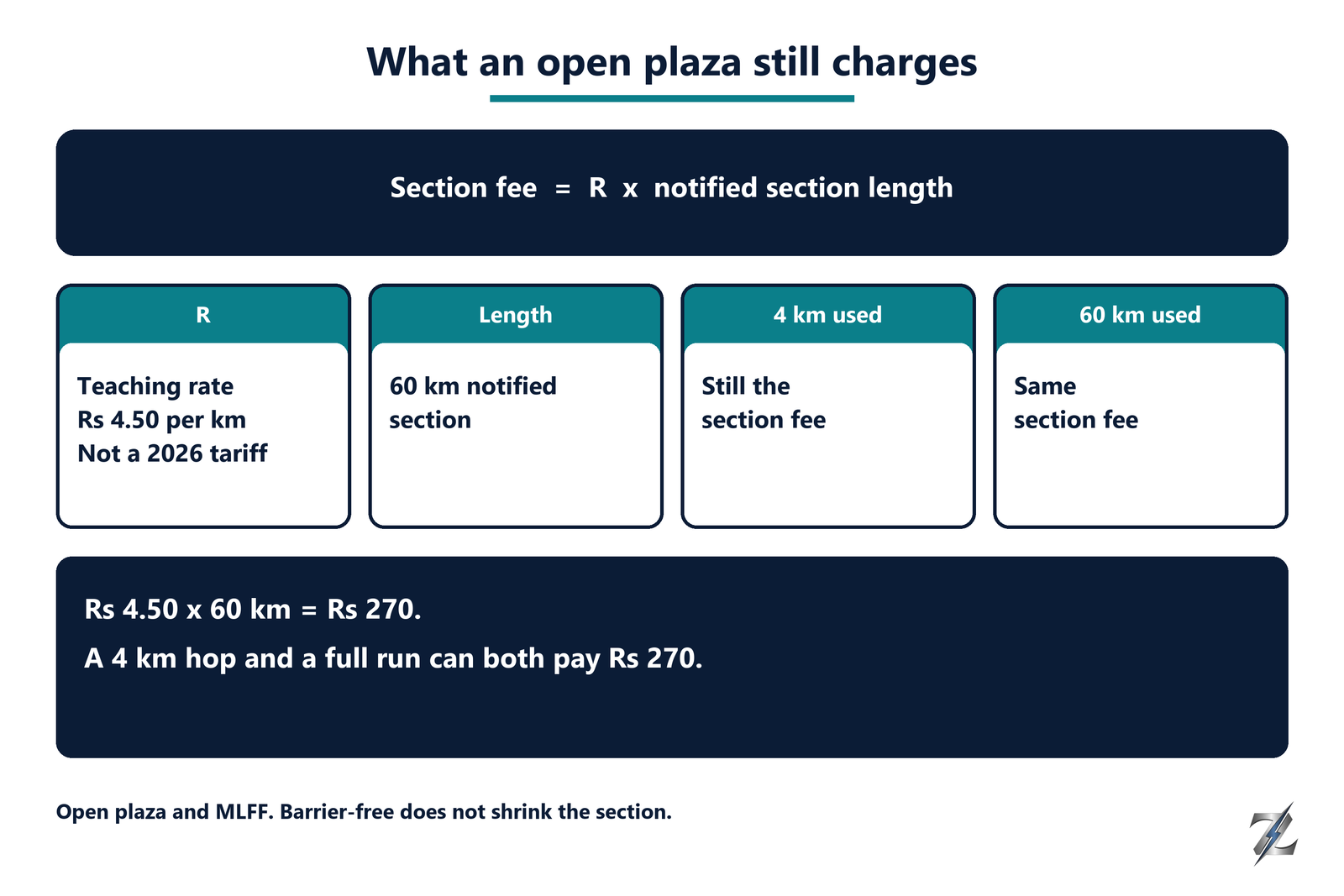
Workshop rate only: ₹4.50 per km and a 60 km section. Not a 2026 multi-axle tariff.
Use of the 60 km section
4 km
Open plaza or MLFF
₹270
Why
The plaza stands for the notified section
Use of the 60 km section
60 km
Open plaza or MLFF
₹270
Why
The same section fee
| Use of the 60 km section | Open plaza or MLFF | Why |
|---|---|---|
| 4 km | ₹270 | The plaza stands for the notified section |
| 60 km | ₹270 | The same section fee |
Rule 8(2) of the 2008 fee rules, as stated in the 30 July 2026 Lok Sabha reply: another plaza is not normally set within 60 km on the same section in the same direction.
Chapter 03
Distance-based tolling: the GNSS rule, and who the 20 km waiver misses
The 2024 amendment is the sentence people quote when they say India has moved to pay-per-kilometre. Read the whole sentence. It applies under a GNSS user-fee system. In October 2026 that system is not the national operating bill.
As reported from the notification, a mechanical vehicle that is not a national permit vehicle gets zero user fee for up to 20 km of journey in each direction in a day on the same section. If the distance is more than 20 km, the fee follows the actual distance. A national permit vehicle is outside that zero. Most interstate plant trucks are national permit vehicles. The waiver is the wrong prize to put in a freight negotiation.
On the same workshop rate, write it this way, and only with the label that the section is actually operating as GNSS. A national permit truck pays R times the actual kilometres. Four kilometres is ₹18. Sixty kilometres is ₹270, the same as the old section fee if the whole section is used. Another mechanical vehicle pays R times the kilometres above 20. Four kilometres is ₹0. Twenty-five kilometres is ₹22.50. Sixty kilometres is ₹180.
The 20 km is not a national daily free slab. It is per direction, per day, on that section. Confirm the gazette, listed in later amendment chains as G.S.R. 556(E) dated 9 September 2024, before a contract copies the number. Indian Express and The Hindu reported the rule on 10 September 2024. The Express report also said the tender for free-flow GNSS lanes had not been finalised.
The same reported rule says a lane may be kept for a vehicle with a valid GNSS on-board unit. A vehicle that enters it without one pays two times the user fee at that plaza. On this workshop section that is ₹540. It is not a new criminal schedule, and it does not apply at a plaza that has no such lane. Do not invent a blacklist fine for a disconnected tracker. The failure mode that exists now is a FASTag with no balance, a dead tag, or the wrong vehicle class.
- Open plaza or MLFF270 ₹
- GNSS, national permit18 ₹
- GNSS, other vehicle0 ₹
Teaching rate ₹4.50 per km. National permit pays actual km. Another vehicle can deduct 20 km. Open plaza and MLFF stay on the section fee.
- Open plaza or MLFF270 ₹
- GNSS, national permit270 ₹
- GNSS, other vehicle180 ₹
Workshop only. A national permit truck pays the full ₹270. Another vehicle pays ₹180 after the 20 km zero.
- Section fee270 ₹
- Twice, wrong lane540 ₹
Reported 2024 rule: a vehicle without a valid GNSS unit that enters an earmarked GNSS lane pays twice the user fee. Workshop section fee ₹270, so twice is ₹540. It does not apply at a plaza with no such lane.
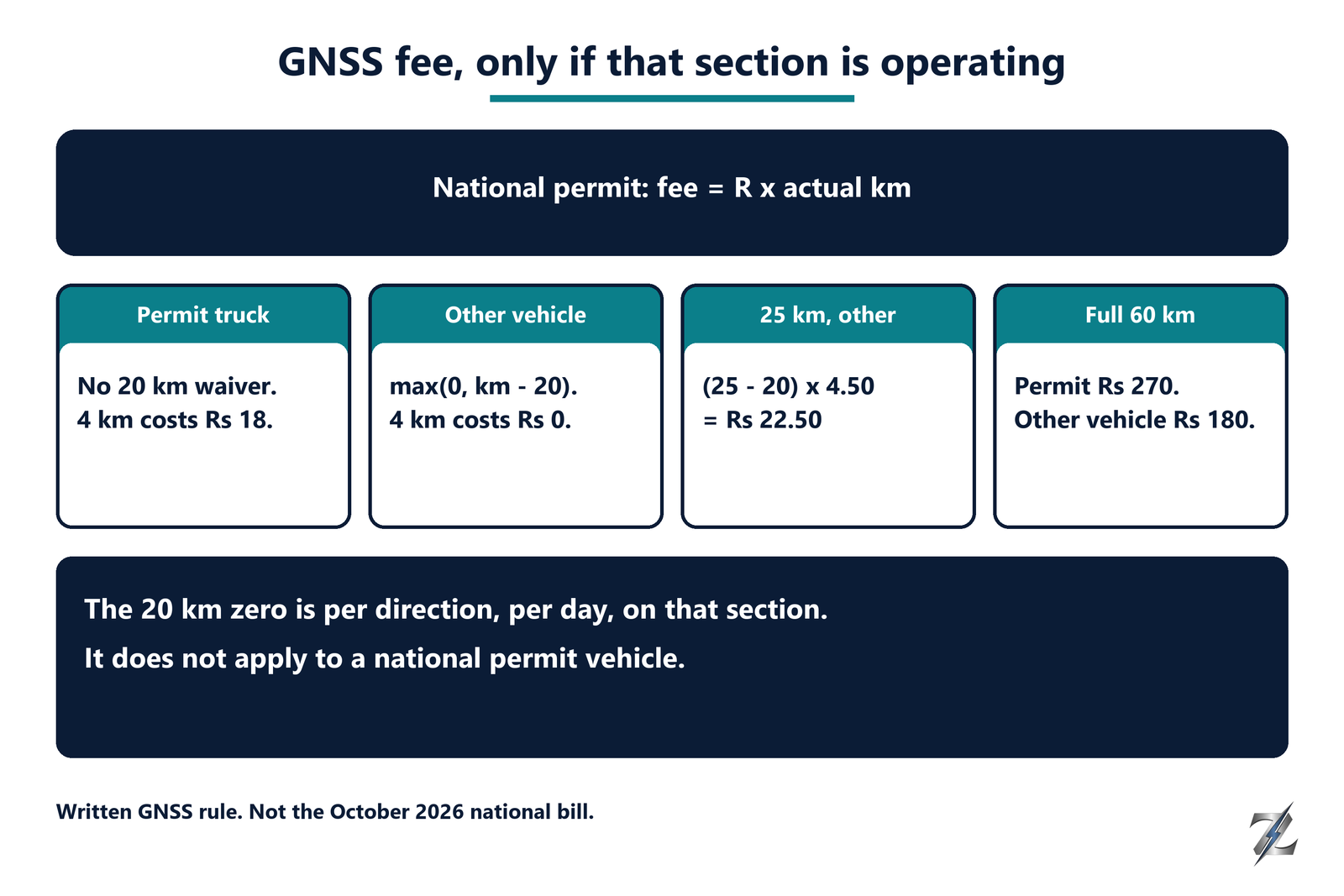
2024 fee-rule amendment, as reported. ₹4.50 per km is a teaching rate.
Distance used
4 km
Open plaza or MLFF
₹270
GNSS, national permit
₹18
GNSS, other vehicle
₹0
Distance used
25 km
Open plaza or MLFF
₹270
GNSS, national permit
₹112.50
GNSS, other vehicle
₹22.50
Distance used
60 km
Open plaza or MLFF
₹270
GNSS, national permit
₹270
GNSS, other vehicle
₹180
| Distance used | Open plaza or MLFF | GNSS, national permit | GNSS, other vehicle |
|---|---|---|---|
| 4 km | ₹270 | ₹18 | ₹0 |
| 25 km | ₹270 | ₹112.50 | ₹22.50 |
| 60 km | ₹270 | ₹270 | ₹180 |
Open plaza and MLFF use the section fee. GNSS columns apply only on an operating GNSS section.
Chapter 04
Barrier-free MLFF plazas: what changes on the road
On 30 July 2026 the government said MLFF had been awarded at 17 plazas and was live at five: Choryasi on NH-48 in Gujarat, Mundka on UER-II in Delhi, Gharaunda on NH-44 in Haryana, and Manoharpura and Daulatpura on NH-48 in Rajasthan. Another 104 plazas had been identified. That is a phased list, not a national switch-off.
The 1 October 2026 release then names a wider live set. It adds Shahjahanpur on the Delhi to Jaipur section and Paranur on the Tambaram to Tindivanam section in Tamil Nadu, and it still names Chorayasi, Mundka, Daulatpura, Manoharpura, and Gharaunda. The July annex had listed Paranur against NH-45. The October note says NH-179B. Cite the date of the note you are using. Do not freeze either highway number into a contract.
What the driver feels is the missing stop. What finance should feel is the same debit, plus a new way to miss it. The October note tells users to keep a working FASTag with enough balance so the pass does not become an electronic notice. There may be no booth where a low balance can be repaired in cash.
Do not turn that into a saved-minute or saved-litre claim. The ministry says the aim is less congestion, less fuel, and less delay. It does not publish a litre per stop or a minute per 500 km. A queue that was never there cannot be saved. A queue that was there is a local measurement, not a national constant.
e-Way Bill validity does not grow because the truck kept its speed. A gantry is not a new expiry law. Vehicle class still matters twice: once for the toll debit, and once for the legal weight in the axle and GVW guide.
- Live5 plazas
- Awarded17 plazas
- Identified104 plazas
Lok Sabha unstarred question 2017, answered 30 July 2026. Five live, 17 awarded, 104 identified. Not a national switch-off of booms.
Plaza
Choryasi / Chorayasi
Place named in the releases
NH-48, Gujarat
Collection
FASTag, barrier-free
Plaza
Mundka
Place named in the releases
UER-II, Delhi
Collection
FASTag, barrier-free
Plaza
Gharaunda
Place named in the releases
NH-44, Haryana
Collection
FASTag, barrier-free
Plaza
Daulatpura
Place named in the releases
NH-48, Rajasthan
Collection
FASTag, barrier-free
Plaza
Manoharpura
Place named in the releases
NH-48, Rajasthan
Collection
FASTag, barrier-free
Plaza
Shahjahanpur
Place named in the releases
NH-48, Rajasthan, in the October release
Collection
FASTag, barrier-free
Plaza
Paranur
Place named in the releases
Tambaram to Tindivanam, Tamil Nadu
Collection
FASTag, barrier-free
| Plaza | Place named in the releases | Collection |
|---|---|---|
| Choryasi / Chorayasi | NH-48, Gujarat | FASTag, barrier-free |
| Mundka | UER-II, Delhi | FASTag, barrier-free |
| Gharaunda | NH-44, Haryana | FASTag, barrier-free |
| Daulatpura | NH-48, Rajasthan | FASTag, barrier-free |
| Manoharpura | NH-48, Rajasthan | FASTag, barrier-free |
| Shahjahanpur | NH-48, Rajasthan, in the October release | FASTag, barrier-free |
| Paranur | Tambaram to Tindivanam, Tamil Nadu | FASTag, barrier-free |
PIB release 2317639. The 30 July reply had named five as live and had not yet included Shahjahanpur or Paranur. Re-check before calling a later plaza live.
01
Class before the gantry
A wrong vehicle class is still a wrong debit. There may be no window where someone can argue it.
02
Balance for the whole lane
A low FASTag balance can become an electronic notice after the truck has passed.
03
Mixed lanes stay mixed
One trip can still see a barrier plaza and an MLFF gantry. Do not price the corridor as if every boom has gone.
PIB, 1 October 2026. No minute or litre saving is claimed.
Chapter 05
The GNSS on-board unit that was designed, and not yet ordered
In June 2024 NHAI and IHMCL described a hybrid. FASTag lanes and GNSS lanes would run together. A vehicle with an on-board unit would use a free-flow lane. The unit in that design was a fully compliant AIS-140 vehicle-location device, mapped to the existing FASTag, sending anonymised time and location pings. Pings off the tolled highway were meant to be discarded. Cameras stayed in the design because a unit can fail.
That paper is the source of the NavIC and AIS-140 sentences now circulating in freight decks. It is a design. It is not an order, issued in 2026, to fit every trailer before the next trip. By July 2026 the government had chosen to extend barrier-free FASTag gantries and had declined to give a GNSS timetable.
Buy the thing the live system can already punish you for missing. One tag per goods vehicle. The class on the tag matching the registration and the body. A balance that survives the lane. A person who owns an electronic notice the day it arrives. Do not buy a special toll unit for the fleet because a 2024 expression of interest described one.
- 01
A location device
The paper pointed at a fully compliant AIS-140 vehicle-location unit.
- 02
Anonymised pings
Time and location would go to the toll charger with a virtual identity and the vehicle class.
- 03
Purpose limit
Pings that are not on the tolled highway were meant to be discarded.
- 04
The existing tag
The issuer would map the unit to the FASTag the vehicle already uses.
- 05
Cameras still matter
A GNSS lane would still need cameras, because a unit can fail and an unequipped truck can enter it.
IHMCL concept note, 29 June 2024, and the NHAI expression of interest, 7 June 2024. Not a 2026 fitment order.
Chapter 06
FASTag toll reconciliation on a freight bill
The clause fails in the same place a diesel clause fails. If the only record is a monthly round number, nobody can tell a real gantry from a guess. The transporter should show the plaza or gantry, the time, the vehicle and class, the issuer debit, and the trip those kilometres belonged to.
A three-way toll match is the statement, the vehicle class, and the trip. It is not a second copy of the delivery match. FASTag can show that a truck passed a point. It does not show that the customer accepted the goods. The billing guide already draws that line. Keep it.
ZAFTYS TMS is where the debit can sit on the same trip as the weight and the delivery. That is an operating choice. It is not a claim that every Indian gantry already pushes a live feed into the product. Owned fleet, contract fleet, and labeled overflow keep their labels. A partner tag does not become a company tag because the boom was removed.
If the lane is contracted, write the toll as its own line on the rate card. Say whether it is reimbursed from the statement or included in the rate. Do not write 'toll as per satellite' until the section is named and operating.
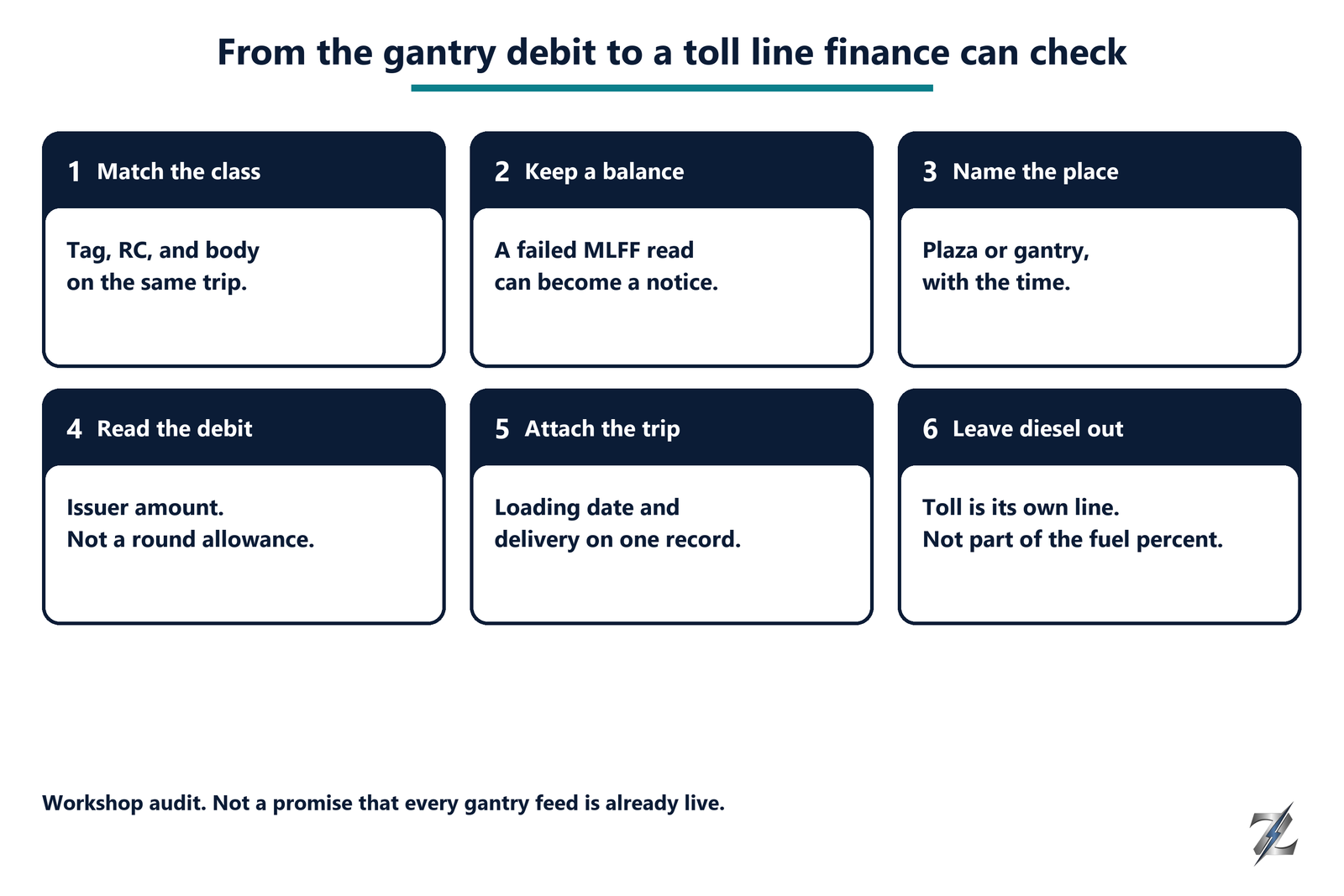
Workshop audit. A gantry feed is live only where the product and the plaza actually provide it.
Line
Plaza or gantry
Source
FASTag statement
Fail looks like
A monthly lump with no place name
Line
Time
Source
Same statement
Fail looks like
A debit that cannot be tied to the trip
Line
Vehicle and class
Source
Tag, RC, and the body on the trip
Fail looks like
A truck tag on a tractor-trailer, or the reverse
Line
Amount
Source
Issuer debit
Fail looks like
A round allowance that nobody can re-run
Line
Trip
Source
Loading and delivery record
Fail looks like
A toll folder that sits outside the freight bill
| Line | Source | Fail looks like |
|---|---|---|
| Plaza or gantry | FASTag statement | A monthly lump with no place name |
| Time | Same statement | A debit that cannot be tied to the trip |
| Vehicle and class | Tag, RC, and the body on the trip | A truck tag on a tractor-trailer, or the reverse |
| Amount | Issuer debit | A round allowance that nobody can re-run |
| Trip | Loading and delivery record | A toll folder that sits outside the freight bill |
PIB, 22 July 2026: a FASTag debit passes through the plaza acquirer, NPCI, and the issuer bank.
Chapter 07
Twenty checks: do now, wait, and do not sign
Score the first ten with procurement, finance, and the person who tops up the tags. Eight to ten, and the live toll line can go into the contract. Under six, you still have a monthly argument with a better gantry in front of it.
The second ten are for the day a section is notified and operating as GNSS. Until that day they stay out. A rate card that grants every truck 20 free kilometres, or that demands a NavIC unit next month, is ahead of the system that is billing you.
Start with the statement you already have. Name the plaza, match the class, and keep toll out of diesel. Add a barrier-free plaza to the lane only when it is on the current live list. Leave the satellite sentence for the gazette, not for this month's bill.
A freight desk does not need a satellite story to tighten toll. It needs the right tag, the right class, a debit that names the place, and a contract line that keeps toll out of diesel. Fit the clause to the system billing the truck this month.
#
1
Check
Tag inventory
Pass looks like
One live tag per commercial vehicle, issuer known
#
2
Check
Class
Pass looks like
Tag class matches the RC and the body on the trip
#
3
Check
Balance
Pass looks like
Someone owns the top-up, and a failed debit is seen the same day
#
4
Check
Statement
Pass looks like
Plaza or gantry, time, class, and rupee are on the debit
#
5
Check
Trip match
Pass looks like
The debit sits on the same trip as the loading date
#
6
Check
MLFF list
Pass looks like
The lane is checked against the current live list
#
7
Check
Electronic notice
Pass looks like
A failed read has an owner. It does not wait for month-end
#
8
Check
Diesel line
Pass looks like
Toll is not inside the fuel percent
#
9
Check
Annual pass
Pass looks like
No car pass has been booked against a goods vehicle
#
10
Check
Fleet label
Pass looks like
Own, contract, or overflow is named; a partner tag is not booked as a company tag
| # | Check | Pass looks like |
|---|---|---|
| 1 | Tag inventory | One live tag per commercial vehicle, issuer known |
| 2 | Class | Tag class matches the RC and the body on the trip |
| 3 | Balance | Someone owns the top-up, and a failed debit is seen the same day |
| 4 | Statement | Plaza or gantry, time, class, and rupee are on the debit |
| 5 | Trip match | The debit sits on the same trip as the loading date |
| 6 | MLFF list | The lane is checked against the current live list |
| 7 | Electronic notice | A failed read has an owner. It does not wait for month-end |
| 8 | Diesel line | Toll is not inside the fuel percent |
| 9 | Annual pass | No car pass has been booked against a goods vehicle |
| 10 | Fleet label | Own, contract, or overflow is named; a partner tag is not booked as a company tag |
Live FASTag and MLFF practice. Not a GNSS rollout plan.
#
11
Check
Section status
Pass looks like
The clause names an operating GNSS section, not all national highways
#
12
Check
Permit
Pass looks like
National permit vehicles are outside the 20 km zero
#
13
Check
Direction and day
Pass looks like
20 km is per direction, per day, on that section
#
14
Check
Distance source
Pass looks like
Kilometres come from the notified system, not the driver's odometer
#
15
Check
Rate
Pass looks like
The rupee per km is the notified class rate, not the workshop 4.50
#
16
Check
Lane mistake
Pass looks like
The double fee is written only for an earmarked GNSS lane
#
17
Check
Unit
Pass looks like
Any on-board-unit line cites the rule in force, not the 2024 concept paper
#
18
Check
Fallback
Pass looks like
A missing GNSS record has a written payable amount
#
19
Check
Privacy
Pass looks like
Location use is limited to the tolled section and the toll charge
#
20
Check
Reset
Pass looks like
If the section leaves GNSS, the contract returns to the plaza rule
| # | Check | Pass looks like |
|---|---|---|
| 11 | Section status | The clause names an operating GNSS section, not all national highways |
| 12 | Permit | National permit vehicles are outside the 20 km zero |
| 13 | Direction and day | 20 km is per direction, per day, on that section |
| 14 | Distance source | Kilometres come from the notified system, not the driver's odometer |
| 15 | Rate | The rupee per km is the notified class rate, not the workshop 4.50 |
| 16 | Lane mistake | The double fee is written only for an earmarked GNSS lane |
| 17 | Unit | Any on-board-unit line cites the rule in force, not the 2024 concept paper |
| 18 | Fallback | A missing GNSS record has a written payable amount |
| 19 | Privacy | Location use is limited to the tolled section and the toll charge |
| 20 | Reset | If the section leaves GNSS, the contract returns to the plaza rule |
2024 amendment, as reported. Counsel should read the gazette before any of these lines is signed.
Appendix
Frequently asked questions
Is GNSS satellite tolling live on Indian highways?
No. On 30 July 2026 the government told the Lok Sabha that expert committees had asked for more deliberation on security, privacy, breach, and operational control, and that there was no timeline to replace plazas with satellite tolling. The live barrier-free project is multi-lane free flow, and it still uses FASTag.
How should FASTag toll reconciliation look on a freight bill?
The plaza or gantry, the time, the vehicle class, the issuer debit, and the trip. A round monthly toll allowance is not an audit. Toll also stays outside the diesel percent.
Does a barrier-free MLFF plaza charge by the kilometre?
No. The gantry is built so the vehicle need not stop, slow down, or stay in one lane. The user fee is still the FASTag fee for that plaza and vehicle class.
Does the 20 km toll waiver apply to trucks?
Only inside a GNSS user-fee system, and not to a national permit vehicle. The written rule is zero user fee for up to 20 km in each direction in a day on the same section. It is not a discount on today's plaza bills.
Will FASTag stop working when GNSS starts?
Not on the evidence available on 8 Oct 2026. The 2024 design put GNSS beside FASTag. The system being rolled out now still debits FASTag.
Does the ₹3,075 FASTag annual pass cover a commercial trailer?
No. The pass that took effect on 15 August 2025 is for non-commercial cars, jeeps, and vans. For 2026-27 it costs ₹3,075 and covers one year or 200 national highway plaza crossings, whichever is earlier.
What happens if the FASTag has no balance at an MLFF gantry?
The vehicle may pass, and the missed debit can become an electronic notice. Low balance is an operational failure, not a delay at a cash window.
Should a fleet fit AIS-140 NavIC units now for satellite tolls?
Not because of a current goods-vehicle order. The June 2024 IHMCL design pointed at an AIS-140 location device. The government has not set a fitment deadline for trailers.
Sources
References and data sources
Public sources below are for orientation. They are not ZAFTYS audited financials. Read the originals before a number goes into a board pack.
- [1]PIB, 22 July 2026, FASTag based toll collection and digital tolling system: more than 98% of user fee through FASTag, the car annual pass, the acquirer, NPCI, and issuer path, and the decision to pursue MLFF while GPS tolling stays under deliberation.
- [2]Lok Sabha unstarred question 2017, answered 30 July 2026: about 6.23 crore active FASTags in June 2026, the 60 km plaza-spacing rule, five live MLFF plazas, 104 more identified, and no GNSS replacement timeline.
- [3]PIB, 1 October 2026, Tamil Nadu's first barrierless MLFF plaza: Paranur plus Chorayasi, Mundka, Shahjahanpur, Daulatpura, Manoharpura, and Gharaunda. The debit is still FASTag. A low balance can become an electronic notice.
- [4]National Highways Fee (Determination of Rates and Collection) Amendment Rules, 2024, reported in force on 10 September 2024 and later listed as G.S.R. 556(E) dated 9 September 2024. The Rajya Sabha papers laid on 18 December 2024 record the notification. Confirm the gazette text before a contract quotes the 20 km zero or the double fee.
- [5]Indian Express, 10 September 2024 and The Hindu, 10 September 2024: reporting of that GNSS amendment. The Express report said the GNSS-lane tender was not finalised.
- [6]NHAI, 7 June 2024 and the IHMCL GNSS concept note, 29 June 2024: hybrid design and an AIS-140 device as the proposed on-board unit. Design history, not an October 2026 fitment order.
- [7]ZAFTYS diesel surcharge guide: source of the older ₹3 to ₹7 per km toll workshop band inside a ₹26 to ₹37 variable-cost band. Teaching context, not a plaza tariff or national toll share.
Related reading