Chapter 01
The underworld of highway freight theft in India
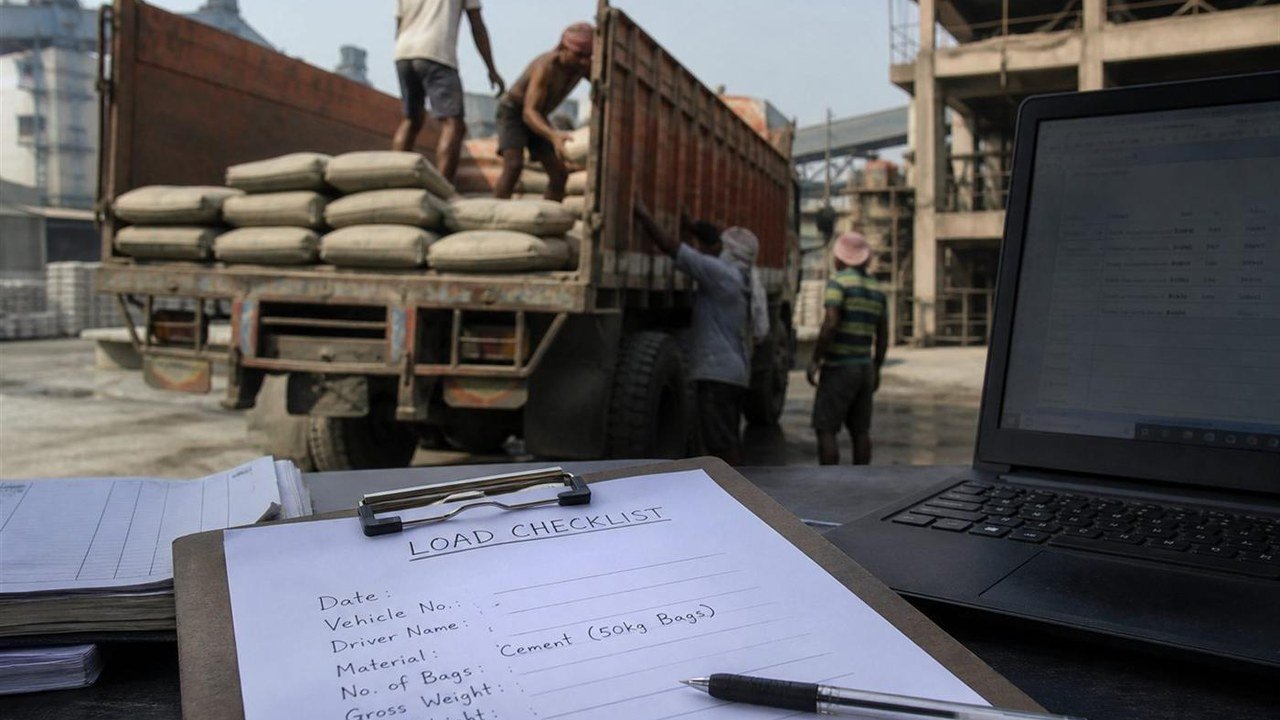
Composite from corridor practice (details changed). A Dahej metals desk needed a spot 10-wheeler for copper wire rods to Bhiwandi overnight. A roadside broker posted the indent into a WhatsApp group. A laminated RC arrived by photo. The rate was slightly soft. The truck looked ordinary. By morning the phone was dead, the legitimate owner of that registration number was hauling gravel in another state, and finance was staring at a repudiated marine claim. That is not a rare anecdote. It is the product of a repeatable racket.
Fake / bogus trucks (farzi gaadi) are assembled, not invented from nothing. Syndicates buy totaled or scrap commercial chassis from insurance auctions and yards, obtain duplicate plates matching active compliant trucks, manufacture laminated RC packs, and hunt spot loads through informal brokers and open WhatsApp freight groups. Primary industrial corridors - Gujarat-Maharashtra chemical and metal belts, Delhi-NCR logistics hubs, Odisha-Jharkhand steel lanes - see the same pattern because liquidation markets sit nearby.
High-value discrete commodities are preferred targets. Finished steel coils, copper wire rods, aluminium ingots, brand-new radial tyres, consumer electronics, and packaged agro-chemicals convert to cash in secondary scrap or wholesale markets inside about 24 hours of plant exit. Continuous process bulk that needs specialised unload equipment is less attractive. Discrete, liquidatable cargo is why verification intensity must scale with invoice value - not with how rushed the shift feels.
Sourcing channel is the first control. Dedicated fleets with known assets fail less often than anonymous spot. Hybrid rules for when spot is allowed - and how it must be labeled - sit in spot market vs dedicated fleets. Unlabeled overflow into anonymous WhatsApp groups and roadside brokers is the highest-risk teaching pattern in this guide - a coaching ranking, not a published national crime share.
What to verify
Registration consistency, chassis/engine identity, fitness/permit/tax status, driver licence class, substitution events, movement signals, and cargo custody.
What a lookup is
A consistency check - not proof of fraud and not a full loading clearance.
Corrections
Report factual errors to contact@zaftys.com with the article URL.
Primary query framing for commercial vehicle verification in India.
Fake / bogus truck (farzi gaadi)
Scrap or totaled chassis with cloned plates and forged or mismatched RC packs, offered into spot loads via brokers or informal WhatsApp groups.
Cloned plate vs forged RC
Clone copies a live registration identity; forged RC fabricates or spoofs the document. Clones often need chassis rubbing and FASTag to catch.
Chassis pencil rubbing
Physical embossed-frame impression matched to the Vahan extract - the ground-truth control when digital identity alone can be stolen.
Ops vocabulary for this guide. Confirm bare statutes before an FIR strategy memo.
01
1. Unverified spot sourcing
Anonymous WhatsApp groups and roadside brokers (dalals) bring trucks the plant has never identity-checked.
02
2. Counterfeit document acceptance
Torch-light laminate checks without a live registry query accept forged RC, fitness, and permit packs.
03
3. Driver impersonation
Missing commercial badges, lost-licence reuse, or handover drivers after a clean gate-in photo.
04
4. In-transit custody break
Phone dark at an unmonitored dhaba after the plant already treated gate paper as enough.
Teaching ranking only - not a national crime share, not MoRTH data, and not a ZAFTYS audited sample. Use it to prioritise SOP coverage, not to quote percentages externally.
01
Scrap chassis + cloned plates
Totaled or scrap commercial frames from auctions get duplicate plates copied from active compliant trucks.
02
Fake laminated RC pack
Desktop-published fitness, Form 48 permits, and insurance PDFs with QR codes aimed at spoofed pages.
03
Spot-load hunting
WhatsApp groups and roadside brokers feed high-value discrete cargo that liquidates in secondary markets inside 24 hours.
Corridor pattern briefing for Gujarat-Maharashtra, Delhi-NCR, and eastern steel belts.
Chapter 02
Document forgery vs reality: the limits of physical paper checks
Factory security gates still run on torch light and laminate thickness. That control died the day Transport Nagar desktop publishers learned to print smart-card lookalikes. High-quality counterfeit RC cards, fitness certificates, Form 48 All-India National Permits, and comprehensive insurance PDFs now carry QR codes that open spoofed 'verification' pages. The guard sees green. Vahan never saw the request.
Physical paper inspection fails because it asks a human to authenticate a document that was designed to look authentic under time pressure. Evening gate congestion, festival rush, and 'broker is known' culture finish the bypass. If your SOP still says 'check original RC' without defining a live registry query, you have a ceremony, not a control.
Driver identity is a second forgery surface. Laminated licences arrive with someone else's name or photo. Commercial badges omit HGMV / TRANS classes required under CMVR practice. Hazchem endorsements under Rule 9 framing are missing on chemical moves. The handover-driver trick is simpler still: the verified driver clears the gate, then an unverified substitute takes the wheel at a roadside dhaba ten kilometres outside the industrial zone. Your trip file still shows the face that smiled at security.
Insurance surveyors will reconstruct this timeline after a diversion. Claim packs that cannot prove live verification and chain of custody fail for reasons explained in transit damage, shortage, and cargo insurance. Prevent at the gate; do not invent paperwork after the phone goes dark.
Smart-card lookalikes
High-quality counterfeit RC cards and fitness laminates from Transport Nagar DTP shops pass a torch-light glance.
Fake QR traps
QR codes that open phishing 'verification' pages give the guard a green screen that is not Vahan.
Plant security briefing. Not a print-shop prevalence study.
01
Wrong name / photo
Laminated DL with someone else's identity, or a license reported lost months earlier.
02
Missing badges
No HGMV / TRANS class, or no Hazchem endorsement when the commodity requires it.
03
Handover driver
Verified driver checks in; an unverified substitute takes the wheel at a dhaba 10 km outside the zone.
CMVR Rule 9 endorsement orientation.
Chapter 03
Digital verification: Vahan 4.0, Sarathi, and ULIP integration
India already built the public registries. The plant failure is not missing databases. It is failing to query them before the loading bay opens.
Vahan 4.0 is the MoRTH-managed national vehicle registry. Gate desks must match maker/model, registered unladen tare, GVW, engine number, chassis number, fitness expiry, road tax validity, and goods permit status against the physical truck. A pretty laminate that disagrees with Vahan is not a 'data lag.' It is a hold.
Sarathi is the national driving-licence repository. Match driver name, photograph, licence status (active versus suspended/cancelled), authorised vehicle classes, and commercial badge validity. For hazardous cargo, confirm the endorsement the commodity requires. A licence that looks fine on paper but is suspended in Sarathi is a hard fail.
India's Unified Logistics Interface Platform (ULIP) provides an access pathway for approved logistics use cases involving integrated government datasets, including VAHAN and SARATHI. Official onboarding - register on goulip.in, submit a data request, screening, NDA, IP whitelisting, compliance, staging then production - is documented at ULIP data access. MoRTH services documented for implementers include VAHAN and SARATHI endpoints among others (ULIP MoRTH docs). Field availability still depends on approval scope.
ZAFTYS Intelligence: ULIP Integration Readiness Assessment (AI-assisted research - not a live API test). This article publishes no ZAFTYS access approval, no request logs, no sample size, and no measured p50/p95 latency. The existence of a government API does not establish production access or a fixed gate timing. Public Parivahan vehicle-status lookup with CAPTCHA remains a user-facing starting point - not unrestricted automated API access. Congestion is still the syndicate's ally: when verification is slow or optional, guards skip it. Recommended plant architecture embeds lawful checks in the weighbridge workflow with hard holds and a documented fallback when a service is down. Gate-to-pay context: industrial TMS control stack. The exhibits below define onboarding requirements, verification risks, p50/p95 meaning, a reproducible future-test method, and clearly labelled synthetic latency examples only.
| Check | Evidence / method | What it establishes | Mismatch response |
|---|---|---|---|
| Registration number | Official vehicle lookup + physical plate | Whether recorded particulars appear consistent | Pause loading; verify independently |
| Chassis / engine IDs | RC/authorized record + physical stamp where lawful | Whether identifiers match the vehicle record | Document and escalate discrepancy |
| GVW / configuration | RC and approved vehicle record | Recorded configuration / weight particulars | Reassess suitability and compliance |
| Fitness, insurance, permit, tax | Official record or valid document | Status of the specific requirement checked | Resolve the specific deficiency |
| Driver licence | Available official verification + physical ID | Licence status/class to the extent the service confirms | Reverify before dispatch |
| Driver substitution | Original vs replacement driver records | Whether the change is documented | Recheck replacement driver |
| FASTag / movement | Authorized available transaction data | Limited corridor evidence only | Treat as signal, not proof of fraud |
| Cargo custody | Seal, photos, weighbridge, ePOD, timestamps | Handover / chain-of-custody evidence | Preserve records and escalate |
Educational matrix. A database lookup is not a complete security clearance. No single signal proves identity, authority, and custody together.
Proves (at most)
Consistency of recorded vehicle or licence particulars against the registry extract available on that access path.
Does not prove
Identity fraud, cargo theft, that the truck is safe to load, or that every MoRTH field is live on every plant path.
Integration evidence
Publish field list, auth path, test date, success/fail counts, and p50/p95 only with a dated test report. Otherwise treat TMS automation as recommended architecture.
Capability framing for public Parivahan lookups and authorized integrations.
| Stage | Action |
|---|---|
| 1. Hold | Pause loading and keep the vehicle in a controlled area |
| 2. Re-verify | Repeat registry/physical checks with a second verifier where practical |
| 3. Document | Photo, extract, timestamps, approving person for exceptions |
| 4. Escalate | Notify dispatch / security lead; involve transporter contact |
| 5. Decide | Clear, reject, or refer - never load on unresolved hard fails |
| 6. Retain | Keep an auditable record with access controls and retention rules |
Do not automatically accuse the driver or carrier of a crime from a single discrepancy.
Accurate claim
ULIP can provide approved access to datasets including VAHAN and SARATHI after onboarding. Field availability depends on approval conditions ([ULIP data access](http://ulipdocs.nldsl.in/docs/getting-started/data-access)).
Not claimed here
No ZAFTYS API access status, field list, instant verification, or measured p50/p95 latency. No fabricated request logs or sample sizes.
Plant practice now
Use public Parivahan lookups and physical checks. Treat TMS automation as recommended architecture until a dated authorised test report exists.
AI-assisted assessment from official ULIP docs (checked 19 Nov 2026). Not a live ZAFTYS API test, access approval, or measured latency report.
- 01
Register and request
Create an account on goulip.in; submit company details, use-case, and the source systems / fields needed.
- 02
Screening and NDA
ULIP review finalises scope; complete the Non-Disclosure Agreement.
- 03
Technical controls
Whitelist the data-centre public IP; keep the consuming app login-based; retain access logs; plan yearly security audit.
- 04
Staging then production
Test on staging, submit a test report, then receive production APIs if approved.
http://ulipdocs.nldsl.in/docs/getting-started/data-access - paraphrase of published steps; confirm live docs before filing a request.
| Topic | What to plan for | Risk if ignored |
|---|---|---|
| Authorisation scope | Only approved VAHAN / SARATHI (and other) fields for the use-case | Expecting fields you were never granted |
| Identity vs clearance | Registry match is consistency evidence, not a load-safety clearance | Skipping chassis rubbing after a green lookup |
| Downtime / fallback | Document hold rules when ULIP or Parivahan is unavailable | Guards accept laminates under congestion |
| Logging and audit | Retain request/response metadata per ULIP compliance expectations | Cannot prove due diligence after a claim |
| Latency at the gate | Measure only after authorised access with a dated test plan | Publishing invented 'instant' timings |
ZAFTYS Intelligence readiness framing. Risks are operational - not evidence that ZAFTYS is already integrated.
| Item | Definition / rule |
|---|---|
| p50 (median) | Half of successful timed requests finish at or below this duration |
| p95 | 95% of successful timed requests finish at or below this duration; captures the slow tail guards feel |
| Clock start / stop | Start when the client sends the authorised request; stop when a final success or hard-fail response is received (exclude UI render) |
| Sample design | Pre-register N, time window, environments (staging vs production), endpoints, and success criteria before the run |
| Exclusions | Separate auth/login time from data-call time; log timeouts and HTTP errors as fails, not as latency samples |
| Publish bar | Field list returned, N, success/fail counts, p50, p95, test date, environment - or publish nothing as 'measured' |
Methodology only. Do not publish measured ZAFTYS timings until this protocol is run on authorised credentials.
Synthetic example A
Suppose 100 successful staging calls: p50 = 1.2 s, p95 = 4.8 s. These figures are synthetic - not from ZAFTYS logs.
Synthetic example B
Suppose the same endpoint under peak load: p50 = 2.5 s, p95 = 12.0 s. Still synthetic. A plant SOP must use measured percentiles after authorised testing.
How to use them
Use only to explain why p95 (not average) drives gate staffing. Replace with real percentiles before any commercial or ops claim.
Invented teaching numbers for methodology literacy. Do not cite as ZAFTYS ULIP results.
Chapter 04
The physical ground truth: chassis rubbing and vehicle geometry audits
Digital records can be cloned when criminals steal the identity of a live, compliant truck in another state. Vahan may show an active RC because the genuine vehicle is active. The truck at your gate is a different machine wearing that plate. Registry queries alone are necessary and insufficient.
Four physical checkpoints still catch what APIs cannot. First, chassis number pencil rubbing: locate the embossed alphanumeric stamp on the frame - typically near a front wheel arch - rub pencil on tracing paper, and compare character font and spacing to manufacturer embossing standards and the Vahan extract. Second, engine number stamping on the mechanical block - not a firewall sticker. Third, body geometry versus registration class: an RC for a 2-axle 18.5 T SXL that arrives as a 3-axle 10-wheeler is a chassis-swapped or rebuilt story. Fourth, cabin condition: mismatched tyres, missing OEM badges, and fresh spray paint over the VIN plate are immediate red flags.
Congestion is not an excuse to skip rubbing. The copper case in this guide failed exactly there. If the shift is overloaded, add a second verifier - do not delete the control. Print the ten-point red-flag table for the guard cabin and treat any hard fail as a hold, not a 'call the broker.'
- 01
Chassis pencil rubbing
Locate frame stamp near wheel arch; rub pencil on tracing paper; match font and spacing to manufacturer embossing and Vahan extract.
- 02
Engine number stamp
Read the mechanical block stamp against the RC engine number - not a sticker on the firewall.
- 03
Body vs registration class
RC shows 2-axle 18.5 T SXL but a 3-axle 10-wheeler arrives - chassis-swapped or rebuilt. Hold.
- 04
Cabin and tyre red flags
Mismatched tyres, missing OEM badges, fresh spray over the VIN plate - escalate before weighbridge.
Plant security SOP orientation.
| # | Red flag | Why it matters |
|---|---|---|
| 1 | Missing / loose HSRP rivets or non-standard plate font | Plate may be cloned or swapped |
| 2 | Handwritten overwrites on laminated RC | Desktop forgery pattern |
| 3 | Driver cannot name transporter head-office city | Impersonation / broker (dalal) hire |
| 4 | Mobile number not consistent with booking record | Burner phone risk |
| 5 | Non-functional tail lamps on high-value dispatch | EHS + stolen-rebuild pattern |
| 6 | Refusal of chassis pencil rubbing | Frame stamp will not match |
| 7 | Fresh paint around VIN / chassis area | Tamper cover-up |
| 8 | Axle count disagrees with RC GVW class | Chassis swap |
| 9 | Insurance QR opens a non-MoRTH page | Spoof verification |
| 10 | Second person loitering to 'help papers' | Handover / syndicate assist |
Print for the guard cabin. Any single hard fail = hold and call dispatch.
Chapter 05
FASTag plausibility audits: the digital footprint check
Every commercial truck in India is supposed to carry an active NETC FASTag mapped to chassis and bank wallet. That creates a highway breadcrumb trail that cloned plates cannot honestly share with two physical trucks at once.
Spatial plausibility is the clone detector. If a vehicle arrives at a Chakan (Pune) factory at 10:00 AM claiming a Mumbai inbound, but the FASTag ledger shows a clearance near Varanasi six hours earlier, the truck at your gate is not the truck that earned those toll debits. Implied speed above about 85 km/h across impossible distance, or travel opposite to the declared corridor, should hard-flag the booking.
Enterprise TMS integrations should query FASTag history at gate-in - not after the e-Way Bill Part B is already filed. Pair toll footprints with trip milestones so a phone switch-off mid-corridor triggers escalation before the 72-hour golden window expires. Toll and freight cost context for honest trucks still sits in the truck freight rates guide; here the ledger is a security sensor, not a rate input.
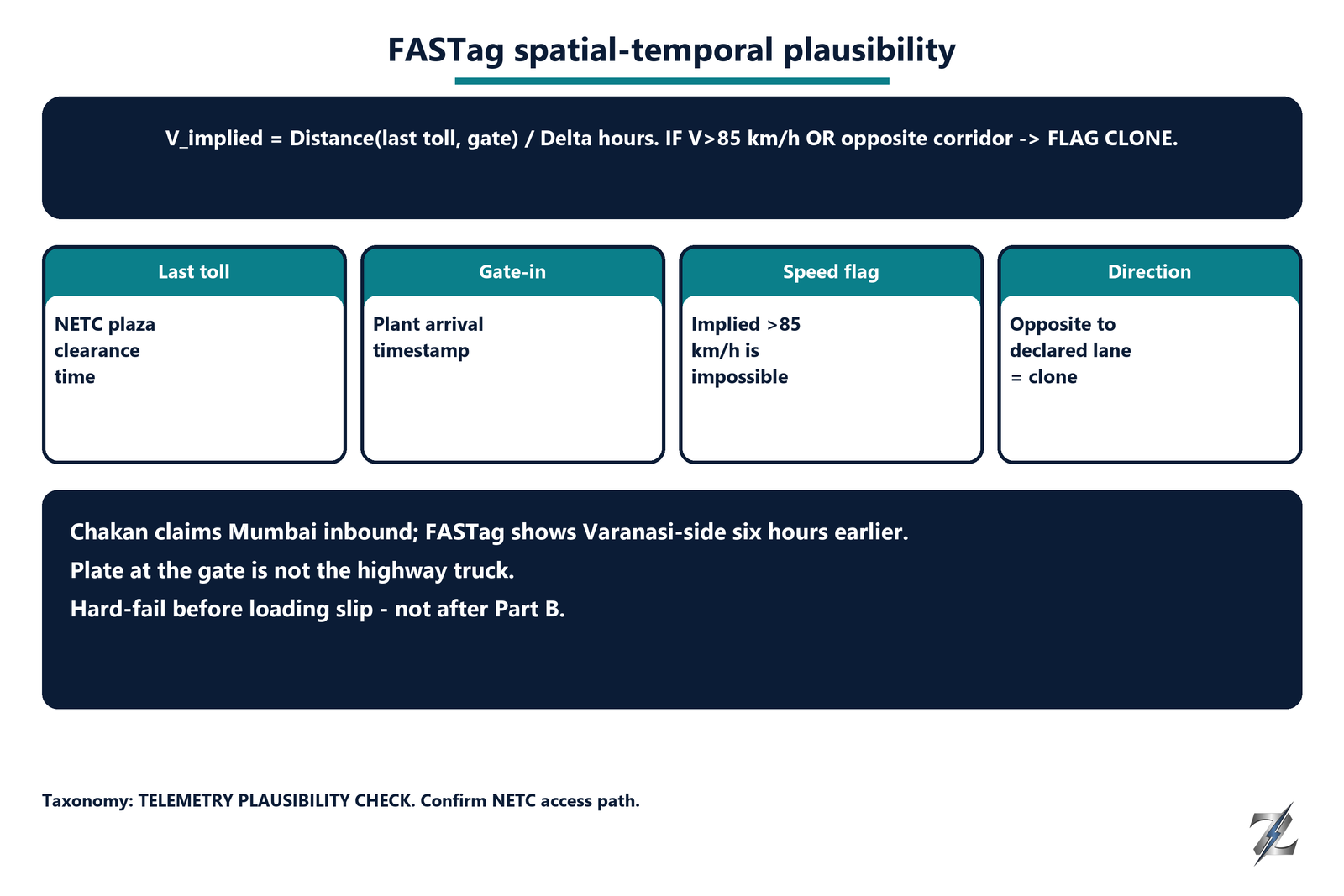
Workshop rule. Confirm NETC / bank ledger access path before locking the SOP.
Impossible trajectory
Truck claims Mumbai arrival at 10:00 AM in Chakan, but FASTag cleared a Varanasi-side plaza six hours earlier - plate at the gate is not the highway truck.
TMS job
Query FASTag history at gate-in and hard-fail opposite-corridor or impossible speed before loading starts.
Chakan gate teaching example.
Clone detector
Flag impossible toll trajectories before loading
Send one corridor where spot trucks arrive with soft rates. We design the FASTag plausibility rule.
Chapter 06
Driver profiling and chain of custody protocols
Machines get verified; operators get substituted. Chain of custody fails when the plant photographs a vehicle and waves through a human it never really identified.
Mandatory live photo capture of the driver standing next to the registration plate at gate-in creates a timestamped pair. Masked Aadhaar OTP or biometric thumbprint matching - per plant privacy policy - ties that face to a unique identity. Digital breathalyzer screening under a zero BAC policy keeps impairment out of high-value and Hazchem dispatches before the bay opens.
Mobile discipline closes the handover trick. Verify that the primary number is registered in the driver's name through telco ownership checks where available, and enforce an active SMS or WhatsApp ping at gate entry. A temporary burner phone that will be discarded after dispatch fails that ping. If the number dies at the first dhaba, your escalation playbook should already be running - not starting from a blank chat history.
01
Live plate photo
Driver standing beside the registration plate at gate-in - timestamped into the trip file.
02
Masked Aadhaar / biometric
OTP or thumbprint match per plant privacy SOP - identity, not a laminated photocopy.
03
Breathalyzer
Zero BAC policy before the loading bay opens on high-value or Hazchem moves.
04
SIM ownership ping
Primary number in driver's name; live SMS/WhatsApp test so burner phones fail at the gate.
Gate human-factor controls. Align with plant EHS policy.
Chapter 07
Worked case study: copper wire rods diverted on the Gujarat-Maharashtra belt
Workshop composite - not a ZAFTYS audited claim file. Consignment: 24 tonnes of electrolytic copper wire rods from Dahej (Gujarat) to Bhiwandi (Maharashtra). Invoiced value: Rs 2.15 crores. The dispatch desk needed a spot 10-wheeler. A roadside broker arranged a truck via WhatsApp at a competitive rate. Soft freight is not a discount when identity is fake - it is bait. Rate shopping without verification is a cost leak of a different kind; see 5 hidden cost leaks.
Failure points stacked. The guard accepted a laminated colour photocopy of the RC without a live Vahan check. The driving licence looked valid but belonged to a person who had reported it lost six months earlier. Chassis pencil rubbing was skipped because evening gate congestion 'would delay production.' Each skipped control was rationalised. Together they authorised the theft.
Diversion timeline: truck left Dahej at 6:00 PM; driver's phone switched off near Valsad at 9:30 PM; vehicle never reached Bhiwandi. The legitimate owner of the cloned registration was found hauling gravel in Rajasthan with the genuine truck. Cargo loss: Rs 2.15 crores. Marine claim repudiated for breach of registered common-carrier due-diligence warranty. Direct balance-sheet write-off: Rs 2.15 crores - before late-delivery LD and legal costs push the workshop total near Rs 2.315 crores.
The control stack that stops this is hold-first: live registry fail, licence status fail, FASTag/movement impossibility, or chassis mismatch - any one pauses loading until independently cleared. A public Parivahan lookup or authorized ULIP path (where available) supports consistency checks; it is not by itself a full security clearance. The workshop cost framing of a registry query is trivial next to cargo value. Prevention is not optional insurance theatre.
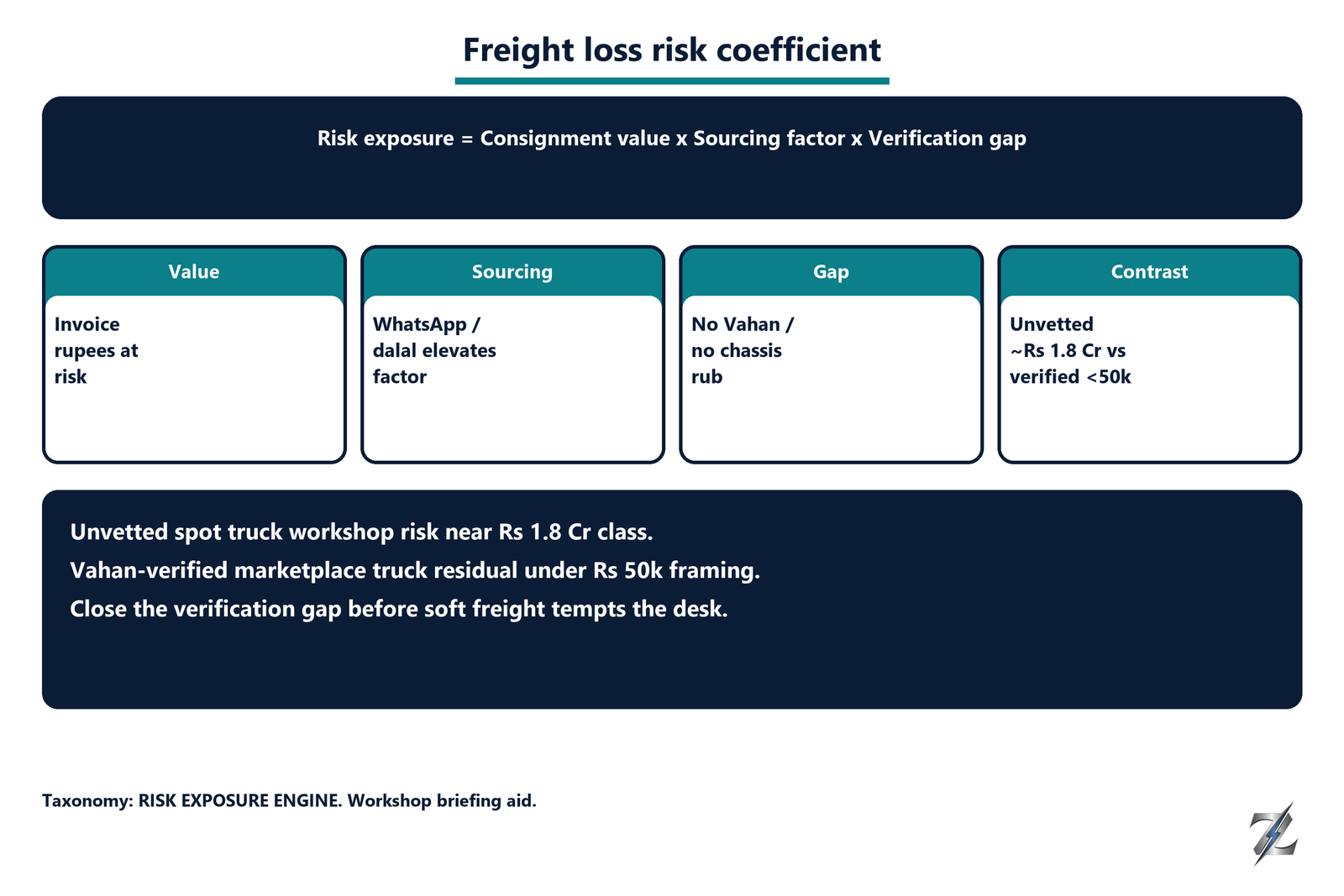
Workshop: Risk = Consignment value x Sourcing factor x Verification gap.
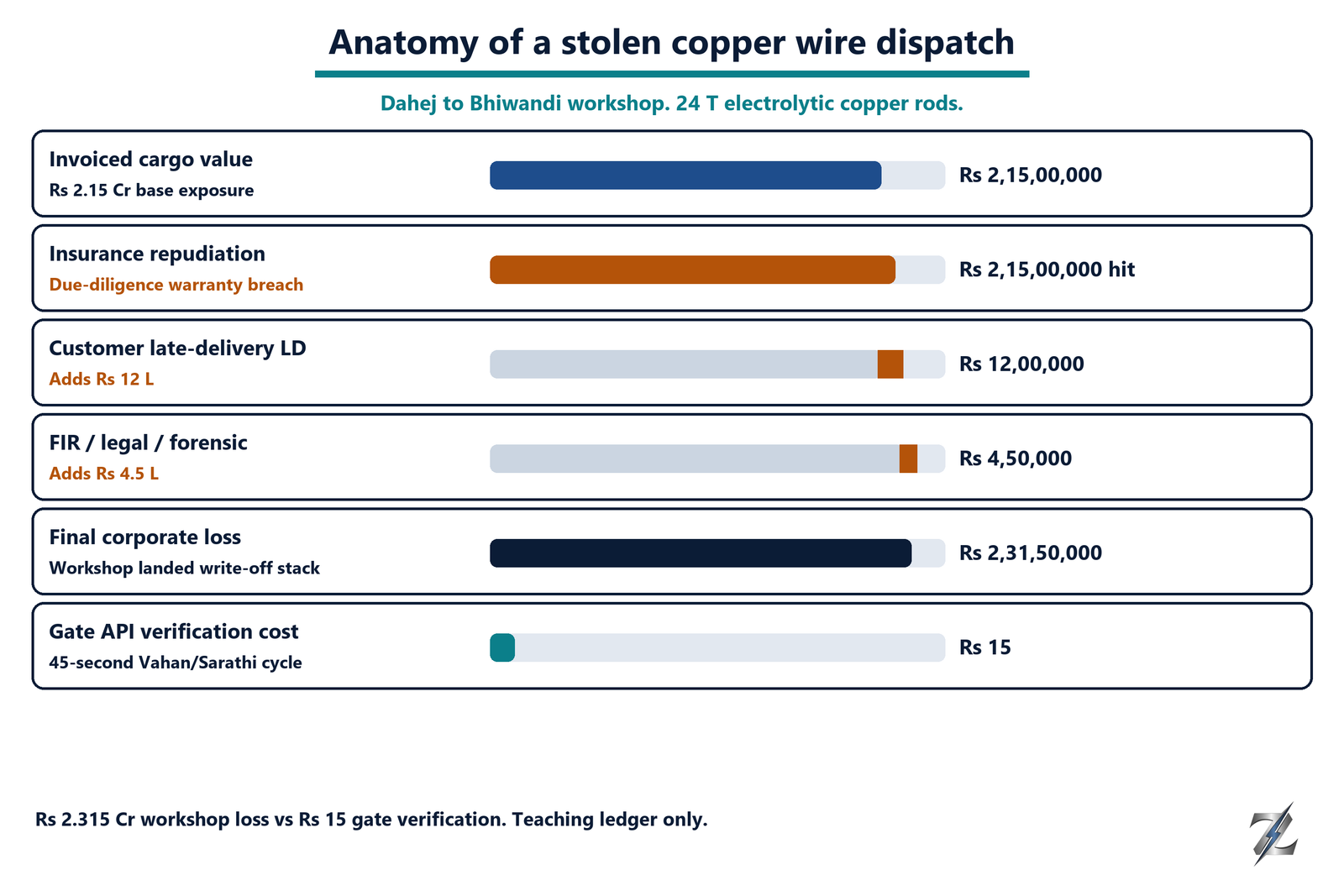
Teaching ledger: cargo Rs 2.15 Cr plus LD and legal costs to ~Rs 2.315 Cr landed loss versus ~Rs 15 gate API cost. Not a ZAFTYS audited claim file.
| Control | What happened | What stops it |
|---|---|---|
| RC check | Laminated photocopy accepted | Live Vahan 4.0 API |
| DL check | Valid-looking DL already reported lost | Sarathi status + photo match |
| Chassis rub | Skipped in evening congestion | Mandatory pencil rubbing |
| Tracking | Phone off near Valsad 9:30 PM | FASTag + milestone TMS |
| Insurance | Repudiated - due diligence warranty | Registered carrier + gate evidence |
| Outcome | Rs 2.15 Cr write-off | Hold-first gate block before load |
Composite workshop. Invoiced value Rs 2.15 Cr / 24 T electrolytic copper wire rods.
Chapter 08
Statutory penalties and the legal framework: BNS 2023 vs IPC
Criminal law is not your primary control, but shippers should know what they are walking into after a diversion. Section 316 of the Bharatiya Nyaya Sanhita, 2023 covers criminal breach of trust by a common carrier, wharfinger, or warehouse-keeper in the lineage formerly associated with IPC Sections 405/407 - punishable with imprisonment up to seven years and fine framing. Section 318 BNS covers cheating and dishonestly inducing delivery of property (ex IPC 415/420). Forgery provisions cover making and using forged RCs, permits, and licences (ex IPC 465/468 practice).
Confirm bare BNS text and charging practice with counsel. Historical FIRs may still cite IPC numbers. Carriage by Road Act, 2007 registration and goods-receipt duties still shape the civil and regulatory overlay for common carriers.
Recovery via police FIR under Section 316 BNS routinely takes years. Working capital does not wait. The imperative for plant leadership is preventative gate-level elimination - Vahan, Sarathi, FASTag, chassis rubbing - over post-theft litigation as the operating plan. Legal pursuit is residual hygiene after the control failed.
01
Section 316 BNS
Criminal breach of trust by common carrier / warehouse-keeper lineage (ex IPC 405/407). Imprisonment up to 7 years and fine framing.
02
Section 318 BNS
Cheating and dishonestly inducing delivery of property (ex IPC 415/420).
03
Forgery lineage
BNS forgery provisions covering forged RCs, permits, and licences (ex IPC 465/468 practice).
BNS 2023 orientation. Counsel owns FIR strategy. Historical IPC numbers noted for older files.
FIR is slow
Police recovery under Section 316 BNS can take years while working capital is already gone.
Gate is fast
Eliminate the bogus truck before loading. Litigation is residual, not the control.
Ops conclusion for plant leadership.
Chapter 09
Standard operating procedure: the 8-point pre-loading gate verification protocol
Security guards, weighbridge operators, and dispatch managers need one shared protocol. No 'known broker' exceptions without a named director approval that will survive an insurance surveyor.
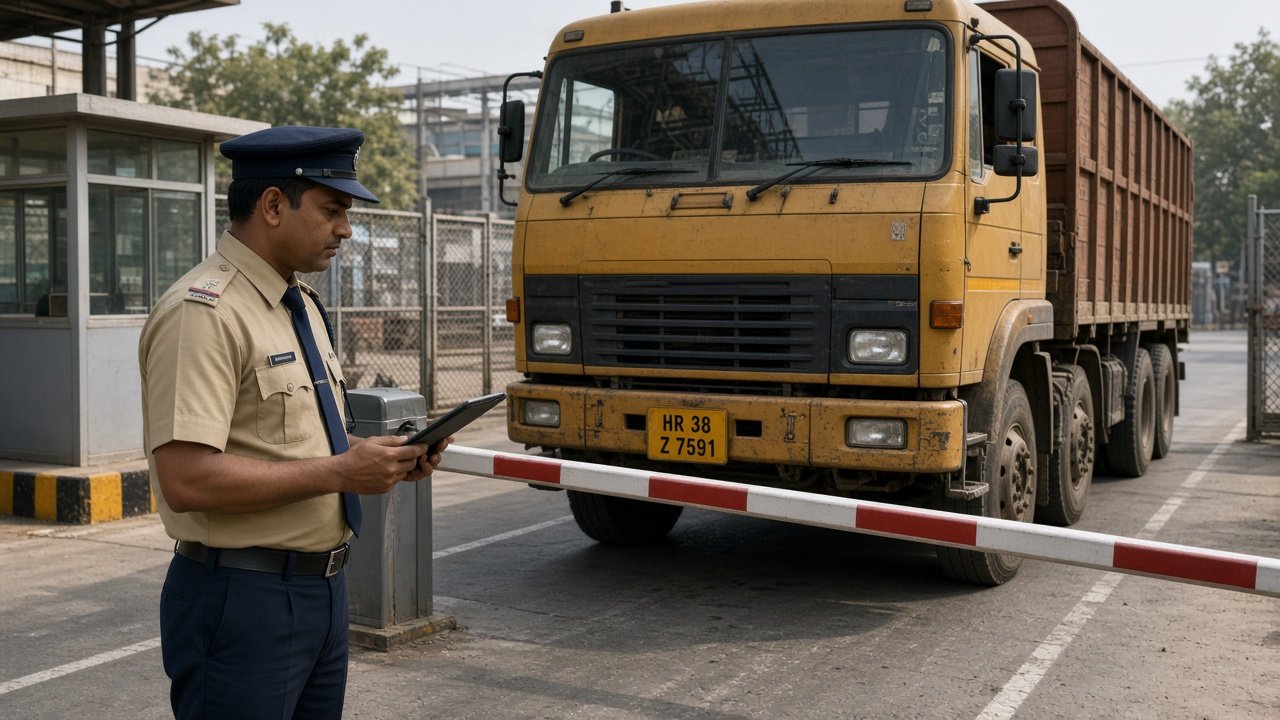
Step 01: record arrival time, registration number, vehicle type, and transporter. Step 02: compare registration / vehicle identifiers with permitted records using available lawful lookups (public Parivahan or authorized registry path) plus physical plate audit. Step 03: verify driver identity and licence with available lawful methods. Step 04: check fitness, insurance, permit, and tax status / expiry.
Step 05: confirm the vehicle is appropriate for the cargo and order (GVW, body, endorsements). Step 06: record any driver or vehicle substitution and re-verify it. Step 07: record loading reference, seal number, photographs where permitted, weighbridge data, and departure time. Step 08: record the approving person for exceptions. Step 09: on discrepancy - hold, verify independently, escalate; do not automatically accuse the driver or carrier of a crime. Step 10: preserve an auditable record with access controls and retention rules.
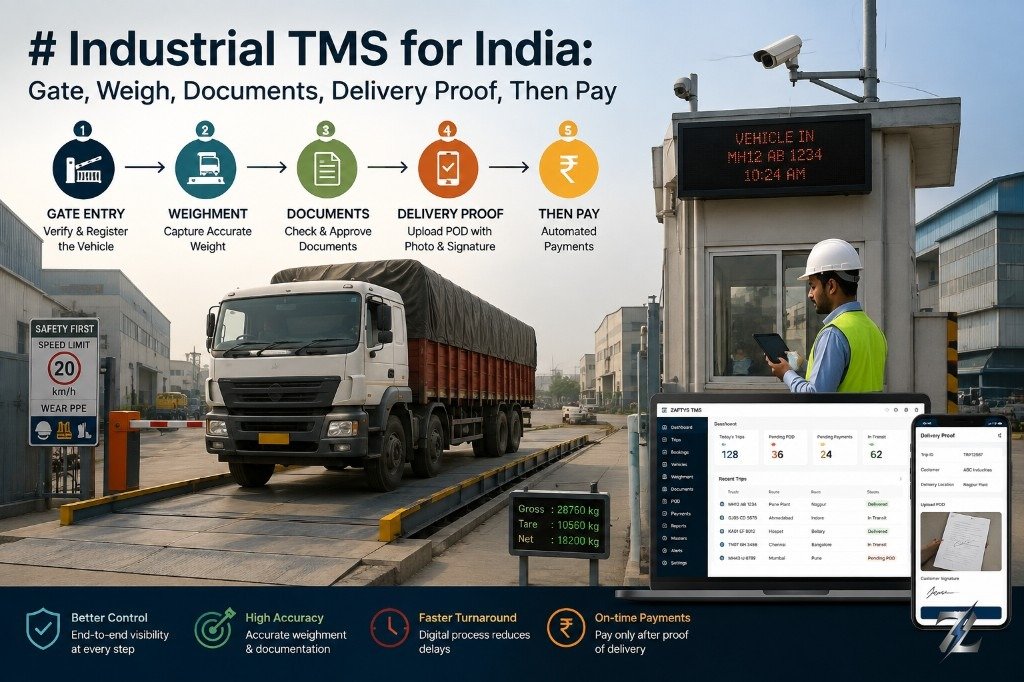
Physical chassis rubbing and FASTag/movement plausibility still sit beside registry checks - a lookup is not a clearance. Congestion staffing must protect identity and chassis steps. Gate-to-pay embedding of these checks on ZAFTYS TMS is recommended architecture where credentials exist, not a claim that every plant already has live automated ULIP timings.
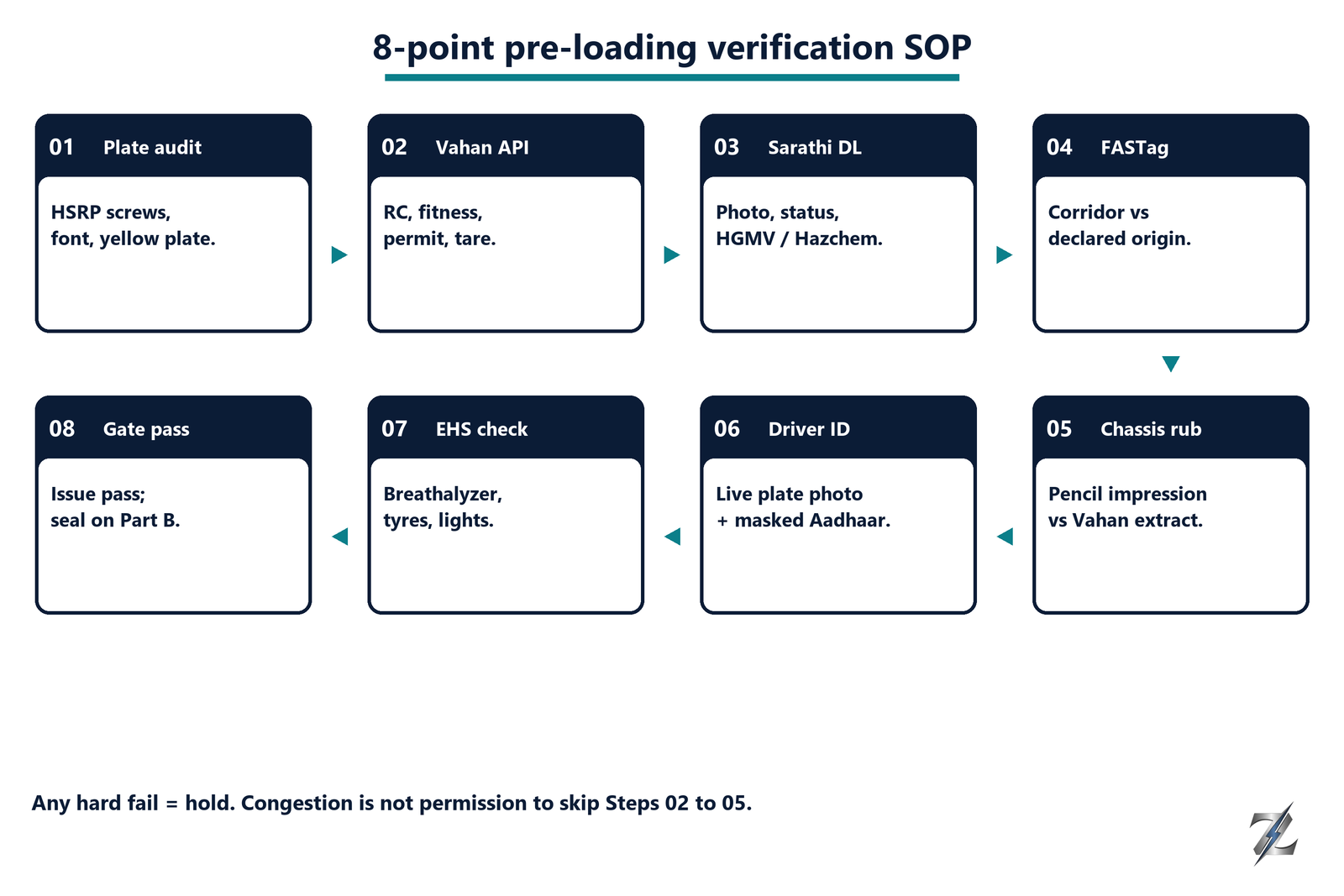
Security, weighbridge, and dispatch shared protocol.
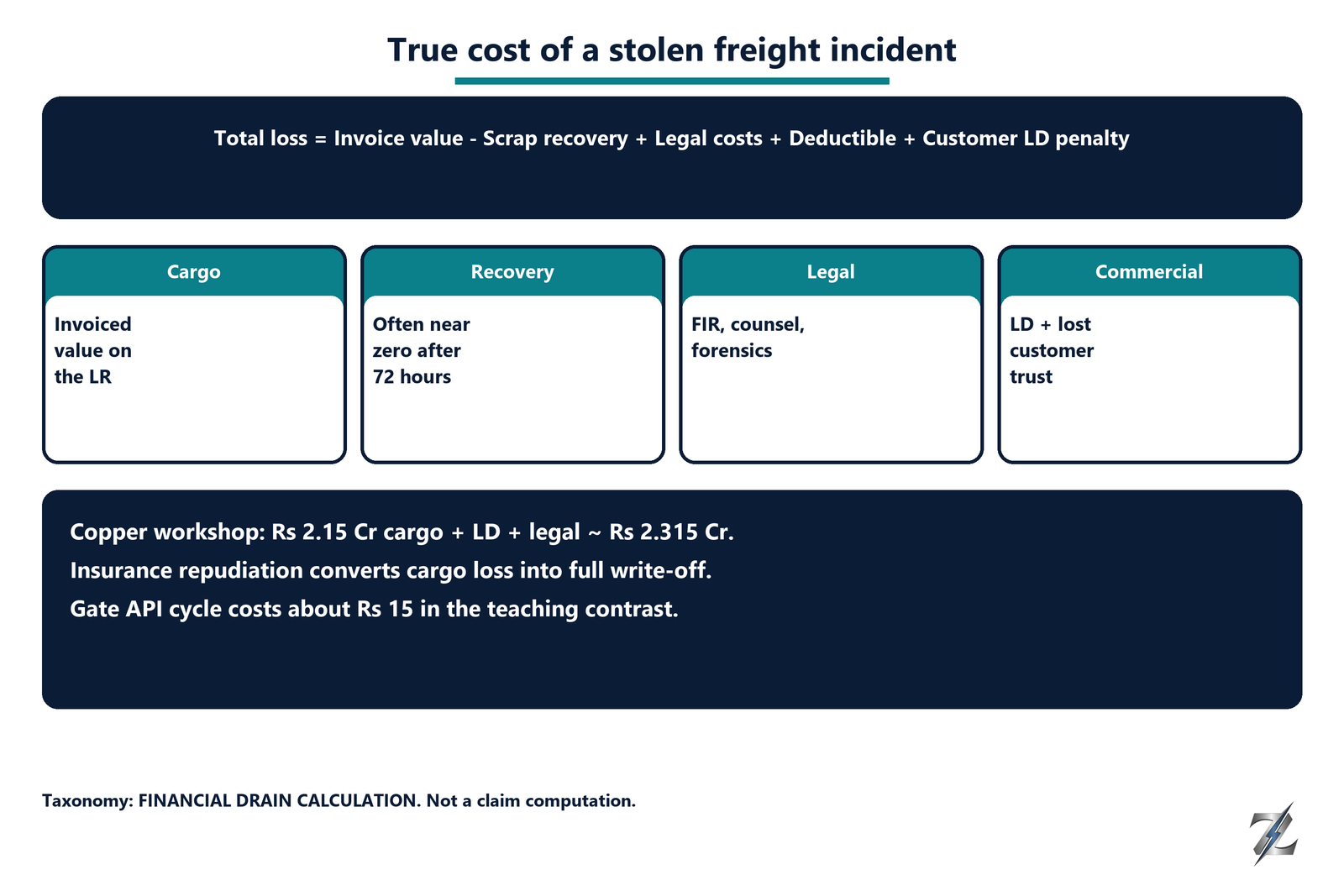
Workshop loss stack beyond invoice value.
- 01
01 Record arrival
Time, registration, vehicle type, transporter.
- 02
02 Compare identifiers
Lawful registry lookup + physical plate / RC consistency.
- 03
03 Driver identity + licence
Available lawful verification methods only.
- 04
04 Document status
Fitness, insurance, permit, tax / expiry.
- 05
05 Cargo suitability
GVW, body, endorsements match the order.
- 06
06 Substitution re-check
Any driver/vehicle change is re-verified.
- 07
07 Custody record
Loading ref, seal, photos where permitted, weighbridge, departure.
- 08
08 Exception approver
Named person for any override.
- 09
09 Mismatch hold
Hold, re-verify, escalate - do not auto-accuse.
- 10
10 Retain audit trail
Access-controlled retention of verification artifacts.
Aligned to the master gate-security checklist. Image above is illustrative process art - follow this sequence.
Chapter 10
How TranZfort and ZAFTYS eliminate sourcing vulnerabilities and the 20-point audit
Sourcing vulnerability starts before the gate. Anonymous WhatsApp broker groups sit at the top of this guide's hypothetical risk ranking. TranZfort replaces that opacity with authenticated indie suppliers and truckers - phone OTP, business details, PAN, and commercial RC review - plus in-app chat, transparent pricing, and a timestamped photo timeline from dock to sealed load to stamped POD. That creates an auditable digital trail instead of a disappearing album. Plant gates still need independent registry and chassis controls.
Enterprise multi-plant manufacturers still need hard controls at the weighbridge. Where authorized Vahan/Sarathi/ULIP paths are live, ZAFTYS web TMS can hard-block expired fitness and suspended permits, maintain blacklisted chassis lists across plants, and reconcile open-marketplace spot capacity sourced via TranZfort inside the same gate-to-pay workflow. Present unavailable integrations as a recommended architecture, not as a measured live guarantee. Verified spot is still spot - it must stay labeled - but it is no longer anonymous.
Score the 20-point readiness matrix with security, dispatch, and procurement in one room. One to five. Skip equals zero. Strong marketplace posting with skipped chassis rubbing still writes off copper. Strong registry checks with WhatsApp-only high-value sourcing still invite the syndicate through the front door.
FAQs below cover cloned plates versus forged RCs, mParivahan limits, insurance repudiation on non-commercial licences, chassis mismatch response, and TranZfort legitimacy controls. Statutory orientation: Motor Vehicles Act Sections 3, 4, 39, 56, 66, 113; CMVR Rules 9, 32, 47, 50, 93; BNS Sections 316 and 318; Carriage by Road Act 2007. Confirm bare text before a demand letter or FIR strategy memo.
Next step: harden gate verification on ZAFTYS TMS and source verified open-market capacity on TranZfort (also TranZfort marketplace) so identity fails before loading - not after a Rs 2 crore phone goes dark.
01
TranZfort identity layer
OTP, business details, PAN, and commercial RC review replace anonymous WhatsApp broker groups.
02
Trip photo timeline
Dock, loading, consignment note / LR (bilty), seal, and POD photos create an auditable chain of custody.
03
ZAFTYS gate controls (where live)
Vahan/Sarathi embedded at weighbridge; auto-block expired fitness and blacklisted chassis.
Product positioning for this guide.
Fleet sourcing
Weight 20%·Lines 1-5
- 1
Are WhatsApp-only spot trucks banned for high-value cargo?
- 2
Is every spot vendor tagged with PAN / GSTIN before first load?
- 3
Do dedicated and marketplace trucks share one gate SOP?
- 4
Is roadside broker (dalal) placement logged as elevated risk?
- 5
Can the desk pull verified capacity from TranZfort instead of groups?
Documents
Weight 15%·Lines 6-10
- 6
Is live Vahan mandatory - no laminated photocopy alone?
- 7
Is Sarathi status checked for suspended / lost licences?
- 8
Are Form 48 permit and fitness expiry hard-gated?
- 9
Do insurance QR codes open only trusted verification paths?
- 10
Is Hazchem endorsement required when commodity needs it?
Gate and masters
Weight 25%·Lines 11-15
- 11
Is chassis pencil rubbing mandatory before loading slip?
- 12
Is engine stamp checked against the RC extract?
- 13
Does axle count vs RC GVW class get a visual confirm?
- 14
Is driver live photo with plate stored on the trip?
- 15
Is breathalyzer enforced on high-value / Hazchem moves?
Transit visibility
Weight 20%·Lines 16-20
- 16
Is FASTag history queried at gate-in?
- 17
Are impossible speed / opposite-corridor flags hard fails?
- 18
Does phone switch-off trigger an escalation playbook?
- 19
Are seals and Part B updates on the same timeline?
- 20
Do blacklisted chassis sync across all plants in the TMS?
Coaching matrix for security, dispatch, and procurement. Not a certification product.
Appendix
Frequently asked questions
How do you verify a commercial vehicle RC online in India before loading?
Query live Vahan fields for maker/model, unladen tare, GVW, engine number, chassis number, fitness expiry, road tax, and goods permit status, then match those fields to the physical truck. Pair with Sarathi for driver licence class and status. Consumer apps can help a human read public fields, but plants should store timestamped API results in the weighbridge workflow. A laminated photocopy is not verification.
What is the difference between a cloned registration number and a forged RC?
A cloned registration number copies the plate identity of a real, often compliant truck operating elsewhere - the highway may show two vehicles 'owning' one number. A forged RC is a fabricated document (laminate, smart-card lookalike, or PDF) that may invent particulars or spoof a verification QR. Clones often pass a casual Vahan glance if the genuine record is active; they fail chassis rubbing and FASTag trajectory checks. Forged RCs often fail live Vahan status, fitness, or permit fields. Run both digital and physical controls.
What is BNS Section 316 for common carriers?
Section 316 of the Bharatiya Nyaya Sanhita, 2023 covers criminal breach of trust by a common carrier, wharfinger, or warehouse-keeper in the lineage formerly associated with IPC Sections 405/407 - punishable with imprisonment up to seven years and fine framing. Orientation only; counsel owns charging strategy. Historical FIRs may still cite IPC numbers. Preventative gate controls matter more than post-theft litigation as an operating plan.
Can FASTag history help detect a cloned truck at the plant gate?
Yes as a plausibility sensor, not as a standalone legal proof. If the plate at your gate implies impossible speed or an opposite-corridor toll trail versus the declared inbound, treat the booking as a hard flag. FASTag confirms the highway footprint of a tag-chassis pair; chassis pencil rubbing still confirms the frame under the plate.
Can a security guard rely on the mParivahan or NextGen Parivahan mobile app for gate entry?
Consumer apps help a human read public fields, but they are not a controlled enterprise audit trail. Plants need timestamped API results inside the TMS weighbridge workflow, hard-fail rules, and stored evidence for insurance. Guard-phone lookups can be skipped under congestion, spoofed by fake QR pages, or lost when the shift ends. Use mParivahan as a backup torch - not as the system of record.
Why do insurance companies reject cargo claims when a truck driver has a non-commercial license?
Marine and cargo policies often carry warranties that carriage is by a properly licensed common carrier and that the vehicle/driver are legally authorised for the goods moved. A non-commercial licence, missing HGMV/TRANS class, or missing Hazchem endorsement can be treated as a due-diligence breach - especially after a diversion or transit loss. Surveyors will ask for gate evidence. Claim hygiene: transit damage and cargo insurance.
What should a plant manager do if the chassis pencil rubbing does not match the RC extract?
Stop the load. Do not negotiate at the bay. Photograph the rubbing, the frame location, the plate, and the driver; quarantine the vehicle outside the loading area; escalate to security and logistics heads; and treat the booking as failed placement. Re-source through verified capacity. Logging a 'known broker assurance' and loading anyway is how Rs crore write-offs begin. Blacklist the chassis/plate pair across plants in the TMS.
What is a fake / bogus truck (farzi gaadi) in Indian highway freight?
A fake / bogus truck (farzi gaadi) is typically a scrap or totaled commercial chassis fitted with cloned plates and a forged or mismatched RC pack, then offered into spot loads through roadside brokers or informal WhatsApp groups. The racket targets high-value discrete cargo that liquidates quickly. Digital registry queries plus physical chassis rubbing are the paired controls.
How does marketplace KYC relate to plant-gate verification?
Marketplace KYC (OTP, PAN, RC review, in-app evidence) replaces anonymous broker groups with identity and a trip timeline - it is not a guarantee against every crime. Enterprise plants still run Vahan, Sarathi, FASTag, and chassis rubbing at the gate, and should pull marketplace trips into TMS hard blocks. Product path: TranZfort (also marketplace overview); matching context: online truck load marketplaces.
Sources
References and data sources
Public sources below are for orientation. They are not ZAFTYS audited financials. Read the originals before a number goes into a board pack.
- [1]Motor Vehicles Act, 1988 - Sections 3, 4, 39, 56, 66, and 113 (licensing, registration, fitness, permits, weight limits). Confirm bare text.
- [2]Central Motor Vehicles Rules (CMVR), 1989 - Rules 9, 32, 47, 50 (HSRP), and 93. Confirm amendments.
- [3]Bharatiya Nyaya Sanhita (BNS), 2023 - Section 316 (criminal breach of trust by carrier / warehouse-keeper lineage) and Section 318 (cheating). Orientation; counsel owns charging strategy.
- [4]Carriage by Road Act, 2007 - common carrier registration, goods forwarding note / goods receipt, and liability framing. Cite the specific section that supports each claim.
- [5]Parivahan - Know Your Vehicle Details - public vehicle-detail starting point. Not a universal API and not every registry field.
- [6]ULIP - Data Access & Onboarding - register, data request, screening, NDA, IP whitelist, compliance, staging then production.
- [7]ULIP - Authentication - token-based HTTPS login for approved users.
- [8]ULIP - MoRTH services - documented VAHAN / SARATHI (and related) endpoints; approved field scope still controls what you receive.
- [9]goulip.in - ULIP portal entry for registration.
- [10]Methodology (ZAFTYS Intelligence): AI-assisted research. Teaching scenarios and hypothetical composites are labelled as such. No national cargo-theft percentage is asserted as an audited MoRTH statistic. No fabricated ULIP latency test.
- [11]Product: TranZfort · TranZfort marketplace.
- [12]Internal cluster: transit damage and insurance, spot vs dedicated, industrial TMS, cost leaks, load marketplaces, freight rates.
Related reading