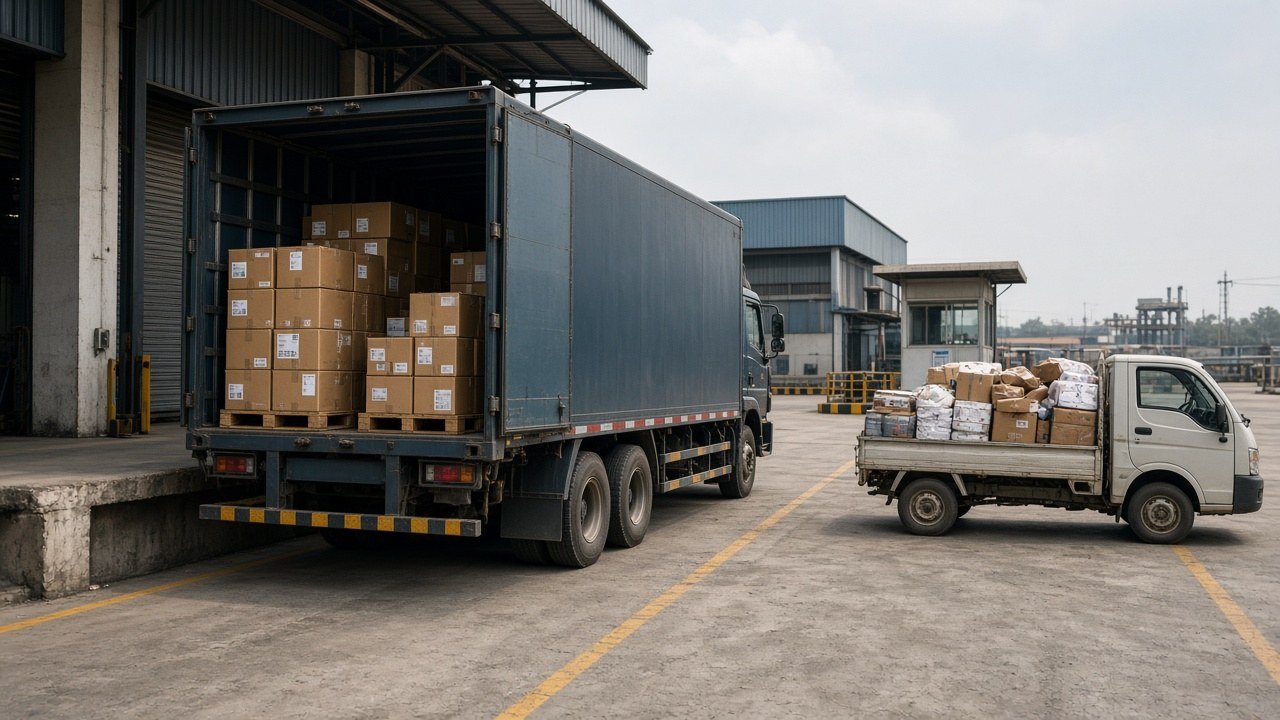
Chapter 01
Start here: FTL vs PTL decision in three lines
Skip the algebra if you only need a desk rule. Use the three bands below, then recompute with your tariff.
Print the one-page worksheet if you want inputs and the break-even steps on one sheet: FTL vs PTL break-even worksheet (PDF).
01
Under ~1/3 of truck
PTL / sundry / LTL usually wins on cost for non-fragile spares and samples. Pay for space used.
02
Half to ~2/3 of truck
Grey zone. Quote both FTL and PTL on the same lane. Dense trunk vs thin town shifts the crossover.
03
Above ~3/4 of truck
Dedicated FTL usually wins on landed cost, speed, and sealed custody - especially after FOV, ODA, and crating.
Desk aid after sizing the smallest suitable truck. Not a national rate law. Recompute with your tariff.
3.5 to 6.0 tonnes
Common industrial starting band where landed FTL often beats sticker PTL. Cube-out cargo crosses earlier.
Worksheet
Blank inputs for trip rate, ₹/kg, FOV, ODA, cube, and damage: PDF in Start here and Ch 5.
Workshop. Corridor-specific.
Chapter 02
The fundamental fork in Indian freight: direct transit vs network consolidation
Composite from corridor practice (details changed). A western India auto-ancillary plant shipped 4.2 tonnes of painted panels on a national PTL docket because the ₹/kg sticker beat the FTL trip quote by about Rs 6,000. The bill later added FOV, ODA into the estate, and wooden crating the hub required. Two cartons crushed in a Transport Nagar godown. The physical bilty returned after two weeks. Finance 'saved' on freight and lost on scrap, delay, and cash turnaround.
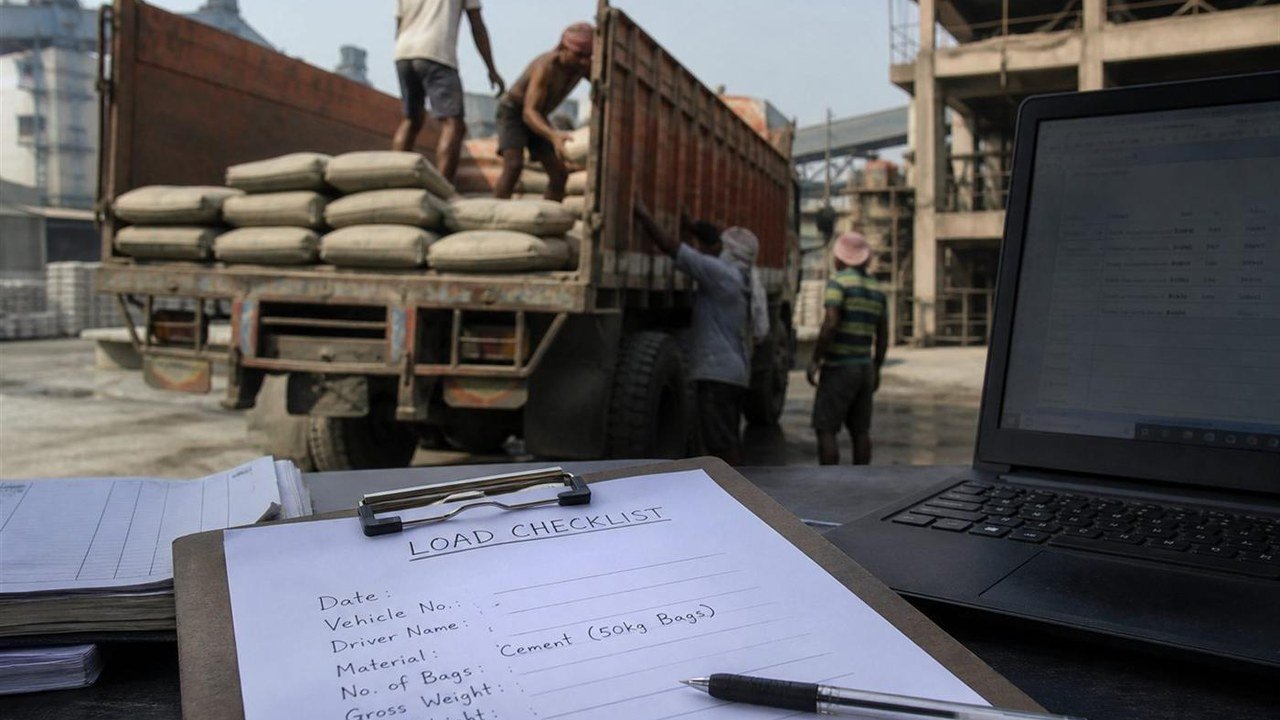
Every industrial dispatch desk in India eventually faces the same fork: book a sundry / part truckload (PTL) docket into a regional parcel network, or book a dedicated full truckload (FTL) that runs point-to-point from your dock to the customer gate.
In Indian plant English, PTL, LTL (less-than-truckload), sundry, and parcel usually describe the same shared-hub model. FTL means one commercial vehicle for one consignor - sealed, dedicated, origin to destination. The label on the booking screen matters less than the operating philosophy.
The Indian PTL market splits between regional sundry operators and national parcel carriers. Multi-tier commission booking agents (dalal) often sell the docket while someone else runs the trunk trailer. That split is fine for samples. It becomes expensive when factory production is steady, finished goods are fragile, and late delivery penalties are real.
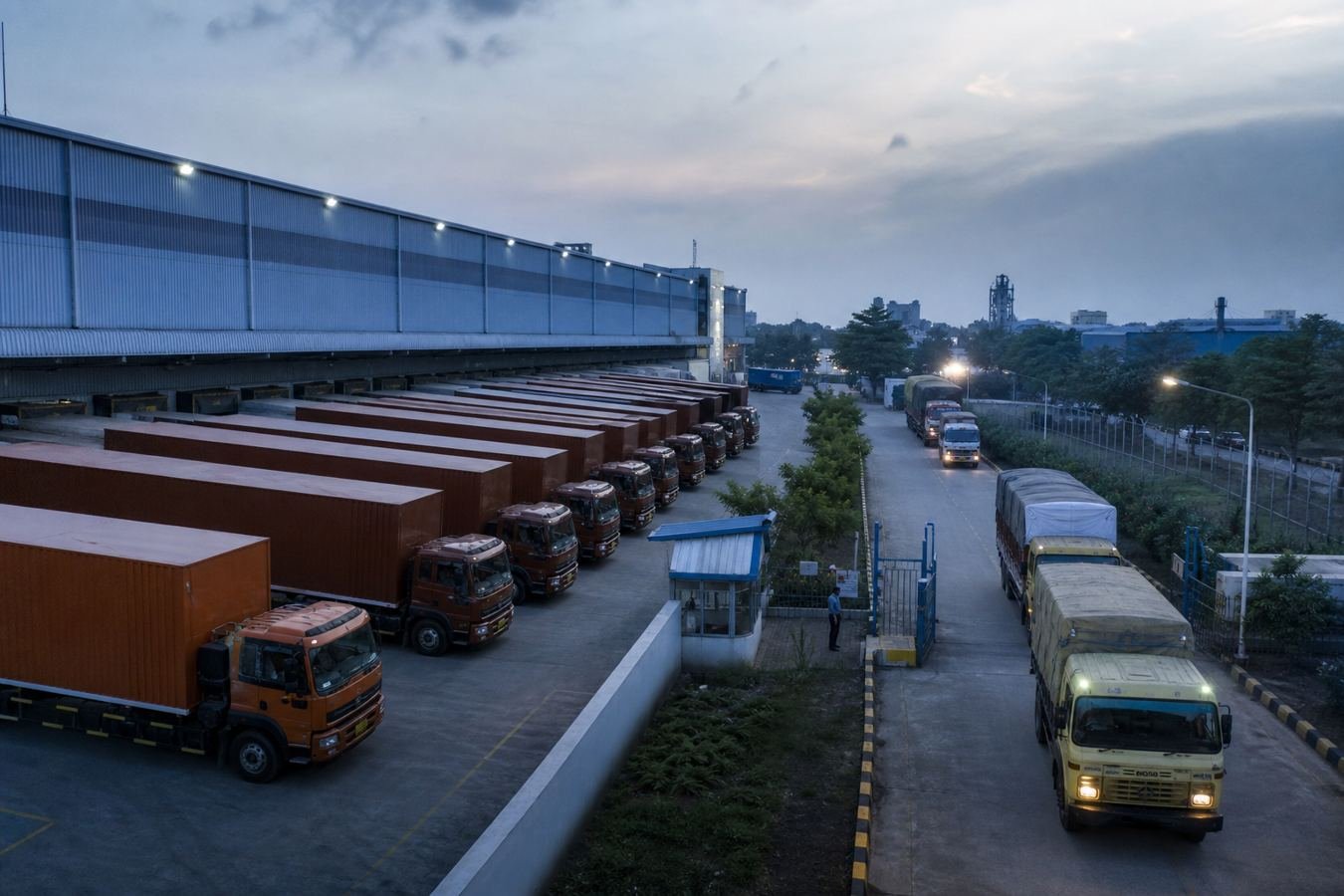
Growing manufacturers outgrow the parcel network when weekly tonnes, cube, and damage history say so. The question is not 'which logo is on the bilty.' The question is which operating philosophy protects landed cost and the next invoice. For how contract FTL capacity sits next to spot overflow, see spot market vs dedicated fleets. To place a dedicated truck on your lane, start with dedicated fleet.
01
PTL / LTL / sundry / parcel
Same shared-hub idea under different labels. Many consignors share hubs, trunk trailers, and last-mile vans. Dalal often sells the docket, not the asset.
02
FTL dedicated
One consignor, one sealed vehicle, origin dock to destination gate. Point-to-point Part B. Owned fleet first, labeled overflow when needed.
03
When plants outgrow PTL
Steady factory volume, fragile finished goods, and LD penalties push desks past sporadic sample dockets into industrial full truckload.
Operating model for this guide. Not a market-share claim.
Chapter 03
The physical journey: how goods move through PTL networks vs dedicated FTL
PTL looks simple on a booking screen. On the ground it is a hub-and-spoke odyssey: feeder tempo to local branch, staging in the godown, consolidation at a regional transshipment centre, line-haul between hubs, destination de-consolidation, branch transfer, then Out of Delivery Area (ODA) last mile.
Count the touches. Shared sundry cargo is often handled four to seven times. Manual dumping, hooks on bags, forklift mast punctures, open rain-yard staging, and tumbling inside unlashed mixed loads are how carton crush and water claims begin. Claim paperwork after the fact sits in the transit damage guide.
Dedicated FTL is boring on purpose. Factory dock loading, driver verification, bolt or electronic seal, highway cruise, unbroken seal audit at the customer gate. One load. One unload. That is the physical reason damage bands collapse and surveyors get a clean custody story.
If your cargo cannot survive a Transport Nagar godown floor, stop paying for the privilege. Point-to-point industrial carriage is what industrial freight and dedicated fleet are built for.
01
Feeder pickup
Tempo / LCV from plant to local branch godown.
02
Local staging
Inward sort and hold at the branch godown.
03
RTC consolidate
Forklift onto multi-axle trunk trailer at regional centre.
04
Line-haul
Hub-to-hub trunk run with mixed consignments.
05
Dest RTC
Inward sort and de-consolidation.
06
Branch transfer
Move to destination local branch.
07
ODA last mile
Out-of-delivery-area van to the dock.
Operating pattern for sundry networks. Individual carriers differ.
PTL: 4 to 7 touches
Hooks, mast punctures, rain-yard staging, tumbling in unlashed mixed loads. Crush and water claims start here.
FTL: 1 load + 1 unload
Bolt or electronic seal at origin. Unbroken seal audit at the customer gate. Surveyors prefer this trail.
Dock pattern. Damage claim SOP sits in the transit-damage guide.
Chapter 04
The true cost stack of PTL: unmasking the surcharges
The base freight per kilogram is a sticker. Landed PTL cost adds minimum docket fees, Freight on Value (FOV) risk charges, hamali, municipal cess entries, ODA penalties when the dock sits outside the pin list, and re-booking or demurrage when the godown holds beyond about forty-eight hours.
FOV at 0.10% to 0.25% of invoice value is easy to miss on a rate card and expensive on a Rs 28 lakh machine move. ODA flat fees of Rs 1,500 to Rs 5,000 turn 'cheap per kg' into a bad joke for industrial estates outside municipal cores.
Add secondary wooden crating that exists only because hubs are violent, plus damage scrap, plus inventory days. That is the hidden rupee stack. Related leak framing sits in 5 hidden cost leaks.
When you compare modes, demand the full ancillary schedule - not only the headline ₹/kg. Then put the same lane on a dedicated trip quote from contract logistics or dedicated fleet.
- Base quoted per-kg freight · 54%
- Secondary crating and palletizing · 18%
- Ancillary surcharges (FOV, docket, ODA, hamali) · 14%
- Damage, rejection, shortage scrap · 10%
- Working capital pipeline drag · 4%
Single-denominator workshop pie for this guide (100%). Not a ZAFTYS audited national rate or claims index.
| Charge | Workshop band | What to check |
|---|---|---|
| Minimum docket | Rs 150 - 400 / consignment | Floor on tiny shipments |
| FOV / risk | 0.10% - 0.25% of invoice | Often auto-billed |
| Hamali | Rs 0.30 - 0.60 / kg | Godown labour |
| ODA | Rs 1,500 - 5,000 flat or per-km | Dock outside pin service list |
| Re-book / demurrage | After ~48 h hold | Receiver window friction |
Commercial workshop bands. Your carrier tariff annex controls.
Chapter 05
Volumetric weight (10 lbs/CFT) trap on industrial PTL
Parcel networks bill chargeable weight as the greater of actual gross mass and volumetric weight. Many Indian PTL tariffs still use about 10 lbs per cubic foot, or a CBM factor around 250 to 300 kg. Confirm the schedule. Do not guess.
Chargeable weight equals max of actual kilograms and (L x W x H in inches / 1728) times 10 lbs times 0.4536. High-cube, lightweight engineering goods - control panels, hollow fabrications, plastics, packaging, air ducting - pay for ghost weight. Effective freight can run two to three times the mass-based rate.
Workshop example: 2,200 kg of control panels at about 12 CBM (~424 CFT) can bill near 4,240 kg under a 10 lbs/CFT rule. You did not ship more steel. You shipped air that the tariff prices as mass.
If your SKUs cube-out, dedicated FTL often wins earlier than a weigh-out spreadsheet suggests. Bring cube and mass when you ask for an FTL quote on dedicated fleet.
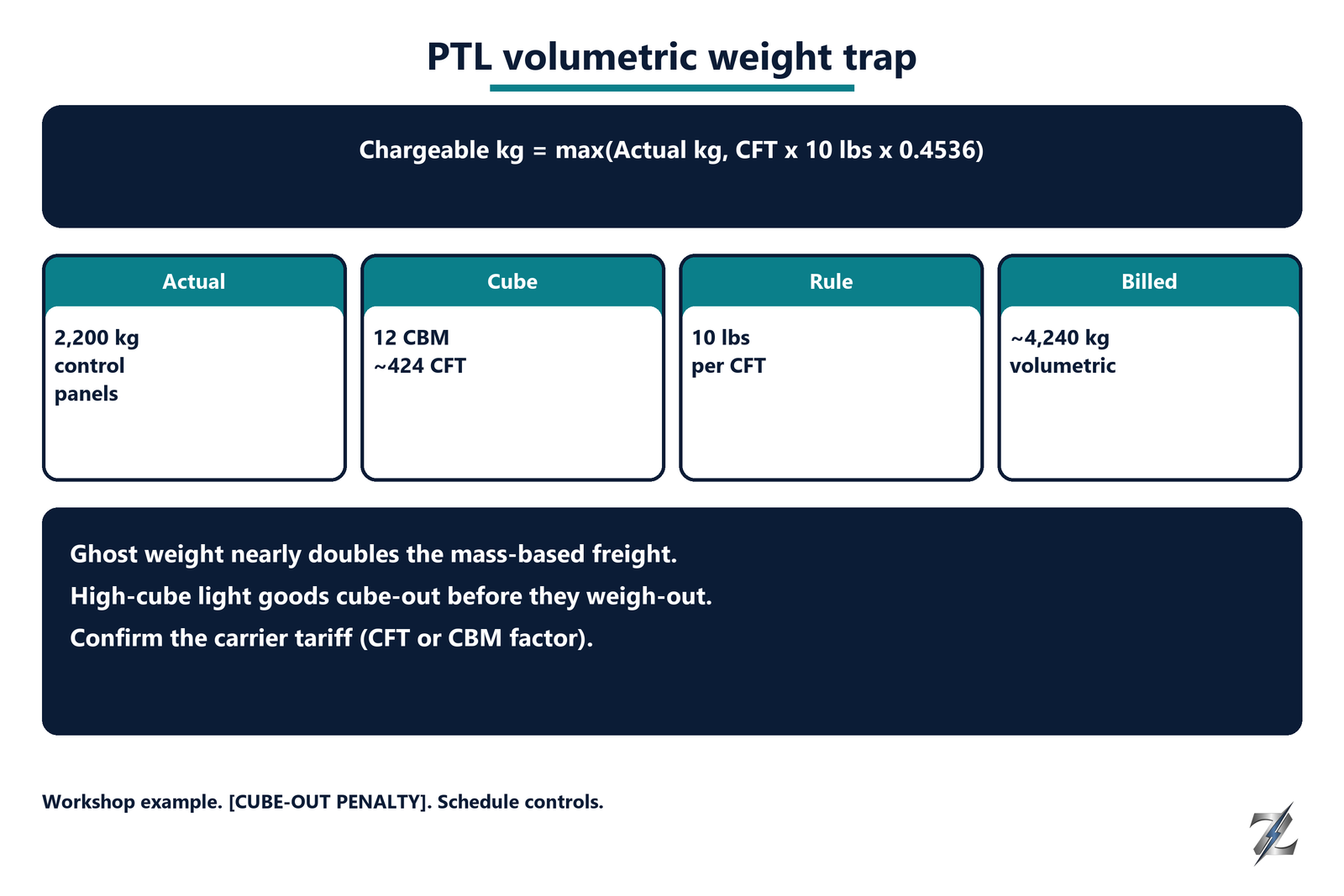
Workshop example. Confirm 10 lbs/CFT or CBM factor on the carrier schedule.
Chapter 06
How to calculate FTL vs PTL break-even weight
Write both sides as total landed cost. Cost of PTL equals weight times rate per kg, plus surcharges, plus packaging, plus damage scrap, plus inventory drag. Cost of FTL equals the dedicated trip rate plus dock handling.
Break-even weight is the threshold where those totals cross. In workshop form: FTL trip minus the fixed PTL fees you avoid, divided by the net per-kg PTL disadvantage after FOV and damage delta. Render the algebra on the formula board - do not trust a raw sticker comparison.
Size the truck before you trust the maths. Break-even only after you pick the smallest body that fits both weight and cube. Comparing a 32-ft FTL quote to a 2-tonne PTL docket invents a false win for sundry. Body-class detail sits in planning industrial shipments.
Use capacity bands with the tonne band. Workshop scanner rule: well under about one-third of that truck usually stays PTL; roughly half to two-thirds is the quote-both grey zone; above about three-quarters, FTL usually wins on cost and control. Density moves the bands - light cube-out cargo pushes crossover earlier.
Lane density moves them too. On a dense trunk (easy consolidation both ways), PTL ₹/kg stays competitive longer. On a thin lane into a smaller town, PTL holds cargo for the next trunk and rates climb - so FTL can win at surprisingly low tonnes. Same weight, different corridor, different answer.
Hidden break-even drift matters. Pure paper freight (ignore pack and scrap) can show break-even near 6.5 tonnes. Adding crating and damage often pulls the real threshold down to about 3.0 to 4.5 tonnes on a standard ~1,000 km industrial corridor. That is a workshop band. Recompute with your numbers.
The two expensive mistakes: booking half-empty FTL without consolidating Monday and Wednesday into one Thursday truck; and splitting one large load into several PTL dockets to 'avoid' an FTL commitment (minimums apply per consignment). How to build the FTL trip line from diesel, wear, and standing cost is in the truck freight rates guide. When the math favours a dedicated truck, convert the lane through contract logistics.
Worksheet with blank inputs: FTL vs PTL break-even worksheet (PDF).
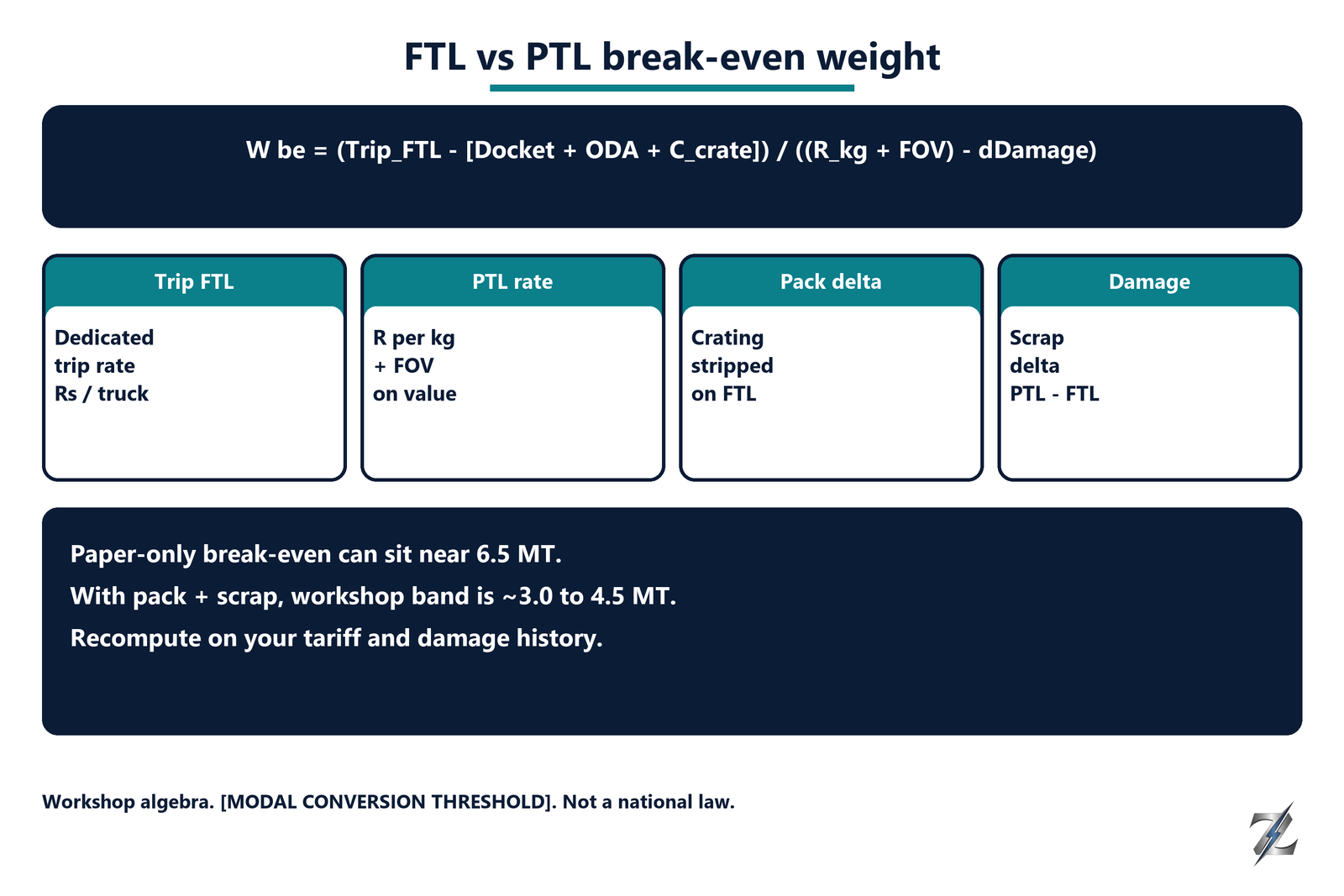
Workshop algebra. Recompute with your trip rate, R/kg, FOV, crating, and damage history.
Paper freight only
Ignore packaging and scrap and break-even can look near 6.5 MT.
Landed cost
Add crating and damage scrap and many desks land nearer 3.0 to 4.5 MT.
Teaching pattern for ~1,000 km industrial corridors.
01
Half-empty FTL, no consolidation
Paying for a 9 T truck to move 4 T twice a week. Hold Monday and Wednesday into one Thursday FTL when the customer window allows.
02
Split load into many PTL dockets
Three PTL bookings to 'avoid' FTL can cost more after minimums, FOV, and ODA than the single truck you were avoiding.
03
Wrong truck in the comparison
Break-even only after sizing the smallest body that fits weight and cube. Else the spreadsheet lies.
Procurement briefing aid. Not a share index.
| Fill of smallest suitable truck | Typical call | Notes |
|---|---|---|
| Under ~1/3 | Stay PTL | Samples, small spares, multi-drop |
| ~1/2 to ~2/3 | Quote both | Grey zone; dense vs thin lane matters |
| Above ~3/4 | Lean FTL | Often aligns with ~3.5-6.0 T industrial band |
Scanner aid. Density and lane type move the lines.
Chapter 07
Transit time, working capital, and cash-flow velocity
Inventory in transit is working capital. Workshop form: consignment value times WACC over 365 times extra transit days. Five extra days on a Rs 28 lakh invoice at 12% WACC is real money even before damage.
PTL paper lorry receipts (bilty) can take 12 to 25 days to return by regional courier. That freezes invoice discounting and slows GST input tax credit hygiene. Direct FTL with electronic proof of delivery inside the hour unlocks faster customer approval and cash turnaround.
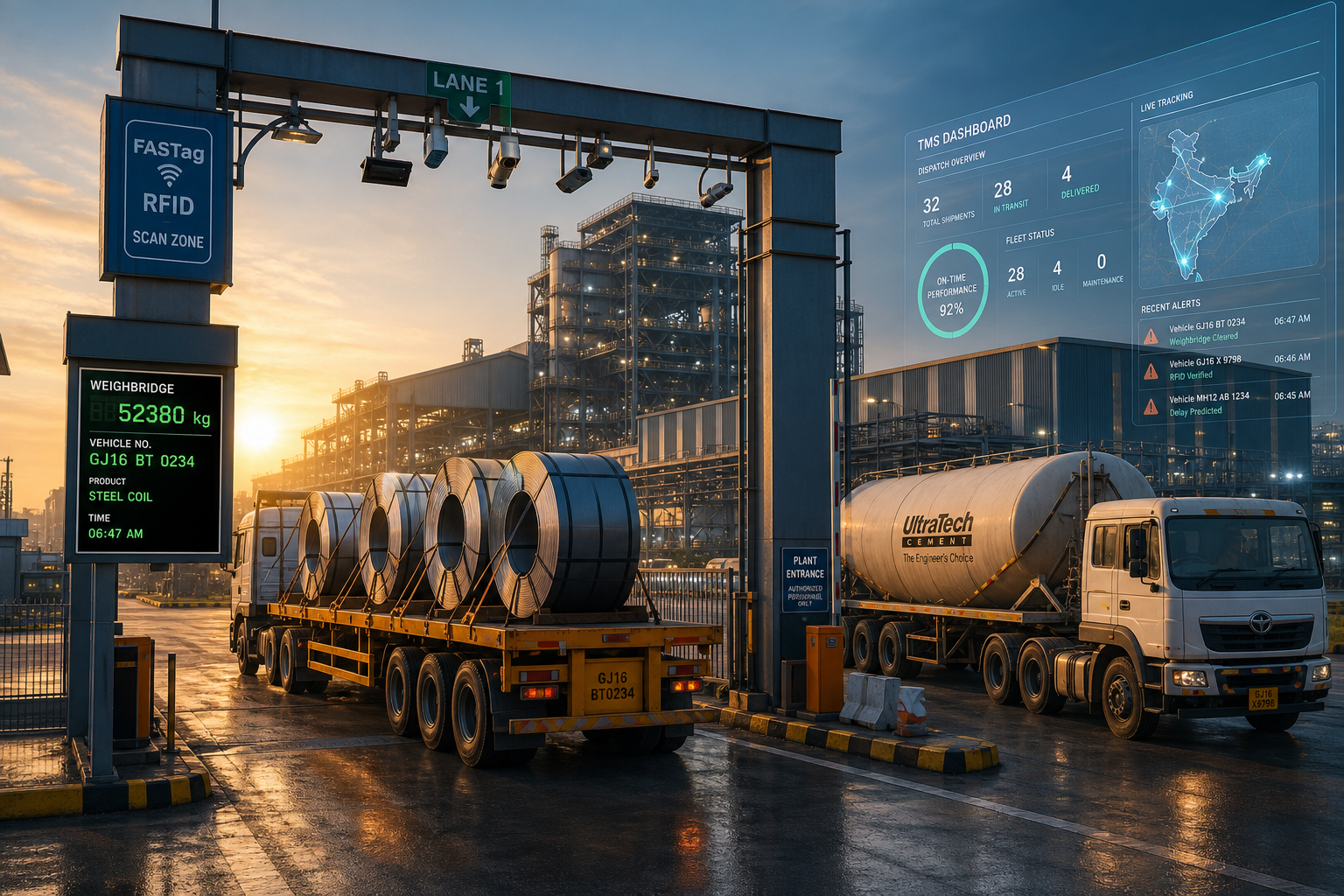
Ops detail for ePOD and e-Way Bill close-out sits in the ePOD billing guide. On trips ZAFTYS runs, capture seals and delivery remarks in ZAFTYS TMS instead of a disappearing chat album.
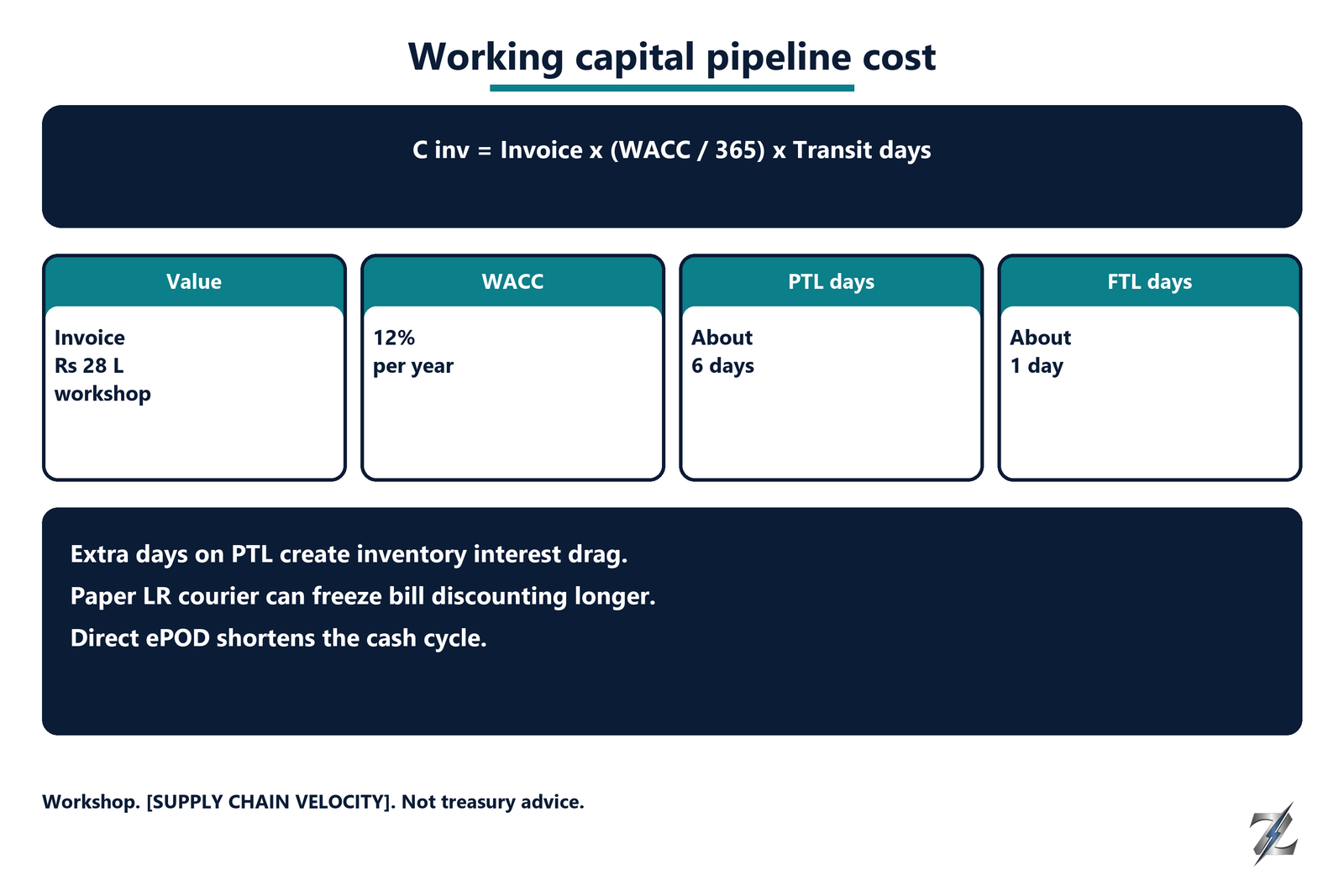
Workshop. Not treasury or bank advice. Pair with ePOD close-out practice.
Chapter 08
Statutory and documentation compliance: e-Way Bill Part B multi-vehicle updating
Under CGST Rule 138 practice, Part B must track the vehicle that actually moves the goods. PTL cargo that hops feeder tempo to trunk trailer to local van needs Part B updates and, where applicable, multi-vehicle consolidation under Form GST EWB-02. Confirm bare rules and CBIC circulars before a legal memo.
Highway interception under Section 129 is the operational nightmare: one expired or mis-updated docket in a mixed sundry trailer can trap every compliant consignment on that vehicle for days. Your clean cargo pays for someone else's paperwork failure.
Dedicated FTL keeps a clean single-vehicle Part B from origin to gate. No intermediate hub rewrite for that consignment. That regulatory simplicity is part of the service value - not a slogan. Place those lanes on dedicated fleet.
01
PTL transshipment
Feeder to trunk to local van. Part B and EWB-02 updates at each change of vehicle.
02
Section 129 risk
One expired docket in a mixed sundry trailer can trap compliant cargo for days.
03
FTL advantage
One vehicle, one Part B, origin to gate. No intermediate hub rewrite for that consignment.
Orientation only. Confirm CGST Rule 138 / EWB-02 before a legal memo.
Chapter 09
Worked numerical case study: 4.5-tonne industrial consignment (Chakan to Sanand)
Workshop corridor only - not a ZAFTYS audited claim file. A precision automotive and electrical shipper moves 4,500 kg (4.5 MT), 12 pallets, invoice Rs 28,00,000, from Chakan (Pune) to Sanand (Ahmedabad), about 660 km.
Model A is a national PTL sundry network at Rs 7.50 per kg. Model B is a dedicated 19-ft closed-body FTL (~6.5 T payload) at Rs 38,000 trip. Sticker comparison says PTL wins at Rs 33,750. Landed comparison does not.
Add docket, hamali, and FOV (+Rs 4,740), mandatory wooden crating (+Rs 9,000), working capital drag on a five-day delta (+Rs 550), and a 1.8% damage scrap allowance (+Rs 5,040) - a workshop allowance for this teaching ledger, not a ZAFTYS audited claims rate. Landed PTL becomes Rs 53,490. Dedicated FTL stays Rs 38,000, arrives in about 22 hours instead of about six days, and saves roughly Rs 15,490 (~29%).
That is why industrial desks that only compare ₹/kg keep losing money. Ask for a landed-cost quote on your consolidation lanes via dedicated fleet or WhatsApp origin, destination, and weekly tonnes.
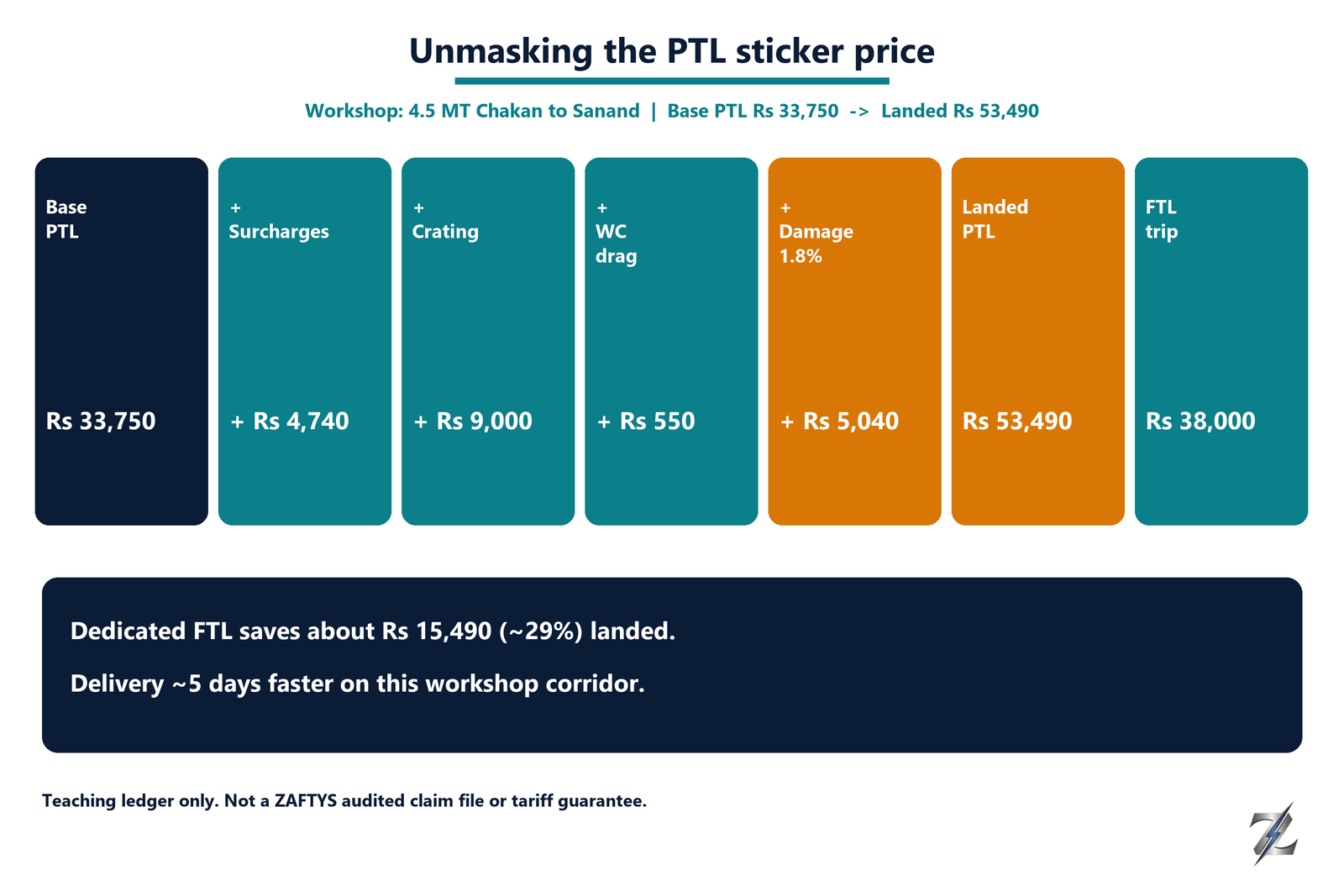
Teaching ledger: base Rs 33,750 to landed Rs 53,490 vs FTL Rs 38,000. Not a ZAFTYS audited claim file. Damage % is a workshop allowance.
Base freight
PTL Model A
Rs 33,750 (4,500 x 7.50)FTL Model B
Rs 38,000 tripDocket + hamali + FOV
PTL Model A
+ Rs 4,740FTL Model B
In trip / dockWooden crating / corners
PTL Model A
+ Rs 9,000FTL Model B
Stripped / minimalWC drag (5-day delta)
PTL Model A
+ Rs 550FTL Model B
BaselineDamage scrap 1.8% (workshop)
PTL Model A
+ Rs 5,040FTL Model B
~0% workshopTransit time
PTL Model A
~6 daysFTL Model B
~22 hoursTrue landed
PTL Model A
Rs 53,490FTL Model B
Rs 38,000Invoice Rs 28,00,000. ~660 km. Confirm your own tariff before a tender.
Chapter 10
When PTL still beats dedicated FTL (and when to switch)
PTL still wins when the job is multi-destination: five customers in five cities is five sundry dockets, not five trucks. It also wins on regular sub-~2 tonne non-fragile spares, sporadic samples to remote Tier-3/4 locations, schedule slack ('this week' not 'Thursday'), and plants that cannot stage a full truck at the dock.
Switch to FTL when consolidated dispatches cross about 3.5 tonnes or about three-quarters of the smallest suitable truck, when finished goods hate water or scratches, when assembly lines carry late-delivery penalties, or when cargo is pilferage-prone (copper, electronics, brass, batteries).
Plot shipment density / volume against cargo value / fragility. Then recompute on that lane's density - dense trunk vs thin town - before you lock a national rule into the SOP.
Use the eight-point transition protocol: density audit, consolidation rhythm, packaging strip, vehicle sizing, seal and route lock, direct gate load, ePOD closeout, cash-flow acceleration. Reserved capacity on repeating lanes belongs on contract logistics. Surge overflow stays labeled - see spot vs dedicated.
If you already know the lanes that should move off sundry, send them to the desk. We quote dedicated industrial FTL first.
01
Stay on PTL
Multi-city small drops, sub-~2 T non-fragile spares, sporadic Tier-3/4 samples, schedule slack, or no dock capacity to stage a full truck.
02
Switch to FTL
Above ~3.5 T or ~3/4 of truck, fragile / wet-sensitive finished goods, LD penalties, or pilferage-prone high value.
03
Recompute on lane type
Dense trunk keeps PTL competitive longer. Thin destination town can make FTL win at lower tonnes.
Decision aid. Lane facts still win.
- 01
SKU density audit
Map kg, CBM, and fragility by lane.
- 02
Order consolidation rhythm
Move from daily micro-dockets to bi-weekly full trucks.
- 03
Packaging stripping
Drop over-crating that only existed for hub handling.
- 04
Vehicle sizing
Match 19-ft / multi-axle payload to the consolidation.
- 05
Route lock and sealing
Bolt or e-seal; single Part B.
- 06
Direct gate loading
Origin dock to destination gate.
- 07
Digital ePOD closeout
Photo + geo remarks inside the hour.
- 08
Cash-flow acceleration
Invoice and ITC without waiting on courier bilty.
Operating sequence for plants consolidating sundry into dedicated FTL.
Low-friction next step
WhatsApp your consolidation lanes
Origin, destination, kg or tonnes per week, and cube if known. We reply with a dedicated FTL quote path - not a sundry docket speech.
Chapter 11
LinkedIn abstract (copy for distribution)
FTL vs PTL in India is not a sticker ₹/kg fight. Part truckload (also called LTL or sundry) shares hubs and bills chargeable weight - often with a 10 lbs/CFT volumetric trap on high-cube industrial goods. Full truckload is one sealed vehicle, origin to gate.
Workshop starting band: under about one-third of the smallest suitable truck, PTL usually wins on cost. Half to two-thirds is quote-both territory. Above about three-quarters - or roughly 3.5 to 6.0 tonnes on many industrial corridors after FOV, ODA, crating, and damage - dedicated FTL often wins on landed cost, damage, and cash-flow. Dense trunks and thin town lanes shift the crossover. Recompute with your tariff.
Two expensive mistakes: half-empty FTL without consolidation, and splitting one load into several PTL dockets to avoid a truck. Full guide and worksheet: zaftys.com/blog/ftl-vs-ptl-freight-services-india-cost-break-even-guide
- Landed cost = base + FOV + ODA + crating + scrap + inventory days
- Quote both modes above ~3 tonnes or ~50% of truck cube/weight
- Next step: dedicated FTL quote on consolidation lanes - /logistics/dedicated-fleet
Hook
FTL vs PTL is a landed-cost decision - volumetric traps and hub touches included.
CTA
Quote dedicated FTL on consolidation lanes: zaftys.com/logistics/dedicated-fleet
Editorial abstract for LinkedIn / email. Not a paid placement.
Chapter 12
Frequently asked questions and statutory citations
The FAQ set below covers LTL vs PTL naming, when to quote both modes, dead freight, Carriage by Road Act evidence differences, ODA thresholds, and how to consolidate daily PTL into bi-weekly FTL. Confirm CGST Rule 138 / Form GST EWB-02, Carriage by Road Act Sections 9-10 and Rule 12, and Indian Contract Act bailment Sections 148-161 against bare text before a demand letter.
Carrier volumetric factors and ODA pin lists sit in the tariff annex. This guide is orientation for procurement and plant logistics - not legal or insurance advice.
When the answer is 'book the truck,' start from dedicated fleet. When the answer is 'fix the claim pack,' use the transit damage guide. When the answer is 'rebuild the rate card,' use the freight rates guide.
Statute text wins
CGST Rule 138 / EWB-02 and Carriage by Road Rule 12 paraphrases are workshops. Read the bare text before a demand letter.
Tariff annex wins
Volumetric factors and ODA pin lists sit in the carrier schedule - not in a blog exhibit.
This guide is orientation. Schedules and bare Acts control.
Appendix
Frequently asked questions
What is the difference between LTL and PTL in India?
In Indian plant English, PTL (part truckload), LTL (less-than-truckload), sundry, and parcel usually mean the same operating model: shared hubs, mixed cargo, and chargeable-weight billing. FTL means a dedicated vehicle for one consignor. Ask the carrier which word their tariff uses, then compare landed cost - not the label.
Should I get both FTL and PTL quotes above 3 tonnes?
Yes. Above about 3 tonnes - or when cargo fills roughly half to two-thirds of the smallest suitable truck - quote both modes on the same lane. Dense trunk routes and thin destination towns shift the break-even. Paper ₹/kg alone is not enough.
Can we book a dedicated FTL truck if the cargo only fills half the vehicle?
Yes. That is a dead-freight trade-off. Compare the empty cubic metres you pay for against PTL packaging, damage scrap, inventory days, and ODA fees on the same lane. Many industrial desks still prefer half a sealed truck to a full sundry journey when cargo is fragile or high value. Start a quote from dedicated fleet.
How does the Carriage by Road Act 2007 treat liability on PTL parcel receipts versus dedicated FTL lorry receipts?
Common-carrier liability still turns on registration, the goods receipt, and declared value (Sections 9-11 and Rule 12). PTL multi-party custody and clean dockets often weaken evidence after hub handling. Dedicated FTL with a seal trail and qualified remarks is cleaner for surveyors. Full claim SOP: transit damage and shortage claims.
What is the standard ODA (Out of Delivery Area) distance threshold in Indian PTL?
There is no single national kilometre rule. Carriers flag docks outside primary municipal or pin-code service lists in the tariff annex. Confirm that annex before you assume a plant is 'local delivery.' Flat ODA penalties of a few thousand rupees are common on industrial estates outside city cores.
How should a plant move from daily small PTL dispatches to consolidated bi-weekly dedicated FTL?
Run an SKU density audit, set a consolidation rhythm, strip over-crating that only existed for hub handling, size the body class, lock route and seals, and close with ePOD. Use the eight-point protocol in this guide. For reserved capacity on repeating lanes, see contract logistics.
When does volumetric weight usually hurt industrial shippers on PTL?
When cargo is high-cube and light: control panels, hollow fabrications, plastics, packaging, air ducting. Under a 10 lbs/CFT style rule, chargeable weight can run near double the actual mass. Always ask for the carrier's CFT or CBM factor in writing.
Is FTL always cheaper than PTL above 3.5 tonnes?
Not always. The 3.5 to 6.0 tonne band is a workshop starting point. Recompute with your trip rate, PTL ₹/kg, FOV, ODA, crating, and damage history. Paper-only comparisons understate FTL. Landed-cost comparisons usually favour dedicated trucks earlier. Method detail sits in the truck freight rates guide.
Sources
References and data sources
Public sources below are for orientation. They are not ZAFTYS audited financials. Read the originals before a number goes into a board pack.
- [1]Central Goods and Services Tax (CGST) Rules - Rule 138 and 138A; Form GST EWB-02 for multi-vehicle / transshipment e-Way Bills. Confirm bare rules and CBIC circulars before a legal memo.
- [2]Carriage by Road Act, 2007 and Carriage by Road Rules, 2011 - Sections 9 and 10, Rule 12 liability framing for common carriers.
- [3]Indian Contract Act, 1872 - Bailment Sections 148-161 (orientation for custody; counsel owns litigation strategy).
- [4]Carrier tariff annexes for volumetric conversion (10 lbs/CFT or CBM factors) and Out of Delivery Area (ODA) pin lists - schedule-controlling.
- [5]Internal cluster: truck freight rates, 5 hidden cost leaks, transit damage claims, spot vs dedicated.
Related reading